Inizio Registrati Login

Elenco album Ultimi arrivi Ultimi commenti Più viste Più votate Preferiti Cerca

Inizio > MARS > After One-Thousand Soles...
Ritorna alla pagina delle miniature FILE 38/2388 Torna all'inizio Guarda foto precedente Guarda foto successiva Salta alla fine
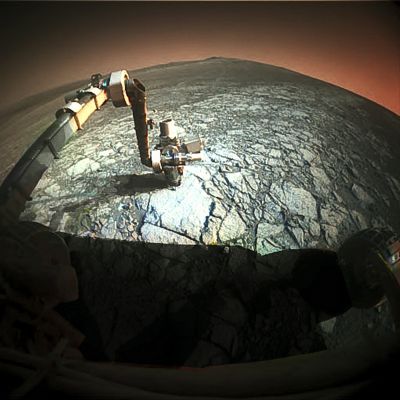
Bright Sun, Dark Sky - Sol 2998 (Natural Colors; credits for the additional process. and color.: Elisabetta Bonora and Marco Faccin - Lunar Explorer Italia/Italian Planetary Foundation)
We said that in the past and we have to say it again: how many times have we already read (here, there and everywhere...), that the Martian Sky should be "Blue" (actually, "Light Blue", according to the "Raleigh Scattering" Model)? Certainly a thousand times (at least!) and, well, maybe some time ago, the question could have made some sense. 
But now, after so many Natural and Absolute Colorizations of the NASA - MER Spirit and Opportunity's Original b/w Frames, how could we keep doubting? Color, brightness, nuances of the Martian Sky... Let's see if we can make a little step forward, once in a while...
Among many other things (and forgetting the color of the Martian Sky for a moment), the NASA People often told us that the Sky of Mars is "bright" and we wish to say that, perhaps, at certain Latitudes and during certain times of the Martian Year (as well as at certain - and given - daytime hours), such a statement could even be reasonable. 

Said that, we honestly believe that, first of all, the Martian Sky is not particularly bright at all. In fact, we believe that the Martian Sky should really (if not extremely) be dark. 
Second, we believe that the Sun, even though its diameter is over one-third smaller than the one which we can see from Earth, shines VERY brightly over the Martian Landscapes: especially, we think, starting from the late morning hours (let's say 09:00/09:30 Mars Local Solar Time) and until, probably (and during the Martian Summer), 16:00 or 17:00 (always Mars Local Solar Time). 
Furthermore, and according to what we have speculated in the past, the portion of the Sky visible near the Martian Horizon, should slightly be brighter than the rest of the Sky. In other words: if you were on Mars, near the Rover and looking at the Horizon of Meridiani Planum, you should see a relatively bright (lower portion of the) Sky that, the more you rise your look, the darker it will get. 

Talking about the color of the Martian Sky, instead, since (and of course...) we haven't been on Mars (yet!) we cannot be one-hundred-percent certain of anything but, after so many years of studying and processing images from the Red Planet, it seems to us quite reasonable and believable to say that the Martian Sky is NOT blue, nor light-blue at all. 
The Martian Sky, most likely, can show itself in quite a few different colors, but its "natural" one, should be a light-orange. Near the Sun, probably, the NASA People are correct when they say that it should be kind of pale-blue and white; but most of it - in any case and for most part of the day - is and should (almost) always be of a light white/orange color (we repeat: near the horizon), and then (as we look over and above the horizon itself), of an orange/yellowish color that the more we look towards the Zenith (or the Nadir), the darker it should get. 
It is also possible that the Martian Sky might show - at certain conditions - some yellow and pink nuances: this depending on the specific time of the day that we consider, as well as on the Atmospheric Opacity - or TAU - existing at that time, on the Martian Season and on the given Martian Latitude. 

In this beautiful frame, processed in Natural Colors, we can see that the Sky near the Horizon is actually (yet quite dimly) bright, while the rest of the visible Sky is dark. Almost black (we should say that its color looks like a VERY dark orange, which tends to the brown). But the Sun, that is shining (relatively) high in the Sky, is VERY bright! So bright that the Martian Paving where NASA - MER Opportunity is rolling on, appears, to the Electronic Eyes of the Rover, of a bright and sharp white color, with some light-blueish nuances (these nuances being probably caused by the blue cristals that seem to be dispersed all over the place). 

In the end, and just to draw some conclusions, the Martian Sky, in our opinion - as IPF (and no matter what we often see - or think to see... - in the frames that come to us from the Red Planet) -, is usually dark (VERY dark during the Late Fall and through the entire Martian Winter), but the Sun (except during the massive Sand Storms that, sometimes, darken the whole Planet) always shines very bright, particularly during the months corresponding to the Late Spring and Summer of the Red Planet. But a bright Sun, in our opinion, does not mean AT ALL a bright Daytime Sky! And please, forgive us, if, one day, we might be proven wrong...

This frame has been colorized in Natural Colors (such as the colors that a perfect human eye would actually perceive if someone were near the NASA - MER Opportunity and then looked towards the Martian Horizon), by using an original technique created - and, in time, dramatically improved - by the Lunar Explorer Italia Team.
Parole chiave: Martian Horizon - Meridiani Planum - Proximities of Endeavour Crater's Rim

Bright Sun, Dark Sky - Sol 2998 (Natural Colors; credits for the additional process. and color.: Elisabetta Bonora and Marco Faccin - Lunar Explorer Italia/Italian Planetary Foundation)

We said that in the past and we have to say it again: how many times have we already read (here, there and everywhere...), that the Martian Sky should be "Blue" (actually, "Light Blue", according to the "Raleigh Scattering" Model)? Certainly a thousand times (at least!) and, well, maybe some time ago, the question could have made some sense.
But now, after so many Natural and Absolute Colorizations of the NASA - MER Spirit and Opportunity's Original b/w Frames, how could we keep doubting? Color, brightness, nuances of the Martian Sky... Let's see if we can make a little step forward, once in a while...
Among many other things (and forgetting the color of the Martian Sky for a moment), the NASA People often told us that the Sky of Mars is "bright" and we wish to say that, perhaps, at certain Latitudes and during certain times of the Martian Year (as well as at certain - and given - daytime hours), such a statement could even be reasonable.

Said that, we honestly believe that, first of all, the Martian Sky is not particularly bright at all. In fact, we believe that the Martian Sky should really (if not extremely) be dark.
Second, we believe that the Sun, even though its diameter is over one-third smaller than the one which we can see from Earth, shines VERY brightly over the Martian Landscapes: especially, we think, starting from the late morning hours (let's say 09:00/09:30 Mars Local Solar Time) and until, probably (and during the Martian Summer), 16:00 or 17:00 (always Mars Local Solar Time).
Furthermore, and according to what we have speculated in the past, the portion of the Sky visible near the Martian Horizon, should slightly be brighter than the rest of the Sky. In other words: if you were on Mars, near the Rover and looking at the Horizon of Meridiani Planum, you should see a relatively bright (lower portion of the) Sky that, the more you rise your look, the darker it will get.

Talking about the color of the Martian Sky, instead, since (and of course...) we haven't been on Mars (yet!) we cannot be one-hundred-percent certain of anything but, after so many years of studying and processing images from the Red Planet, it seems to us quite reasonable and believable to say that the Martian Sky is NOT blue, nor light-blue at all.
The Martian Sky, most likely, can show itself in quite a few different colors, but its "natural" one, should be a light-orange. Near the Sun, probably, the NASA People are correct when they say that it should be kind of pale-blue and white; but most of it - in any case and for most part of the day - is and should (almost) always be of a light white/orange color (we repeat: near the horizon), and then (as we look over and above the horizon itself), of an orange/yellowish color that the more we look towards the Zenith (or the Nadir), the darker it should get.
It is also possible that the Martian Sky might show - at certain conditions - some yellow and pink nuances: this depending on the specific time of the day that we consider, as well as on the Atmospheric Opacity - or TAU - existing at that time, on the Martian Season and on the given Martian Latitude.

In this beautiful frame, processed in Natural Colors, we can see that the Sky near the Horizon is actually (yet quite dimly) bright, while the rest of the visible Sky is dark. Almost black (we should say that its color looks like a VERY dark orange, which tends to the brown). But the Sun, that is shining (relatively) high in the Sky, is VERY bright! So bright that the Martian Paving where NASA - MER Opportunity is rolling on, appears, to the Electronic Eyes of the Rover, of a bright and sharp white color, with some light-blueish nuances (these nuances being probably caused by the blue cristals that seem to be dispersed all over the place).

In the end, and just to draw some conclusions, the Martian Sky, in our opinion - as IPF (and no matter what we often see - or think to see... - in the frames that come to us from the Red Planet) -, is usually dark (VERY dark during the Late Fall and through the entire Martian Winter), but the Sun (except during the massive Sand Storms that, sometimes, darken the whole Planet) always shines very bright, particularly during the months corresponding to the Late Spring and Summer of the Red Planet. But a bright Sun, in our opinion, does not mean AT ALL a bright Daytime Sky! And please, forgive us, if, one day, we might be proven wrong...

This frame has been colorized in Natural Colors (such as the colors that a perfect human eye would actually perceive if someone were near the NASA - MER Opportunity and then looked towards the Martian Horizon), by using an original technique created - and, in time, dramatically improved - by the Lunar Explorer Italia Team.

OPP-SOL3019-GB-PCF-LXTT-IPF-1.jpg OPP-SOL3019-GB-LXTT-IPF.jpg OPP-SOL2998-EB-MF-LXTT-IPF-2.jpg OPP-SOL3001-MF-EB-LXTT-IPF.jpg OPP-SOL2971-1N391940652EFFBRNAP0605L0M2.jpg
Informazioni sul file
Nome del file:OPP-SOL2998-EB-MF-LXTT-IPF-2.jpg
Nome album:MareKromium / After One-Thousand Soles...
Valutazione (6 voti):55555(Mostra dettagli)
Parole chiave:Martian / Horizon / - / Meridiani / Planum / - / Proximities / of / Endeavour / Crater's / Rim
Copyright:NASA - MER Opportunity and Elisabetta Bonora and Marco Faccin for the additional process. and color.
Dimensione del file:702 KiB
Data di inserimento:Lug 11, 2012
Dimensioni:3000 x 3000 pixels
Visualizzato:115 volte
URL:https://www.lunexit.it/gallery/displayimage.php?pid=30729
Preferiti:Aggiungi ai preferiti

Commento 1 a 1 di 1
Pagina: 1

MareKromium   [Gen 21, 2020 at 07:12 PM]
Un vecchio, ormai, "Capolavoro".

Commento 1 a 1 di 1
Pagina: 1


Powered by Coppermine Photo Gallery