Inizio Registrati Login

Elenco album Ultimi arrivi Ultimi commenti Più viste Più votate Preferiti Cerca

Inizio > MARS > Mars Reconnaissance Orbiter (MRO)
Ritorna alla pagina delle miniature FILE 1048/2237 Torna all'inizio Guarda foto precedente Guarda foto successiva Salta alla fine
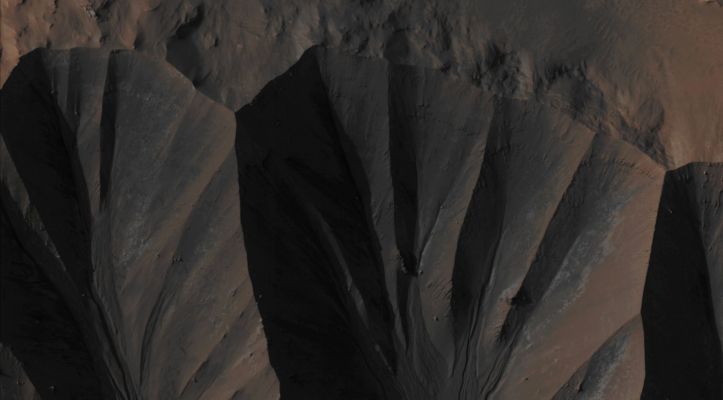
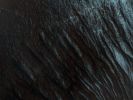
Gullies in Gasa Crater (Absolute Natural Colors; credits for the additional process. and color.: Dr Paolo C. Fienga/Lunar Explorer Italia/Italian Planetary Foundation)
The so-called "Gully Landforms" - just like the ones shown here, in this NASA - Mars Reconnaissance Orbiter image - can often be found in the Inner Rims (or even below, along the Inner Slopes) of many Impact Craters that are located at the Martian Mid-Latitudes. Some changes in these Gully Landforms were first seen in frames taken by the NASA - Mars Global Surveyor - Mars Orbiter Camera (MGS-MOC) in the AD 2006, and studying such activity has been a high priority for HiRISE ever since (and, in fact, many examples of New Deposits located inside Gully Landforms are now well known). 
This frame shows a New Deposit inside some Gully Landforms located on the Inner Rim of Gasa Crater; a very (relatively speaking) "fresh" approx. 7-Km diameter Impact Crater that is found in the Southern Mid-Latitudes of the Red Planet (to be precise, at 35,72° South Latitude and 129.45° East Longitude). Said New Deposit appears of a distinctive gray color, with some patches of white Material too, in this Absolute Natural Color version of the NASA - Mars Reconnaissance Orbiter image n. ESP_020661_1440. The picture was acquired during the Southern Spring of Mars, but the Flow that formed the Deposit occurred in the preceding Winter. 
As a matter of fact, the current Gully Activities appear to be concentrated in periods going from the late Winter to the early Spring of Mars, and this circumstance may be a consequence of the Sublimation of the Seasonal Carbon Dioxide (CO2) Frost (which, by the way, is well visible in several Gully "Alcoves" during Wintertime). 

Mars Local Time: 15:49 (Middle Afternoon)
Coord. (centered): 35,729° North Lat. and 129,386° East Long.
Spacecraft altitude: 258,2 Km (such as about 160,3 miles) 
Original image scale range: 25,8 cm/pixel (with 1 x 1 binning) so objects ~ 78 cm across are resolved
Map projected scale: 25 cm/pixel
Map projection: EQUIRECTANGULAR
Emission Angle: 11,0° 
Sun-Mars-Spacecraft (or Phase) Angle: 47,6°
Solar Incidence Angle: 58° (meaning that the Sun was about 32° above the Local Horizon at the time the picture was taken)
Solar Longitude: 203,7° (Northern Fall - Southern Spring)
Credits: NASA/JPL/University of Arizona
Additional process. and coloring: Lunar Explorer Italia

This picture (which is an Original Mars Reconnaissance Orbiter EDM enhanced color frame, identified by the serial n. ESP_020661_1440) has been additionally processed and then re-colorized in Absolute Natural Colors (such as the colors that a human eye would actually perceive if someone were onboard the NASA - Mars Reconnaissance Orbiter and then looked down, towards the Surface of Mars), by using an original technique created - and, in time, dramatically improved - by the Lunar Explorer Italia Team.
Parole chiave: Mars from orbit - Craters - Gasa Crater

Gullies in Gasa Crater (Absolute Natural Colors; credits for the additional process. and color.: Dr Paolo C. Fienga/Lunar Explorer Italia/Italian Planetary Foundation)

The so-called "Gully Landforms" - just like the ones shown here, in this NASA - Mars Reconnaissance Orbiter image - can often be found in the Inner Rims (or even below, along the Inner Slopes) of many Impact Craters that are located at the Martian Mid-Latitudes. Some changes in these Gully Landforms were first seen in frames taken by the NASA - Mars Global Surveyor - Mars Orbiter Camera (MGS-MOC) in the AD 2006, and studying such activity has been a high priority for HiRISE ever since (and, in fact, many examples of New Deposits located inside Gully Landforms are now well known).
This frame shows a New Deposit inside some Gully Landforms located on the Inner Rim of Gasa Crater; a very (relatively speaking) "fresh" approx. 7-Km diameter Impact Crater that is found in the Southern Mid-Latitudes of the Red Planet (to be precise, at 35,72° South Latitude and 129.45° East Longitude). Said New Deposit appears of a distinctive gray color, with some patches of white Material too, in this Absolute Natural Color version of the NASA - Mars Reconnaissance Orbiter image n. ESP_020661_1440. The picture was acquired during the Southern Spring of Mars, but the Flow that formed the Deposit occurred in the preceding Winter.
As a matter of fact, the current Gully Activities appear to be concentrated in periods going from the late Winter to the early Spring of Mars, and this circumstance may be a consequence of the Sublimation of the Seasonal Carbon Dioxide (CO2) Frost (which, by the way, is well visible in several Gully "Alcoves" during Wintertime).

Mars Local Time: 15:49 (Middle Afternoon)
Coord. (centered): 35,729° North Lat. and 129,386° East Long.
Spacecraft altitude: 258,2 Km (such as about 160,3 miles)
Original image scale range: 25,8 cm/pixel (with 1 x 1 binning) so objects ~ 78 cm across are resolved
Map projected scale: 25 cm/pixel
Map projection: EQUIRECTANGULAR
Emission Angle: 11,0°
Sun-Mars-Spacecraft (or Phase) Angle: 47,6°
Solar Incidence Angle: 58° (meaning that the Sun was about 32° above the Local Horizon at the time the picture was taken)
Solar Longitude: 203,7° (Northern Fall - Southern Spring)
Credits: NASA/JPL/University of Arizona
Additional process. and coloring: Lunar Explorer Italia

This picture (which is an Original Mars Reconnaissance Orbiter EDM enhanced color frame, identified by the serial n. ESP_020661_1440) has been additionally processed and then re-colorized in Absolute Natural Colors (such as the colors that a human eye would actually perceive if someone were onboard the NASA - Mars Reconnaissance Orbiter and then looked down, towards the Surface of Mars), by using an original technique created - and, in time, dramatically improved - by the Lunar Explorer Italia Team.

Esp_012065_9000_color.jpg Gale_Crater-PIA12508.jpg Gullies-ESP_020661_1440-PCF-LXTT-IPF.jpg Gullies-Hellas_Planitia-PIA13802.jpg Gullies-Terra_Sirenum-PIA12881.jpg
Informazioni sul file
Nome del file:Gullies-ESP_020661_1440-PCF-LXTT-IPF.jpg
Nome album:MareKromium / Mars Reconnaissance Orbiter (MRO)
Valutazione (6 voti):55555(Mostra dettagli)
Parole chiave:Mars / from / orbit / - / Craters / - / Gasa / Crater
Copyright:NASA/JPL/Univ. of Arizona e Dr Paolo C. Fienga - Lunar Explorer/IPF Italia per l'additional process. e la colorizzazione
Dimensione del file:309 KiB
Data di inserimento:Mar 22, 2013
Dimensioni:3000 x 1659 pixels
Visualizzato:81 volte
URL:https://www.lunexit.it/gallery/displayimage.php?pid=31068
Preferiti:Aggiungi ai preferiti

Commento 1 a 2 di 2
Pagina: 1

walthari   [Dic 18, 2013 at 08:05 PM]
meraviglioso reticolo idrografico innestato nell interno del cratere.Notare le lineazioni formate dal ruscellamento, indicanti un substrato impermeabile ma facilmente erodibile e molto ripido.In effetti i rami del reticolo scendono senza meandri ed hanno un aspetto a calanco come i reticoli terrestri impostati sulle argilliti.
paolocf1963   [Dic 19, 2013 at 03:25 PM]
GRANDE WALT!

Commento 1 a 2 di 2
Pagina: 1


Powered by Coppermine Photo Gallery