Inizio Registrati Login

Elenco album Ultimi arrivi Ultimi commenti Più viste Più votate Preferiti Cerca

Inizio > MARS > Mars Reconnaissance Orbiter (MRO)
Ritorna alla pagina delle miniature FILE 1649/2237 Torna all'inizio Guarda foto precedente Guarda foto successiva Salta alla fine
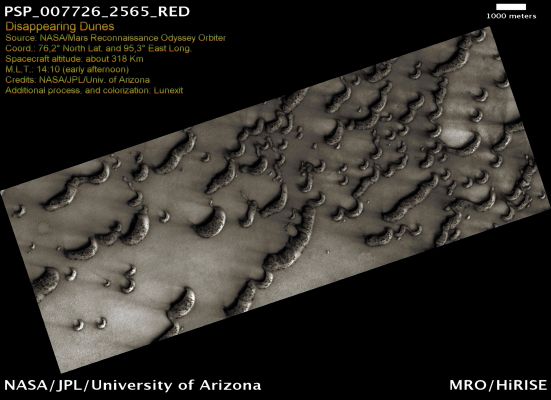
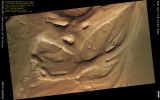
Northern Dunes (Absolute Natural Colors; credits for the additional process. and color.: Dr Paolo C. Fienga/Lunar Explorer Italia/Italian Planetary Foundation)
This NASA - Mars Reconnaissance Orbiter "HiRISE" image shows a portion of a Dunefield where many large "Barchan" (meaning "Crescent-shaped"), a few "Barchanoid" (meaning a "Non uniformly Crescent-shaped") and some smaller Dome-shaped Sand Dunes can be seen. The Dunefield that contains all these types of Sand Dunes is located in the Northern Regions of Mars and in a specific place where the first significant changes occurring to Sand Dunes was reported on the Red Planet (in the AD 2008). That study made by Dr Bourke (et al.) used a time series of NASA - Mars Global Surveyor (MGS), Mars Orbiter Camera (MOC) images taken over a period of 3 Martian Years (which are equivalent to 6 Earth Years) and showed that 2 (two) approx. 20 meter-wide Dome Dunes disappeared while a third one shrank by an estimated 15%. 
Now, the HiRISE image here confirms that the first two Sand Dune studied by Dr Bourke no longer exist but, interestingly, it also suggests that the Sediment removal is still ongoing, since the third Dune has dramatically reduced its volume. On the other hand, it must be noticed and underlined that this "Dune-Changing Process" does not occur in a uniform and generalized way (at least in this specific location), since many of the other large Dunes present in the Dunefield do not show any (apparent/obvious) change; however, more time and some more precise measurements (fit to display evidence of the occurrence of an actual change of the larger Dunes, either in their shape, or their position) are needed in order to achieve a more substantiated conclusion. 
In addition to that, we should also consider that it is even possible that the stability of all the other larger Dunes present in the Dunefield might be caused by the circumstance that the Sediment existing inside them is now (let us say "at present time"...) unavailable for removal, due to Induration (meaning that said Sediment became too hard to be blown away by just a simple, even though quite strong sometime, Aeolian Action, but in a future - maybe as a consequence of a dramatic variation in the Surface Temperature of this Region of Mars - its physical conditions could change again, and therefore make it fit to be remodeled, removed or, maybe, totally dispersed). 
In the end, the change observed in the small Dome-shaped Dunes indicates, once and for all, that certainly not all Dunes on Mars are effectively and permanently stabilized and immobile, as it was erroneously believed for a long time.

Mars Local Time: 14:10 (Early Afternoon)
Coord. (centered): 76,182° North Lat. and 95,300° East Long.
Spacecraft altitude: 318,0 Km (such as about 198,8 miles) 
Original image scale range: 63,6 cm/pixel (with 2 x 2 binning) so objects ~ 1 mt and 91 cm across are resolved
Map projected scale: 50 cm/pixel
Map projection: POLAR STEREOGRAPHIC
Emission Angle: 2,8° 
Phase Angle: 62,5°
Solar Incidence Angle: 60° (meaning that the Sun was about 30° above the Local Horizon at the time the picture was taken)
Solar Longitude: 47,6° (Northern Spring- Southern Autumn)
Credits: NASA/JPL/University of Arizona
Additional process. and coloring: Lunar Explorer Italia

This picture (which is a NASA - Original Mars Reconnaissance Orbiter EDM color frame identified by the serial n. PSP_007726_2565) has been additionally processed and then colorized in Absolute Natural Colors (such as the colors that a human eye would actually perceive if someone were onboard the NASA - Mars Reconnaissance Orbiter and then looked down, towards the Surface of Mars), by using an original technique created - and, in time, dramatically improved - by the Lunar Explorer Italia Team.
Parole chiave: Mars from orbit - Dunes - Northern Regions

Northern Dunes (Absolute Natural Colors; credits for the additional process. and color.: Dr Paolo C. Fienga/Lunar Explorer Italia/Italian Planetary Foundation)

This NASA - Mars Reconnaissance Orbiter "HiRISE" image shows a portion of a Dunefield where many large "Barchan" (meaning "Crescent-shaped"), a few "Barchanoid" (meaning a "Non uniformly Crescent-shaped") and some smaller Dome-shaped Sand Dunes can be seen. The Dunefield that contains all these types of Sand Dunes is located in the Northern Regions of Mars and in a specific place where the first significant changes occurring to Sand Dunes was reported on the Red Planet (in the AD 2008). That study made by Dr Bourke (et al.) used a time series of NASA - Mars Global Surveyor (MGS), Mars Orbiter Camera (MOC) images taken over a period of 3 Martian Years (which are equivalent to 6 Earth Years) and showed that 2 (two) approx. 20 meter-wide Dome Dunes disappeared while a third one shrank by an estimated 15%.
Now, the HiRISE image here confirms that the first two Sand Dune studied by Dr Bourke no longer exist but, interestingly, it also suggests that the Sediment removal is still ongoing, since the third Dune has dramatically reduced its volume. On the other hand, it must be noticed and underlined that this "Dune-Changing Process" does not occur in a uniform and generalized way (at least in this specific location), since many of the other large Dunes present in the Dunefield do not show any (apparent/obvious) change; however, more time and some more precise measurements (fit to display evidence of the occurrence of an actual change of the larger Dunes, either in their shape, or their position) are needed in order to achieve a more substantiated conclusion.
In addition to that, we should also consider that it is even possible that the stability of all the other larger Dunes present in the Dunefield might be caused by the circumstance that the Sediment existing inside them is now (let us say "at present time"...) unavailable for removal, due to Induration (meaning that said Sediment became too hard to be blown away by just a simple, even though quite strong sometime, Aeolian Action, but in a future - maybe as a consequence of a dramatic variation in the Surface Temperature of this Region of Mars - its physical conditions could change again, and therefore make it fit to be remodeled, removed or, maybe, totally dispersed).
In the end, the change observed in the small Dome-shaped Dunes indicates, once and for all, that certainly not all Dunes on Mars are effectively and permanently stabilized and immobile, as it was erroneously believed for a long time.

Mars Local Time: 14:10 (Early Afternoon)
Coord. (centered): 76,182° North Lat. and 95,300° East Long.
Spacecraft altitude: 318,0 Km (such as about 198,8 miles)
Original image scale range: 63,6 cm/pixel (with 2 x 2 binning) so objects ~ 1 mt and 91 cm across are resolved
Map projected scale: 50 cm/pixel
Map projection: POLAR STEREOGRAPHIC
Emission Angle: 2,8°
Phase Angle: 62,5°
Solar Incidence Angle: 60° (meaning that the Sun was about 30° above the Local Horizon at the time the picture was taken)
Solar Longitude: 47,6° (Northern Spring- Southern Autumn)
Credits: NASA/JPL/University of Arizona
Additional process. and coloring: Lunar Explorer Italia

This picture (which is a NASA - Original Mars Reconnaissance Orbiter EDM color frame identified by the serial n. PSP_007726_2565) has been additionally processed and then colorized in Absolute Natural Colors (such as the colors that a human eye would actually perceive if someone were onboard the NASA - Mars Reconnaissance Orbiter and then looked down, towards the Surface of Mars), by using an original technique created - and, in time, dramatically improved - by the Lunar Explorer Italia Team.

PSP_007678_2050_RED_abrowse~0.jpg PSP_007704_1765_RED_abrowse~0.jpg PSP_007726_2565_RED_abrowse-PCF-LXTT-IPF.jpg PSP_007738_2145_RED_abrowse.jpg PSP_007767_1970_RED_abrowse-01.jpg
Informazioni sul file
Nome del file:PSP_007726_2565_RED_abrowse-PCF-LXTT-IPF.jpg
Nome album:MareKromium / Mars Reconnaissance Orbiter (MRO)
Valutazione (3 voti):55555(Mostra dettagli)
Parole chiave:Mars / from / orbit / - / Dunes / - / Northern / Regions
Copyright:NASA/JPL/Univ. of Arizona e Dr Paolo C. Fienga - Lunar Explorer/IPF Italia per l'additional process. e la colorizzazione
Dimensione del file:705 KiB
Data di inserimento:Ott 14, 2012
Dimensioni:3000 x 2174 pixels
Visualizzato:107 volte
URL:https://www.lunexit.it/gallery/displayimage.php?pid=30847
Preferiti:Aggiungi ai preferiti

Commento 1 a 12 di 12
Pagina: 1

Paolo C. Fienga   [Gen 02, 2022 at 05:36 PM]
Ho dato un'occhiata ai vari "Cultori" di Instagram (social che non mi interessa, vista la deriva che ha preso) i quali si occupano di Spazio.

Ho guardato almeno un centinaio di "elaborazioni". Dire che quelle di Lunexit (questa fra le tante) sono Anni Luce avanti, è dire pochissimo. Mamma mia quante autentiche "cagate" (sorry per il linguaggio) che ho visto...Oscenità pure. Ovviamente con migliaia di "like".

Bah, probabilmente (anzi: sicuramente) non capisco un caxxo io. O, come qualcuno mi ha detto (in realtà mi è stato riferito) di recente, "sono scemo". Beh, meno male che lo sono. Visto quello che fanno gli "intelligenti", accolgo la mia scemenza con quieta ed allegra consapevolezza, onestà e serenità! ;-)
Ufologo   [Gen 02, 2022 at 05:50 PM]
Ahahhaahahah! Paolo! (Rido per quello che scrivi perché qua ... come Nuovo Anno, mia moglie proprio ieri s'è rotta la clavicola! E che voi fa', nun ce vede più, per cui ...)
Ad maiora (chi?). :-)
Paolo C. Fienga   [Gen 02, 2022 at 07:25 PM]
Sono contento di averti fatto ridere Amico Mio. Mi spiace tanto per la Tua Consorte, invece. Le auguro il meglio, con tutto il Cuore! - paolo

p.s.: Ad Maiora!
Ufologo   [Gen 03, 2022 at 11:43 AM]
Mia moglie ti ringrazia! (E anche il sottoscritto naturlamente)
Paolo C. Fienga   [Gen 03, 2022 at 11:52 AM]
Dille che prego per Lei, per favore. Magari raccontale questo. Qualche notte fa, mi sono alzato per andare in bagno. Al buio (o quasi) non vedo praticamente nulla. Sono inciampato su qualcosa e caduto come un sacco di patate. Mi son fatto anche male al polso. La comprendo BENE! E Le voglio BENE. Come a Te. Diglielo. Poi, noi due, dovremo parlare un momento. E' successa una cosa sgradevole. Molto. Abbraccio.
Ufologo   [Gen 03, 2022 at 02:26 PM]
Grazie di TUTTO Paolo! E' stato un vero piacere ...
Paolo C. Fienga   [Gen 03, 2022 at 04:57 PM]
Il Piacere è stato mio. Te lo ricordi Lando Fiorini?... Mandami la Tua E-Mail, please. Abbraccio Forte!

p.s.: Cento Campane a Voi!
Ufologo   [Gen 03, 2022 at 05:19 PM]
massimo.staccioli@libero.it
(Ti ho inviato un paio d'E-Mail; mi puoi dire se le hai ricevute tutt'e due, perché mi sa che una ... ) :-)
MareKromium   [Gen 04, 2022 at 07:04 PM]
Ricevute entrambe. Guardo ora. Vi voglio bene! "Altri" pagheranno caro.
Anakin   [Gen 08, 2022 at 06:44 PM]
Le immagini e le elaborazioni di Lunexit non si battono. Un grande abbraccioa tua moglie Max
Paolo, sei sicuro che ti sei fatto male al polso cadendo? :-D
Paolo C. Fienga   [Gen 12, 2022 at 05:58 PM]
...Uhmmm...si Anakin, forse ricordo male... ;-)
Ufologo   [Gen 13, 2022 at 11:48 AM]
Grazie Anakin! Forse è per quello che si è rotta la ... clavicola! :-) Troppo "forte".
(Guarda, ce ne succedono di tutti i colori ... Fatighiamo ad andare avanti)

Commento 1 a 12 di 12
Pagina: 1


Powered by Coppermine Photo Gallery