Inizio Registrati Login

Elenco album Ultimi arrivi Ultimi commenti Più viste Più votate Preferiti Cerca

Inizio > MARS > Mars Reconnaissance Orbiter (MRO)
Ritorna alla pagina delle miniature FILE 1166/2237 Torna all'inizio Guarda foto precedente Guarda foto successiva Salta alla fine
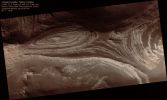
Layering inside Terby Crater (Absolute Natural Colors; credits: Dr Paolo C. Fienga - Lunexit Team)
Image PSP_001596_1525 shows a sequence of predominantly light-toned, layered, sedimentary rocks exposed by erosion on the floor of Terby Crater. Terby Crater is ~165 Km (~100 miles) in diameter. It's located on the northern rim of the Hellas impact basin in the Southern Hemisphere of Mars. 
The layered sequence is ~2 Km (~1,2 miles) thick and consists of many repetitive, relatively horizontal beds. The beds appear to be laterally continuous, which means you can identify a given layer in many locations across the area. 
Details in the layering seen in this HiRISE image reveal variations in the brightness of the layers and may indicate differing mineralogies. Based on the ease with which wind appears to erode these layers, they are believed to be composed mostly of fine-grained sediments. 
However, one or more of the beds is weathering to form meter(yard)-scale boulders that have accumulated downslope in fans of debris. 

These larger boulders indicate the material in the layers may be stronger than just fine-grained sediments.

It's not clear how these layers formed, but it may have involved deposition by wind or volcanic activity. Another theory involves all or part of the Hellas basin being filled with ice-covered lakes at one time in the past. The layers we see may have formed as material that was suspended in the water dropped down to the bottom of the lake. 
Parole chiave: Mars from orbit - Craters - Terby Crater

Layering inside Terby Crater (Absolute Natural Colors; credits: Dr Paolo C. Fienga - Lunexit Team)

Image PSP_001596_1525 shows a sequence of predominantly light-toned, layered, sedimentary rocks exposed by erosion on the floor of Terby Crater. Terby Crater is ~165 Km (~100 miles) in diameter. It's located on the northern rim of the Hellas impact basin in the Southern Hemisphere of Mars.
The layered sequence is ~2 Km (~1,2 miles) thick and consists of many repetitive, relatively horizontal beds. The beds appear to be laterally continuous, which means you can identify a given layer in many locations across the area.
Details in the layering seen in this HiRISE image reveal variations in the brightness of the layers and may indicate differing mineralogies. Based on the ease with which wind appears to erode these layers, they are believed to be composed mostly of fine-grained sediments.
However, one or more of the beds is weathering to form meter(yard)-scale boulders that have accumulated downslope in fans of debris.

These larger boulders indicate the material in the layers may be stronger than just fine-grained sediments.

It's not clear how these layers formed, but it may have involved deposition by wind or volcanic activity. Another theory involves all or part of the Hellas basin being filled with ice-covered lakes at one time in the past. The layers we see may have formed as material that was suspended in the water dropped down to the bottom of the lake.

PSP_001578_1425_RED_abrowse.jpg PSP_001578_2000-MF-LXT.jpg PSP_001596_1525_RED_browse-01-PCF-LXTT.jpg PSP_001602_1700_red-00~0.jpg PSP_001602_1700_red_01~0.jpg
Informazioni sul file
Nome del file:PSP_001596_1525_RED_browse-01-PCF-LXTT.jpg
Nome album:MareKromium / Mars Reconnaissance Orbiter (MRO)
Valutazione (4 voti):55555(Mostra dettagli)
Parole chiave:Mars / from / orbit / - / Craters / - / Terby / Crater
Copyright:NASA/JPL/Univ. of Arizona and Paolo C. Fienga/Lunexit Team per l'additional process. e la colorizzazione
Dimensione del file:1028 KiB
Data di inserimento:Apr 04, 2011
Dimensioni:3550 x 2125 pixels
Visualizzato:251 volte
URL:https://www.lunexit.it/gallery/displayimage.php?pid=28795
Preferiti:Aggiungi ai preferiti

Commento 1 a 5 di 5
Pagina: 1

MareKromium   [Apr 04, 2011 at 02:28 PM]
Non esiste comunque paragone fra la Qualità dei frames NASA/MRO ed ESA/Mars Express. Non c'è confronto. - paolo
walthari   [Apr 04, 2011 at 02:51 PM]
verissimo!
TunaSalad   [Apr 04, 2011 at 04:07 PM]
E' sacrosanto Paolo, però non capisco: ESA e NASA non usano, in fondo, la stessa (o una MOLTO simile!) tecnologia? Perchè, secondo te, questa abissale differenza? M
MareKromium   [Apr 04, 2011 at 05:46 PM]
...la risposta, Carissimo M, non la so. Ma posso dirti che, sicuramente, una porzione di essa è nella tua stessa domanda... - doc
andreagg   [Apr 04, 2011 at 10:28 PM]
Penso che anche se la tecnologia è la stessa, son ben diversigli assemblaggi.
Mi spiego meglio con un esempio pratico: i CCD (sensore delle macchine fotografiche digitali), anche se aquistati dallo stesso produttore vengono montati su hardware differenti.. e questo è una prima differenza non solo per la diversa architettura di gestione; successivamente vanno tradotte le informazione che arrivano dal sensore, i cosiddetto CoDec... implementati da personale secondo le proprie conoscenze (ed attitudini) sebbene si attengano alle indicazioni del produttore rappresentano a mio avviso forse il passaggio dove nascono le maggiori differenze; il sensore va successivamente raffreddato per migliorarne le prestazioni ed impedirne deleteri aumenti di temperatura.. un errore nella progettazione di questo apparato potrebbe comprometterne il funzionamento. E qui ho parlato a grandi linee del solo ccd. Macchine come quelle che girano intorno a Marte sono composte da centinaia di diversi apparati che sicuramente si influenzeranno a vicenda (se uno strumento assorbirà maggior energia per una data operazione, ne sottrarrà ad altri sistemi). Non asserisco certo che i satelliti Esa siano catorci... solo che in quest'ambito la Nasa può vantare un'esperienza ben maggiore e che se unita alla possibilità di poter arruolare esperti in un bacino maggiore porta ai risultati che abbiamo di fronte agli occhi.

Elucubrazioni e speculazioni dettate dalla mia testolina, quindi se ho detto castronerie, correggetemi pure! ;)

Commento 1 a 5 di 5
Pagina: 1


Powered by Coppermine Photo Gallery