Inizio Registrati Login

Elenco album Ultimi arrivi Ultimi commenti Più viste Più votate Preferiti Cerca

Inizio > MARS > Mars Reconnaissance Orbiter (MRO)
Ritorna alla pagina delle miniature FILE 549/2237 Torna all'inizio Guarda foto precedente Guarda foto successiva Salta alla fine
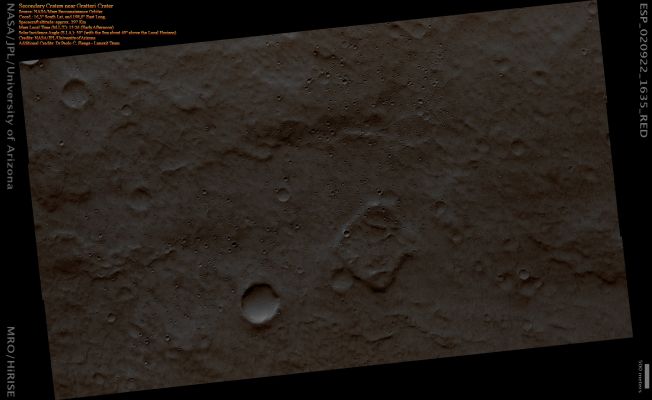
Proximities of Gratteri Crater (Absolute Natural Colors; credits: Dr Paolo C. Fienga - Lunexit Team)
Caption NASA:"Gratteri Crater, located about 150 Km to the South-East, ejected rocks that created millions of Secondary Craters over a Region at least 500 Km wide.
Many of these Secondary Craters are concentrated in "Rays", or lines extending radially from the Primary Impact Area (such as the "Gratteri Crater" Area). 
Crater Rays on the Moon are typically bright at visible wavelengths, but on Mars they are often best seen in the Thermal InfraRed wavelengths, from temperature contrasts. This image confirms that this Ray contains many Secondary Craters (they are the small, sharp-rimmed Craters). Since millions of Secondary Craters form at once, they all have the same age and same degree of modification over time. Understanding the distribution of secondary craters provides information about impact processes, including escape of rocks that could become Martian meteorites on Earth".
Parole chiave: Mars from orbit - Craters - Secondary Crater Field

Proximities of Gratteri Crater (Absolute Natural Colors; credits: Dr Paolo C. Fienga - Lunexit Team)

Caption NASA:"Gratteri Crater, located about 150 Km to the South-East, ejected rocks that created millions of Secondary Craters over a Region at least 500 Km wide.
Many of these Secondary Craters are concentrated in "Rays", or lines extending radially from the Primary Impact Area (such as the "Gratteri Crater" Area).
Crater Rays on the Moon are typically bright at visible wavelengths, but on Mars they are often best seen in the Thermal InfraRed wavelengths, from temperature contrasts. This image confirms that this Ray contains many Secondary Craters (they are the small, sharp-rimmed Craters). Since millions of Secondary Craters form at once, they all have the same age and same degree of modification over time. Understanding the distribution of secondary craters provides information about impact processes, including escape of rocks that could become Martian meteorites on Earth".

ESP_020918_1400_RED_abrowse.jpg ESP_020919_1525_RED_abrowse.jpg ESP_020922_1635_RED_abrowse.jpg ESP_020924_1455_RED_abrowse.jpg ESP_020926_1815_RED_abrowse-PCF-LXTT.jpg
Informazioni sul file
Nome del file:ESP_020922_1635_RED_abrowse.jpg
Nome album:MareKromium / Mars Reconnaissance Orbiter (MRO)
Valutazione (2 voti):55555(Mostra dettagli)
Parole chiave:Mars / from / orbit / - / Craters / - / Secondary / Crater / Field
Copyright:NASA/JPL/Univ. of Arizona and Paolo C. Fienga/Lunexit Team per l'additional process. e la colorizzazione
Dimensione del file:887 KiB
Data di inserimento:Feb 27, 2011
Dimensioni:3342 x 2048 pixels
Visualizzato:267 volte
URL:https://www.lunexit.it/gallery/displayimage.php?pid=28519
Preferiti:Aggiungi ai preferiti


Powered by Coppermine Photo Gallery