Inizio Registrati Login

Elenco album Ultimi arrivi Ultimi commenti Più viste Più votate Preferiti Cerca

Inizio > MARS > Mars Reconnaissance Orbiter (MRO)
Ritorna alla pagina delle miniature FILE 1543/2237 Torna all'inizio Guarda foto precedente Guarda foto successiva Salta alla fine
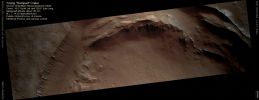
Features of Henry Crater (Absolute Natural Colors; credits for the additional process. and color.: Dr Paolo C. Fienga - Lunexit Team)
Named after a 19th Century French Astronomer, Henry Crater is an about 165 Km (approx. 103 mile) diameter Impact Crater, located in Arabia Terra, on a portion of the Martian Highlands extending into the Northern Hemisphere. This observation shows multiple Layers on the Edge of a Mound on the Floor of the Crater, which is distinct from others in the immediate vicinity.
The Layers represent the eroded remains of Sedimentary Rocks that formed from Sediments deposited within the Crater sometime after its formation. The origin of the Sediments on the Crater Floor in not known but may be windblown Dust and Sand. 
The Layers exhibit differences in degrees of hardness and resistance to erosion with resistant Layers forming Cliffs and more easily eroded Layers forming Ledges.

Inset: Several Dark Streaks are visible on the Slopes. Slope Streak formation is among the few known processes currently active on Mars. Streaks are believed to form by downslope movement of Dust in an almost fluid-like manner (analogous to a terrestrial Snow Avalanche) either exposing darker underlying material or creating a darker surface by increasing its roughness. 
Parole chiave: Mars from orbit - Craters - Henry Crater

Features of Henry Crater (Absolute Natural Colors; credits for the additional process. and color.: Dr Paolo C. Fienga - Lunexit Team)

Named after a 19th Century French Astronomer, Henry Crater is an about 165 Km (approx. 103 mile) diameter Impact Crater, located in Arabia Terra, on a portion of the Martian Highlands extending into the Northern Hemisphere. This observation shows multiple Layers on the Edge of a Mound on the Floor of the Crater, which is distinct from others in the immediate vicinity.
The Layers represent the eroded remains of Sedimentary Rocks that formed from Sediments deposited within the Crater sometime after its formation. The origin of the Sediments on the Crater Floor in not known but may be windblown Dust and Sand.
The Layers exhibit differences in degrees of hardness and resistance to erosion with resistant Layers forming Cliffs and more easily eroded Layers forming Ledges.

Inset: Several Dark Streaks are visible on the Slopes. Slope Streak formation is among the few known processes currently active on Mars. Streaks are believed to form by downslope movement of Dust in an almost fluid-like manner (analogous to a terrestrial Snow Avalanche) either exposing darker underlying material or creating a darker surface by increasing its roughness.

PSP_006567_2220_RED_abrowse-00.jpg PSP_006567_2220_RED_abrowse-01.jpg PSP_006569_1915_RED_abrowse-00-PCF-LXTT.jpg PSP_006573_1560_RED_abrowse-PCF-LXTT.jpg PSP_006588_1615_RED_abrowse-PCF-LXTT.jpg
Informazioni sul file
Nome del file:PSP_006569_1915_RED_abrowse-00-PCF-LXTT.jpg
Nome album:MareKromium / Mars Reconnaissance Orbiter (MRO)
Valutazione (3 voti):55555(Mostra dettagli)
Parole chiave:Mars / from / orbit / - / Craters / - / Henry / Crater
Copyright:NASA/JPL/Univ. of Arizona and Paolo C. Fienga/Lunexit Team per l'additional process. e la colorizzazione
Dimensione del file:1019 KiB
Data di inserimento:Gen 31, 2011
Dimensioni:3550 x 1699 pixels
Visualizzato:86 volte
URL:https://www.lunexit.it/gallery/displayimage.php?pid=28245
Preferiti:Aggiungi ai preferiti


Powered by Coppermine Photo Gallery