Inizio Registrati Login

Elenco album Ultimi arrivi Ultimi commenti Più viste Più votate Preferiti Cerca

Inizio > MARS > Mars Reconnaissance Orbiter (MRO)
Ritorna alla pagina delle miniature FILE 1348/2237 Torna all'inizio Guarda foto precedente Guarda foto successiva Salta alla fine
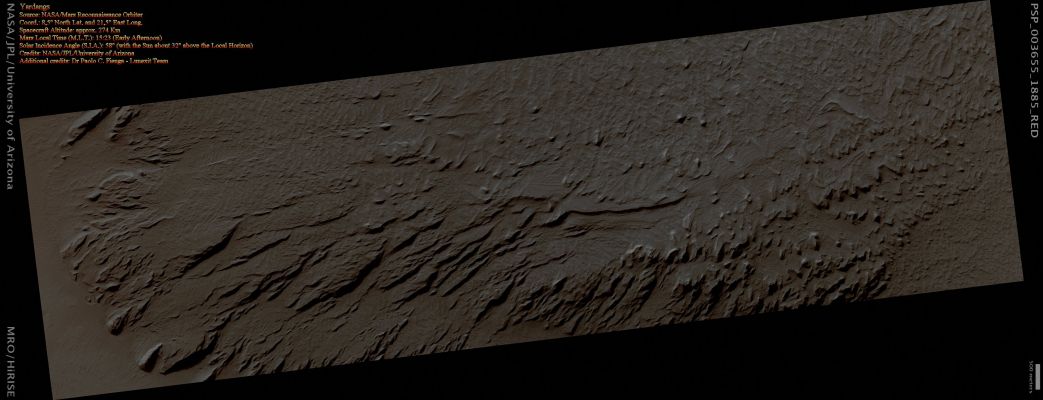
Beautiful Windworks (Natural Colors; credits for the additional process. and color.: Dr Paolo C. Fienga)
This image shows a portion of a Mound partly filling an Unnamed Impact Crater. 
The Impact Crater is a little more than 60 Km (approx. 37 miles) across while the Central Mound is about half that figure (since it extends itself well beyond the area shown here). 

Large Impact Craters typically have Central Peaks which surge upwards in the last stage of crater formation. However, Mounds like this represent a different process: Sedimentary Infill of the Crater AFTER its formation. 

At this site, the Mound appears to be Layered. Step-forming Layers crop out throughout the center of the image. This indicates that the Mound material was deposited in a series of events, likely the same process repeating many times. Many processes could form Layers like this, including Aeolian Deposition, Volcanic Ash or Lake Sedimentation. 

Unfortunately, fine details of the Layers are obscured by Dust which covers most of the Mound. Avalanches in this Dust Layer are responsible for the many small Dark Streaks that can be seen in the image. 

Anyway, however the material in the Mound formed, it was once even more extensive, perhaps entirely filling the Crater. Wind Erosion has caused the formation of these elongated shapes (called "Yardangs").
Parole chiave: Mars from orbit - Yardangs

Beautiful Windworks (Natural Colors; credits for the additional process. and color.: Dr Paolo C. Fienga)

This image shows a portion of a Mound partly filling an Unnamed Impact Crater.
The Impact Crater is a little more than 60 Km (approx. 37 miles) across while the Central Mound is about half that figure (since it extends itself well beyond the area shown here).

Large Impact Craters typically have Central Peaks which surge upwards in the last stage of crater formation. However, Mounds like this represent a different process: Sedimentary Infill of the Crater AFTER its formation.

At this site, the Mound appears to be Layered. Step-forming Layers crop out throughout the center of the image. This indicates that the Mound material was deposited in a series of events, likely the same process repeating many times. Many processes could form Layers like this, including Aeolian Deposition, Volcanic Ash or Lake Sedimentation.

Unfortunately, fine details of the Layers are obscured by Dust which covers most of the Mound. Avalanches in this Dust Layer are responsible for the many small Dark Streaks that can be seen in the image.

Anyway, however the material in the Mound formed, it was once even more extensive, perhaps entirely filling the Crater. Wind Erosion has caused the formation of these elongated shapes (called "Yardangs").

PSP_003639_1345_RED_browse-02.jpg PSP_003647_1745_RED_browse-00.jpg PSP_003655_1885_RED_abrowse-00.jpg PSP_003656_2015_RED_abrowse-PCF-LXTT.jpg PSP_003695_1250_RED_abrowse-00.jpg
Informazioni sul file
Nome del file:PSP_003655_1885_RED_abrowse-00.jpg
Nome album:MareKromium / Mars Reconnaissance Orbiter (MRO)
Valutazione (2 voti):55555(Mostra dettagli)
Parole chiave:Mars / from / orbit / - / Yardangs
Copyright:NASA/JPL/Univ. of Arizona and Paolo C. Fienga/Lunexit Team per l'additional process. e la colorizzazione
Dimensione del file:684 KiB
Data di inserimento:Dic 29, 2010
Dimensioni:3660 x 1403 pixels
Visualizzato:120 volte
URL:https://www.lunexit.it/gallery/displayimage.php?pid=28080
Preferiti:Aggiungi ai preferiti


Powered by Coppermine Photo Gallery