Inizio Registrati Login

Elenco album Ultimi arrivi Ultimi commenti Più viste Più votate Preferiti Cerca

Inizio > MARS > Mars Reconnaissance Orbiter (MRO)
Ritorna alla pagina delle miniature FILE 1268/2237 Torna all'inizio Guarda foto precedente Guarda foto successiva Salta alla fine
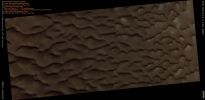
The Dunes of Kaiser Crater (CTX Frame - Natural Colors; credits for the additional process. and color.: Dr Paolo C. Fienga - Lunexit Team)
Caption NASA:"Image PSP_003141_1330 shows a Sand Dunefield in Kaiser Crater, a 210 Km (such as about 130 miles) wide Impact Basin in the Hellespontus Region of Mars.Winds have trapped massive quantities of Sand on the Floors of broad Craters in this Region. 
The steepest slopes on each Dune, such as the Slip-Faces, point to the East indicating that the dominant wind direction in this part of the Dunefield is from West to East. Patches of seasonal frost can be seen in the low areas between the Dunes".

Nota Lunexit: noi non crediamo che che le aree ad albedo più elevata (e che appaiono di un bel color bianco/argento nel frame colorizzato) le quali sono chiaramente individuabili fra le dune sìano, come dice la NASA, "chiazze di brine ghiacciate". 
O meglio: può darsi che esse lo sìano, così come è pure plausibile che si tratti di sabbie cristalline (ne abbiamo già incontrate nei Campi di Dune) o di porzioni di suolo libere dalle sabbie (e che magari evidenziano il "Martian Paving"...) 
Parole chiave: Mars from orbit - Craters - Kaiser Crater

The Dunes of Kaiser Crater (CTX Frame - Natural Colors; credits for the additional process. and color.: Dr Paolo C. Fienga - Lunexit Team)

Caption NASA:"Image PSP_003141_1330 shows a Sand Dunefield in Kaiser Crater, a 210 Km (such as about 130 miles) wide Impact Basin in the Hellespontus Region of Mars.Winds have trapped massive quantities of Sand on the Floors of broad Craters in this Region.
The steepest slopes on each Dune, such as the Slip-Faces, point to the East indicating that the dominant wind direction in this part of the Dunefield is from West to East. Patches of seasonal frost can be seen in the low areas between the Dunes".

Nota Lunexit: noi non crediamo che che le aree ad albedo più elevata (e che appaiono di un bel color bianco/argento nel frame colorizzato) le quali sono chiaramente individuabili fra le dune sìano, come dice la NASA, "chiazze di brine ghiacciate".
O meglio: può darsi che esse lo sìano, così come è pure plausibile che si tratti di sabbie cristalline (ne abbiamo già incontrate nei Campi di Dune) o di porzioni di suolo libere dalle sabbie (e che magari evidenziano il "Martian Paving"...)

PSP_003086_2015_RED_abrowse.jpg PSP_003086_2015_red-PCF-LXTT.jpg PSP_003141_1330_RED_abrowse-00-PCF-LXTT.jpg PSP_003141_1330_RED_abrowse-01-PCF-LXTT.jpg PSP_003162_1445_RED_abrowse-00-PCF-LXTT.jpg
Informazioni sul file
Nome del file:PSP_003141_1330_RED_abrowse-00-PCF-LXTT.jpg
Nome album:MareKromium / Mars Reconnaissance Orbiter (MRO)
Valutazione (1 voti):55555(Mostra dettagli)
Parole chiave:Mars / from / orbit / - / Craters / - / Kaiser / Crater
Copyright:NASA/JPL/Univ. of Arizona and Paolo C. Fienga/Lunexit Team per l'additional process. e la colorizzazione
Dimensione del file:574 KiB
Data di inserimento:Ott 08, 2010
Dimensioni:3600 x 1756 pixels
Visualizzato:111 volte
URL:https://www.lunexit.it/gallery/displayimage.php?pid=27619
Preferiti:Aggiungi ai preferiti


Powered by Coppermine Photo Gallery