Inizio Registrati Login

Elenco album Ultimi arrivi Ultimi commenti Più viste Più votate Preferiti Cerca

Inizio > MARS > Mars Reconnaissance Orbiter (MRO)
Ritorna alla pagina delle miniature FILE 1212/2237 Torna all'inizio Guarda foto precedente Guarda foto successiva Salta alla fine
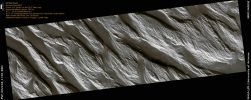
White Rock (Saturated Natural Colors; credits for the additional process. and color.: Dr Paolo C. Fienga - Lunexit Team)
This image shows a portion of a relatively bright landform named "White Rock" on the Floor of Pollack Crater, in the Sinus Sabaeus Region of Mars. 

Data from the Mars Global Surveyor Thermal Emission Spectrometer (TES) indicates that this landform is not anomalously bright, relative to other bright Martian Regions. Further, the apparent brightness seen here is due to contrast with other materials on the Crater Floor. 
Dunes and Ripples are visible in the dark material between the bright ridges. Their orientations appear to be influenced by wind directionally channeled by the ridges. 
Material appears to have been shed from the white landform and deposited on the darker bedforms indicating that the light-toned outcrops break down into fine materials. 

Its high albedo and location in a topographic basin have led to suggestions that White Rock is an erosional remnant of an ancient lacustrine evaporate deposit. Other interpretations include an eroded accumulation of compacted or weakly cemented aeolian sediment.
Parole chiave: Mars from orbit - Craters - Pollack Crater

White Rock (Saturated Natural Colors; credits for the additional process. and color.: Dr Paolo C. Fienga - Lunexit Team)

This image shows a portion of a relatively bright landform named "White Rock" on the Floor of Pollack Crater, in the Sinus Sabaeus Region of Mars.

Data from the Mars Global Surveyor Thermal Emission Spectrometer (TES) indicates that this landform is not anomalously bright, relative to other bright Martian Regions. Further, the apparent brightness seen here is due to contrast with other materials on the Crater Floor.
Dunes and Ripples are visible in the dark material between the bright ridges. Their orientations appear to be influenced by wind directionally channeled by the ridges.
Material appears to have been shed from the white landform and deposited on the darker bedforms indicating that the light-toned outcrops break down into fine materials.

Its high albedo and location in a topographic basin have led to suggestions that White Rock is an erosional remnant of an ancient lacustrine evaporate deposit. Other interpretations include an eroded accumulation of compacted or weakly cemented aeolian sediment.

PSP_002202_2250_RED_browse-00.jpg PSP_002202_2250_RED_browse-01.jpg PSP_002244_1720_RED_abrowse.jpg PSP_002244_1720_red.jpg PSP_002290_1585andPSP_001868_1585-MemnoniaFossae-Channel-CollapseFeatures.jpg
Informazioni sul file
Nome del file:PSP_002244_1720_RED_abrowse.jpg
Nome album:MareKromium / Mars Reconnaissance Orbiter (MRO)
Valutazione (5 voti):55555(Mostra dettagli)
Parole chiave:Mars / from / orbit / - / Craters / - / Pollack / Crater
Copyright:NASA/JPL/Univ. of Arizona and Paolo C. Fienga/Lunexit Team per l'additional process. e la colorizzazione
Dimensione del file:1471 KiB
Data di inserimento:Lug 18, 2010
Dimensioni:5157 x 2048 pixels
Visualizzato:55 volte
URL:https://www.lunexit.it/gallery/displayimage.php?pid=27143
Preferiti:Aggiungi ai preferiti


Powered by Coppermine Photo Gallery