Inizio Registrati Login

Elenco album Ultimi arrivi Ultimi commenti Più viste Più votate Preferiti Cerca

Inizio > MARS > Mars Reconnaissance Orbiter (MRO)
Ritorna alla pagina delle miniature FILE 381/2237 Torna all'inizio Guarda foto precedente Guarda foto successiva Salta alla fine
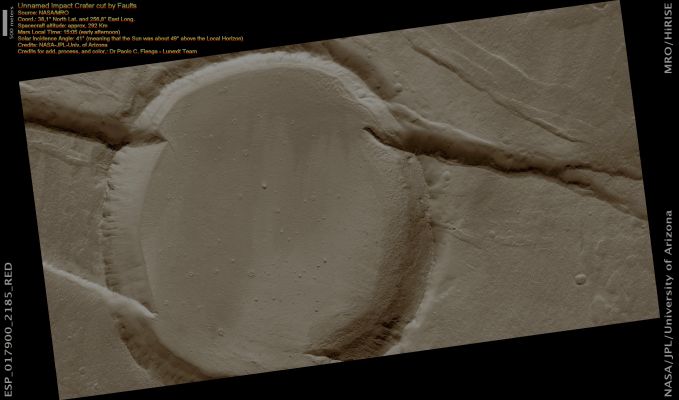
Unnamed Impact Crater cut by Faults (Natural Colors; credits: Dr Paolo C. Fienga - Lunexit Team)
This image reveals an interesting coincidence of two important Planetary Processes: Cratering by Impacts and Tectonism.

Here we have an Impact Crater (the large round feature, approx. 6,2 Km, or 3,9 miles, across) that intersects a series of Faults (the linear features). The Faults are seen to cut the circular Rim of the Impact Crater. Also, the impact did not destroy the adjacent faults. These observations tell us that the Fault was active after the impact occurred. 
In addition, by measuring the distance of offset of the different pieces of the Crater Rim separated by the Fault Line (assuming that when the Crater formed, the Rim was continuous around its circumference), the amount of movement along the Fault can be estimated, laterally and vertically. Faults like these cause Troughs to form, called "Graben", of which the heavily shadowed one is a good example. The center (shadowed) section has been dropped downwards relative to the surrounding Terrain, forming the Trough.

It is also clear that parts of the Crater Rim are lower than others where the Graben intersects the Crater. The sides of the Graben (the Faults forming the Walls of the Trough) are sloped, so that the dropped-down part of the Crater Rim has also moved horizontally away from its higher part. The combined down-dropping and moving apart indicates that the land here is being stretched and pulled apart, called "extension". By measuring the amount of offset on all the Faults, we can estimate how much extension has occurred in this part of the Planet.

This location is especially helpful because, as mentioned above, we have a good knowledge of the “before-faulting” configuration of the land, in which the Crater Rim was continuous. Finally, it is interesting that there is no sign of the Fault on the Floor of the Crater – its Floor has not been faulted and no part is down-dropped and stretched apart as the Rim has been. This indicates that some infilling of the Crater (perhaps by Lava or Airborne Sediment) has likely occurred since the Fault was active, burying the trace of the Fault and representing a third stage of geologic history in this area.
Parole chiave: Mars from orbit - Craters - Unnamed Crater with Faults - Utopia Planitia Region

Unnamed Impact Crater cut by Faults (Natural Colors; credits: Dr Paolo C. Fienga - Lunexit Team)

This image reveals an interesting coincidence of two important Planetary Processes: Cratering by Impacts and Tectonism.

Here we have an Impact Crater (the large round feature, approx. 6,2 Km, or 3,9 miles, across) that intersects a series of Faults (the linear features). The Faults are seen to cut the circular Rim of the Impact Crater. Also, the impact did not destroy the adjacent faults. These observations tell us that the Fault was active after the impact occurred.
In addition, by measuring the distance of offset of the different pieces of the Crater Rim separated by the Fault Line (assuming that when the Crater formed, the Rim was continuous around its circumference), the amount of movement along the Fault can be estimated, laterally and vertically. Faults like these cause Troughs to form, called "Graben", of which the heavily shadowed one is a good example. The center (shadowed) section has been dropped downwards relative to the surrounding Terrain, forming the Trough.

It is also clear that parts of the Crater Rim are lower than others where the Graben intersects the Crater. The sides of the Graben (the Faults forming the Walls of the Trough) are sloped, so that the dropped-down part of the Crater Rim has also moved horizontally away from its higher part. The combined down-dropping and moving apart indicates that the land here is being stretched and pulled apart, called "extension". By measuring the amount of offset on all the Faults, we can estimate how much extension has occurred in this part of the Planet.

This location is especially helpful because, as mentioned above, we have a good knowledge of the “before-faulting” configuration of the land, in which the Crater Rim was continuous. Finally, it is interesting that there is no sign of the Fault on the Floor of the Crater – its Floor has not been faulted and no part is down-dropped and stretched apart as the Rim has been. This indicates that some infilling of the Crater (perhaps by Lava or Airborne Sediment) has likely occurred since the Fault was active, burying the trace of the Fault and representing a third stage of geologic history in this area.

ESP_017888_1950_RED_abrowse.jpg ESP_017897_2045_RED_abrowse-PCF-LXTT.jpg ESP_017900_2185_RED_abrowse.jpg ESP_017950_2205_RED_abrowse.jpg ESP_018011_2565_RED_abrowse.jpg
Informazioni sul file
Nome del file:ESP_017900_2185_RED_abrowse.jpg
Nome album:MareKromium / Mars Reconnaissance Orbiter (MRO)
Valutazione (4 voti):55555(Mostra dettagli)
Parole chiave:Mars / from / orbit / - / Craters / - / Unnamed / Crater / with / Faults / - / Utopia / Planitia / Region
Copyright:NASA/JPL/Univ. of Arizona and Paolo C. Fienga/Lunexit Team per l'additional process. e la colorizzazione
Dimensione del file:845 KiB
Data di inserimento:Giu 18, 2010
Dimensioni:3481 x 2048 pixels
Visualizzato:54 volte
URL:https://www.lunexit.it/gallery/displayimage.php?pid=26975
Preferiti:Aggiungi ai preferiti

Commento 1 a 1 di 1
Pagina: 1

walthari   [Giu 21, 2010 at 09:23 AM]
splendido esempio del "principio delle relazioni di taglio".Le faglie tagliano un antico cratere, il che ci pone nella condizione di conoscere l'ordine cronologico degli eventi!!
Concetto banalissimo ma di fondamentale importanza
"Le faglie sono sempre pi giovani delle rocce che tagliano se una faglia penetra certe formazioni ma non quelle al di sopra allora le formazioni tagliate sono pi antiche, quelle non tagliate pi giovani."

Commento 1 a 1 di 1
Pagina: 1


Powered by Coppermine Photo Gallery