Inizio Registrati Login

Elenco album Ultimi arrivi Ultimi commenti Più viste Più votate Preferiti Cerca

Inizio > MARS > Mars Reconnaissance Orbiter (MRO)
Ritorna alla pagina delle miniature FILE 1880/2237 Torna all'inizio Guarda foto precedente Guarda foto successiva Salta alla fine
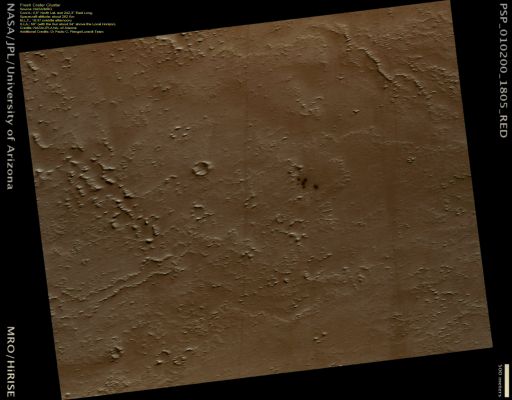
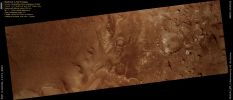
Fresh Crater Cluster (CTX Frame - Natural Colors; credits: Dr Paolo C. Fienga - Lunexit Team)
Although most of the craters HiRISE usually images are ancient, impact cratering is an ongoing process on the Martian Surface.
While very large craters are rare, smaller ones with diameters of a few meters form on timescales rapid enough for Mars missions to confirm the presence of a new crater. Data from the Mars Orbiter Camera (MOC) on the (now defunct) Mars Global Surveyor, the Context Camera (CTX) on MRO, and HiRISE have dated craters to within a few years or even months, based on repeat images that show no craters in the earlier image and craters present in the later image. 

Most of the new craters identified by CTX and HiRISE have been located in Mars' dustiest areas, where a new impact will scour dust from the Surface and reveal darker underlying rock. This color difference makes the craters easier to spot. Other, less dusty areas of Mars are certainly being bombarded as well, but the size of the craters makes them difficult to detect without stark color contrasts. 
Once a new dark spot has been identified by CTX, HiRISE will take a follow-up image to confirm that the dark spots are in fact Impact Craters.
Parole chiave: Mars from orbit - Craters - Fresh Crater Cluster

Fresh Crater Cluster (CTX Frame - Natural Colors; credits: Dr Paolo C. Fienga - Lunexit Team)

Although most of the craters HiRISE usually images are ancient, impact cratering is an ongoing process on the Martian Surface.
While very large craters are rare, smaller ones with diameters of a few meters form on timescales rapid enough for Mars missions to confirm the presence of a new crater. Data from the Mars Orbiter Camera (MOC) on the (now defunct) Mars Global Surveyor, the Context Camera (CTX) on MRO, and HiRISE have dated craters to within a few years or even months, based on repeat images that show no craters in the earlier image and craters present in the later image.

Most of the new craters identified by CTX and HiRISE have been located in Mars' dustiest areas, where a new impact will scour dust from the Surface and reveal darker underlying rock. This color difference makes the craters easier to spot. Other, less dusty areas of Mars are certainly being bombarded as well, but the size of the craters makes them difficult to detect without stark color contrasts.
Once a new dark spot has been identified by CTX, HiRISE will take a follow-up image to confirm that the dark spots are in fact Impact Craters.

PSP_010183_2035_RED_abrowse-00.jpg PSP_010198_2645_RED.jpg PSP_010200_1805_RED_abrowse-00.jpg PSP_010200_1805_RED_abrowse-01.jpg PSP_010206_1975_RED_abrowse-00.jpg
Informazioni sul file
Nome del file:PSP_010200_1805_RED_abrowse-00.jpg
Nome album:MareKromium / Mars Reconnaissance Orbiter (MRO)
Valutazione (3 voti):55555(Mostra dettagli)
Parole chiave:Mars / from / orbit / - / Craters / - / Fresh / Crater / Cluster
Copyright:NASA/JPL/Univ. of Arizona, Paolo C. Fienga/Lunexit Team per il processing addizionale e la colorizzazione
Dimensione del file:650 KiB
Data di inserimento:Gen 31, 2010
Dimensioni:3001 x 2341 pixels
Visualizzato:54 volte
URL:https://www.lunexit.it/gallery/displayimage.php?pid=26214
Preferiti:Aggiungi ai preferiti


Powered by Coppermine Photo Gallery