Inizio Registrati Login

Elenco album Ultimi arrivi Ultimi commenti Più viste Più votate Preferiti Cerca

Inizio > MARS > Mars Reconnaissance Orbiter (MRO)
Ritorna alla pagina delle miniature FILE 1150/2237 Torna all'inizio Guarda foto precedente Guarda foto successiva Salta alla fine
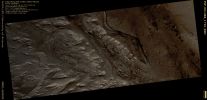
Edge along Gale Craters's Interior Mound (Natural Colors; credits: Dr Paolo C. Fienga - Lunexit Team)
Gale Crater is one of several craters around the Equator that show the presence of Light-Toned Layered Deposits (or LTLD). This HiRISE image covers the northern edge of the LTLD in the Central Mound of Gale Crater, as well as a small portion of the Crater Floor. The right side of the image shows a relatively flat surface with some Impact Craters. 
Moving to the left (Southward), there is a large Canyon where Dark Sands have accumulated and formed Ripples and Dunes. 

As one moves further to the South, the LTLD rises upward in topography and Layering is visible in some locations. The Surface of the LTLD is very fractured, producing meter-size blocks. 
The fact that we don't see many loose rocks along the Surface suggests that the rocks are quickly being destroyed by winds due to their fragile nature. 
Resistant Hills, on the other side, tend to be elongated, which is consistent with upslope or downslope winds eroding the rocks themselves.
Parole chiave: Mars from orbit - Craters - Gale Crater

Edge along Gale Craters's Interior Mound (Natural Colors; credits: Dr Paolo C. Fienga - Lunexit Team)

Gale Crater is one of several craters around the Equator that show the presence of Light-Toned Layered Deposits (or LTLD). This HiRISE image covers the northern edge of the LTLD in the Central Mound of Gale Crater, as well as a small portion of the Crater Floor. The right side of the image shows a relatively flat surface with some Impact Craters.
Moving to the left (Southward), there is a large Canyon where Dark Sands have accumulated and formed Ripples and Dunes.

As one moves further to the South, the LTLD rises upward in topography and Layering is visible in some locations. The Surface of the LTLD is very fractured, producing meter-size blocks.
The fact that we don't see many loose rocks along the Surface suggests that the rocks are quickly being destroyed by winds due to their fragile nature.
Resistant Hills, on the other side, tend to be elongated, which is consistent with upslope or downslope winds eroding the rocks themselves.

PSP_001483_1545_RED-more_lakes.jpg PSP_001483_1545_RED-more_lakes~0.jpg PSP_001488_1750_RED_abrowse.jpg PSP_001493_1815_RED_abrowse-1.jpg PSP_001501_2280_RED_abrowse-00.jpg
Informazioni sul file
Nome del file:PSP_001488_1750_RED_abrowse.jpg
Nome album:MareKromium / Mars Reconnaissance Orbiter (MRO)
Valutazione (4 voti):55555(Mostra dettagli)
Parole chiave:Mars / from / orbit / - / Craters / - / Gale / Crater
Copyright:NASA/JPL/Univ. of Arizona, Paolo C. Fienga & Lunexit Team per il processing addizionale e la colorizzazione
Dimensione del file:1934 KiB
Data di inserimento:Dic 25, 2009
Dimensioni:5500 x 2648 pixels
Visualizzato:54 volte
URL:https://www.lunexit.it/gallery/displayimage.php?pid=26039
Preferiti:Aggiungi ai preferiti


Powered by Coppermine Photo Gallery