Inizio Registrati Login

Elenco album Ultimi arrivi Ultimi commenti Più viste Più votate Preferiti Cerca

Inizio > MARS > Mars Reconnaissance Orbiter (MRO)
Ritorna alla pagina delle miniature FILE 316/2237 Torna all'inizio Guarda foto precedente Guarda foto successiva Salta alla fine
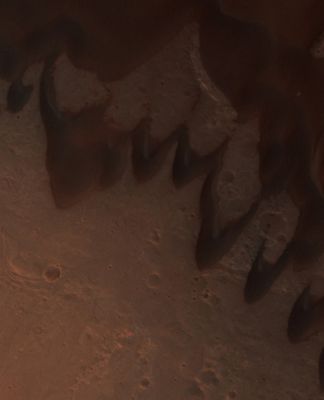
Equatorial Martian Barchans (EDM - Natural Colors; credits: NASA/JPL/Univ. of Arizona)
Barchan Dunes are common on both Earth and Mars. These Dunes are very distinctive in shape, and are important because they can tell scientists about the environment in which they formed.
Barchans form in wind regimes that blow in one Dominant Direction. The ridged arcs of sand that define the Barchan Dunes end in horns that point downwind. Sand is transported up the broad, relatively shallow windward slopes and once it overtops the Dune Crest, the sand falls down a shorter steeper slope between the horns, known as the "Slip Face". Over time, the Barchans migrate downwind, following their horns.

This HiRISE image shows an example of several Barchans merging to form an even larger Barchan Dune. This can happen through a variety of circumstances, such as when smaller, faster dunes collide with larger, slower-moving dunes that absorb them, resulting in single, larger dunes. The distance between the merging horns of the large dune in this highlighted region is a little over 500 meters (about 1600 feet).

Coord.: 3,3° South Lat. and 307,6° East Long.
Spacecraft altitude: about 268 Km
M.L.T.: 14:17 (early afternoon)
S.I.A.: 36° (with the Sun about 54° abov the Local Horizon)

Parole chiave: Mars from orbit - Dunes - Aeria Terra

Equatorial Martian Barchans (EDM - Natural Colors; credits: NASA/JPL/Univ. of Arizona)

Barchan Dunes are common on both Earth and Mars. These Dunes are very distinctive in shape, and are important because they can tell scientists about the environment in which they formed.
Barchans form in wind regimes that blow in one Dominant Direction. The ridged arcs of sand that define the Barchan Dunes end in horns that point downwind. Sand is transported up the broad, relatively shallow windward slopes and once it overtops the Dune Crest, the sand falls down a shorter steeper slope between the horns, known as the "Slip Face". Over time, the Barchans migrate downwind, following their horns.

This HiRISE image shows an example of several Barchans merging to form an even larger Barchan Dune. This can happen through a variety of circumstances, such as when smaller, faster dunes collide with larger, slower-moving dunes that absorb them, resulting in single, larger dunes. The distance between the merging horns of the large dune in this highlighted region is a little over 500 meters (about 1600 feet).

Coord.: 3,3° South Lat. and 307,6° East Long.
Spacecraft altitude: about 268 Km
M.L.T.: 14:17 (early afternoon)
S.I.A.: 36° (with the Sun about 54° abov the Local Horizon)

ESP_014404_1275-GB-LXT-04.jpg ESP_014404_1765_RED_abrowse-00.jpg ESP_014404_1765_RED_abrowse-01.jpg ESP_014405_0945_RED_abrowse.jpg ESP_014410_1470_RED_abrowse.jpg
Informazioni sul file
Nome del file:ESP_014404_1765_RED_abrowse-01.jpg
Nome album:MareKromium / Mars Reconnaissance Orbiter (MRO)
Valutazione (4 voti):55555(Mostra dettagli)
Parole chiave:Mars / from / orbit / - / Dunes / - / Aeria / Terra
Copyright:NASA/JPL/Univ. of Arizona
Dimensione del file:521 KiB
Data di inserimento:Dic 23, 2009
Dimensioni:891 x 1100 pixels
Visualizzato:55 volte
URL:https://www.lunexit.it/gallery/displayimage.php?pid=26025
Preferiti:Aggiungi ai preferiti


Powered by Coppermine Photo Gallery