Inizio Registrati Login

Elenco album Ultimi arrivi Ultimi commenti Più viste Più votate Preferiti Cerca

Inizio > MARS > Mars Reconnaissance Orbiter (MRO)
Ritorna alla pagina delle miniature FILE 1137/2237 Torna all'inizio Guarda foto precedente Guarda foto successiva Salta alla fine
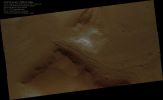
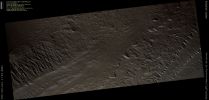
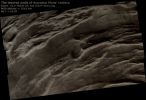
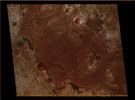
Layers in Gale Crater Central Mound (Natural Colors; credits: Lunexit)
This image shows a portion of the Central Mound in the Gale Crater (Central Mound that is of interest to scientists because of the light-toned Layered Deposits that can be found inside it). 

The Layered Deposits could have formed in a water environment if, for instance, a lake - once - filled the Crater. Alternatively, particles suspended in the Atmosphere, such as Dust or Volcanic Ashes, could have built up the Layers over time. 
By using HiRISE images to see details in the Layers, such as how their thicknesses vary horizontally and vertically, scientists can narrow down the potential origins. 
The paucity of Impact Craters on the Layered Deposits indicates that either the Deposits are very young, or more likely that they are being eroded up to the point where such (alleged) Impact Craters were erased. 

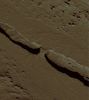
Wind Erosion modified the Layers after they formed, creating both sharp corners and rounded depressions along the Surface. 
A few meter-size Boulders are visible at the base of some steep Cliffs, but the really poor amount of visible Boulders elsewhere suggests that most of the erosion occurred (and it is still occurring) because of eolic processes (such as wind action) rather than downslope movement of material.
Parole chiave: Mars from orbit - Craters - Gale Crater

Layers in Gale Crater Central Mound (Natural Colors; credits: Lunexit)

This image shows a portion of the Central Mound in the Gale Crater (Central Mound that is of interest to scientists because of the light-toned Layered Deposits that can be found inside it).

The Layered Deposits could have formed in a water environment if, for instance, a lake - once - filled the Crater. Alternatively, particles suspended in the Atmosphere, such as Dust or Volcanic Ashes, could have built up the Layers over time.
By using HiRISE images to see details in the Layers, such as how their thicknesses vary horizontally and vertically, scientists can narrow down the potential origins.
The paucity of Impact Craters on the Layered Deposits indicates that either the Deposits are very young, or more likely that they are being eroded up to the point where such (alleged) Impact Craters were erased.

Wind Erosion modified the Layers after they formed, creating both sharp corners and rounded depressions along the Surface.
A few meter-size Boulders are visible at the base of some steep Cliffs, but the really poor amount of visible Boulders elsewhere suggests that most of the erosion occurred (and it is still occurring) because of eolic processes (such as wind action) rather than downslope movement of material.

PSP_001420_2045_RED_browse-00~0.jpg PSP_001420_2045_RED_browse-01~0.jpg PSP_001422_1750_RED_abrowse.jpg PSP_001444_1915_red.jpg PSP_001454_2030_and_001784_2030-Anagliph-MF-PCF-LXTT.jpg
Informazioni sul file
Nome del file:PSP_001422_1750_RED_abrowse.jpg
Nome album:MareKromium / Mars Reconnaissance Orbiter (MRO)
Valutazione (1 voti):55555(Mostra dettagli)
Parole chiave:Mars / from / orbit / - / Craters / - / Gale / Crater
Copyright:NASA/JPL/Univ. of Arizona e Lunar Explorer Italia per il processing addizionale e la colorizzazione
Dimensione del file:1406 KiB
Data di inserimento:Dic 14, 2009
Dimensioni:5500 x 2628 pixels
Visualizzato:55 volte
URL:https://www.lunexit.it/gallery/displayimage.php?pid=25942
Preferiti:Aggiungi ai preferiti


Powered by Coppermine Photo Gallery