Inizio Registrati Login

Elenco album Ultimi arrivi Ultimi commenti Più viste Più votate Preferiti Cerca

Inizio > MARS > Mars Reconnaissance Orbiter (MRO)
Ritorna alla pagina delle miniature FILE 1419/2237 Torna all'inizio Guarda foto precedente Guarda foto successiva Salta alla fine
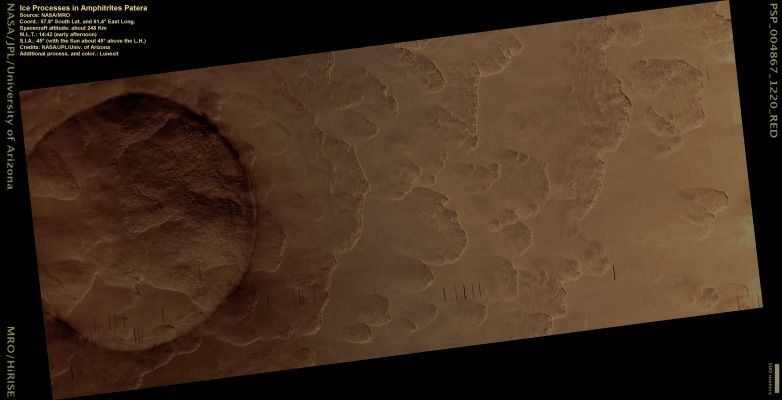
Ice Processes in Amphitrites Patera (CTX Frame - Natural Colors; elab. Lunexit)
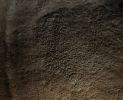
This image captures an impact crater on the surface of Amphitrites Patera, an ancient volcano on the southern margin of the giant Hellas Basin. The Hellas Basin was formed by a very large impact into the Southern Highlands early in the geologic history of Mars. The basin has a number of volcanoes along its margin, perhaps because magma could take advantage of the deep cracks in the crust that resulted from the impact. 
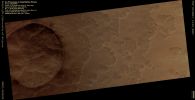
Amphitrites Patera is far enough South to approach the Martian Antarctic and there is evidence for large amounts of ice in the ground. As in the Polar Regions of Earth, the icy ground (permafrost) is able to move and be modified by a variety of processes. In this case, the rim of the small impact crater is filled with a honeycomb of cracks. These are likely to have formed where dust- and soil-covered ice or ice cemented soil was cracked by thermal contraction in the winter. Subsequently, the underlying ice was able to escape into the atmosphere (sublimate) allowing the ground along the cracks to collapse. The only place where large boulders are visible is along the rim of the crater; this is probably where the boulders were not so deeply buried by the icy layer. 
Parole chiave: Mars from orbit - Volcanic Features - Amphitrites Patera

Ice Processes in Amphitrites Patera (CTX Frame - Natural Colors; elab. Lunexit)

This image captures an impact crater on the surface of Amphitrites Patera, an ancient volcano on the southern margin of the giant Hellas Basin. The Hellas Basin was formed by a very large impact into the Southern Highlands early in the geologic history of Mars. The basin has a number of volcanoes along its margin, perhaps because magma could take advantage of the deep cracks in the crust that resulted from the impact.
Amphitrites Patera is far enough South to approach the Martian Antarctic and there is evidence for large amounts of ice in the ground. As in the Polar Regions of Earth, the icy ground (permafrost) is able to move and be modified by a variety of processes. In this case, the rim of the small impact crater is filled with a honeycomb of cracks. These are likely to have formed where dust- and soil-covered ice or ice cemented soil was cracked by thermal contraction in the winter. Subsequently, the underlying ice was able to escape into the atmosphere (sublimate) allowing the ground along the cracks to collapse. The only place where large boulders are visible is along the rim of the crater; this is probably where the boulders were not so deeply buried by the icy layer.

PSP_004847_1745_RED_browse-00.jpg PSP_004847_1745_RED_browse-02.jpg PSP_004867_1220_RED_abrowse-00.jpg PSP_004867_1220_RED_abrowse-01.jpg PSP_004903_2050_RED_browse-PCF-LXTT.jpg
Informazioni sul file
Nome del file:PSP_004867_1220_RED_abrowse-00.jpg
Nome album:MareKromium / Mars Reconnaissance Orbiter (MRO)
Valutazione (3 voti):55555(Mostra dettagli)
Parole chiave:Mars / from / orbit / - / Volcanic / Features / - / Amphitrites / Patera
Copyright:NASA/JPL/Univ. of Arizona e Lunar Explorer Italia per il processing addizionale e la colorizzazione
Dimensione del file:1101 KiB
Data di inserimento:Ott 18, 2009
Dimensioni:5000 x 2556 pixels
Visualizzato:84 volte
URL:https://www.lunexit.it/gallery/displayimage.php?pid=25527
Preferiti:Aggiungi ai preferiti


Powered by Coppermine Photo Gallery