Inizio Registrati Login

Elenco album Ultimi arrivi Ultimi commenti Più viste Più votate Preferiti Cerca

Inizio > MARS > Mars Reconnaissance Orbiter (MRO)
Ritorna alla pagina delle miniature FILE 259/2237 Torna all'inizio Guarda foto precedente Guarda foto successiva Salta alla fine
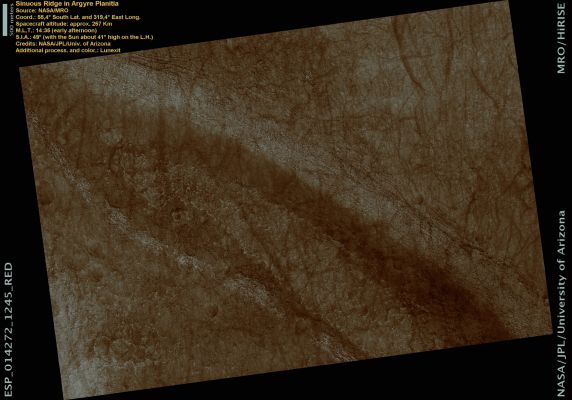
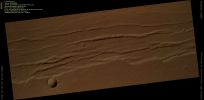
Esker in Southern Argyre Planitia (Natural Colors; credits: Lunexit)
Though a variety of origins have been proposed, this sinuous, layered, boulder-filled deposit in the Southern Argyre Planitia is likely an "Esker". 
"Eskers" form in wet-based glaciers, when water flows inside or below the glaciers and deposits sediment. After the ice melts, the sediment is left behind as a ridge.

Because the material is deposited by flowing water, the sediment in Eskers is sorted: larger rocks, pebbles, sand grains, etc. are deposited first, and smaller sediment - such as smaller pebbles, sand, or clay - are deposited further from the source and on top of the coarser material. 
Several factors (including the amount of sediment available, the speed and volume of the flowing water, and the slope over which it flowed) determine how much sediment is deposited and how large the dominant grain size is. There may be many of these sequences preserved within an Esker.

Eskers look a little like Inverted River Beds. One relatively simple way to differentiate between the two is that IRBs record flow in a downhill direction along their entire length. 
Eskers, on the other hand, can record flow both down- and uphill. This is possible because water flowing through the ice tunnels in glaciers is under pressure, just like water in a hose.

This particular Esker is part of a branching and braided network of Ridges in the Southern Argyre Basin. 
The boulders are on the order of 1-3 meters (about 3-10 feet) in diameter.
Parole chiave: Mars from orbit - Argyre Planitia Region

Esker in Southern Argyre Planitia (Natural Colors; credits: Lunexit)

Though a variety of origins have been proposed, this sinuous, layered, boulder-filled deposit in the Southern Argyre Planitia is likely an "Esker".
"Eskers" form in wet-based glaciers, when water flows inside or below the glaciers and deposits sediment. After the ice melts, the sediment is left behind as a ridge.

Because the material is deposited by flowing water, the sediment in Eskers is sorted: larger rocks, pebbles, sand grains, etc. are deposited first, and smaller sediment - such as smaller pebbles, sand, or clay - are deposited further from the source and on top of the coarser material.
Several factors (including the amount of sediment available, the speed and volume of the flowing water, and the slope over which it flowed) determine how much sediment is deposited and how large the dominant grain size is. There may be many of these sequences preserved within an Esker.

Eskers look a little like Inverted River Beds. One relatively simple way to differentiate between the two is that IRBs record flow in a downhill direction along their entire length.
Eskers, on the other hand, can record flow both down- and uphill. This is possible because water flowing through the ice tunnels in glaciers is under pressure, just like water in a hose.

This particular Esker is part of a branching and braided network of Ridges in the Southern Argyre Basin.
The boulders are on the order of 1-3 meters (about 3-10 feet) in diameter.

ESP_014267_1460_RED_abrowse.jpg ESP_014271_1480_RED_abrowse.jpg ESP_014272_1245_RED_abrowse.jpg ESP_014278_2050_RED_abrowse.jpg ESP_014282_0930_RED_abrowse-00.jpg
Informazioni sul file
Nome del file:ESP_014272_1245_RED_abrowse.jpg
Nome album:MareKromium / Mars Reconnaissance Orbiter (MRO)
Valutazione (4 voti):55555(Mostra dettagli)
Parole chiave:Mars / from / orbit / - / Argyre / Planitia / Region
Copyright:NASA/JPL/Univ. of Arizona e Lunar Explorer Italia per il processing addizionale e la colorizzazione
Dimensione del file:817 KiB
Data di inserimento:Set 21, 2009
Dimensioni:2930 x 2048 pixels
Visualizzato:60 volte
URL:https://www.lunexit.it/gallery/displayimage.php?pid=25341
Preferiti:Aggiungi ai preferiti


Powered by Coppermine Photo Gallery