Inizio Registrati Login

Elenco album Ultimi arrivi Ultimi commenti Più viste Più votate Preferiti Cerca

Inizio > MARS > Mars Reconnaissance Orbiter (MRO)
Ritorna alla pagina delle miniature FILE 230/2237 Torna all'inizio Guarda foto precedente Guarda foto successiva Salta alla fine
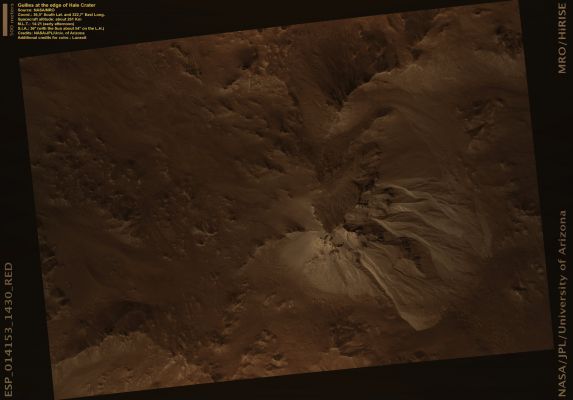
Gullies at the Edge of Hale Crater (Natural Colors; credits: Lunexit)
Several years ago, Gullies carved into hill-slopes and the walls of impact craters like the ones pictured here were discovered. Scientists are excited to study these features because, on Earth, they usually form through the action of liquid water - long thought to be absent on the Martian Surface. 
Whether Gullies form under today's cold dry conditions is a major question that planetary scientists are trying to answer.

The Gullies pictured here are great examples of what a typical Martian Gully looks like. You can see wide V-shaped channels running downhill (from top to bottom) where the material that carved the Gully flowed. At the bottom of the channel this material empties out onto a fan-shaped mound. Several Gullies are visible here and the fans from each gully overlap one other in complicated ways.
At the tops of the channels, large amphitheater-shaped alcoves are carved in the rock. The material removed from these alcoves likely flowed downhill to the aprons through the Gullies.

Gullies at this site are especially interesting because scientists recently discovered examples at similar locations to be still active. Images separated by several years showed changes in the appearance of some of these Gullies. 
Today, planetary scientists are using the HiRISE camera to examine Gullies for ongoing change and investigate what that might mean for the occurrence of liquid water on the Surface of Mars.
Parole chiave: Mars from orbit - Craters - Hale Crater

Gullies at the Edge of Hale Crater (Natural Colors; credits: Lunexit)

Several years ago, Gullies carved into hill-slopes and the walls of impact craters like the ones pictured here were discovered. Scientists are excited to study these features because, on Earth, they usually form through the action of liquid water - long thought to be absent on the Martian Surface.
Whether Gullies form under today's cold dry conditions is a major question that planetary scientists are trying to answer.

The Gullies pictured here are great examples of what a typical Martian Gully looks like. You can see wide V-shaped channels running downhill (from top to bottom) where the material that carved the Gully flowed. At the bottom of the channel this material empties out onto a fan-shaped mound. Several Gullies are visible here and the fans from each gully overlap one other in complicated ways.
At the tops of the channels, large amphitheater-shaped alcoves are carved in the rock. The material removed from these alcoves likely flowed downhill to the aprons through the Gullies.

Gullies at this site are especially interesting because scientists recently discovered examples at similar locations to be still active. Images separated by several years showed changes in the appearance of some of these Gullies.
Today, planetary scientists are using the HiRISE camera to examine Gullies for ongoing change and investigate what that might mean for the occurrence of liquid water on the Surface of Mars.

ESP_014139_2070_RED_abrowse-01.jpg ESP_014141_1665_RED_abrowse.jpg ESP_014153_1430_RED_abrowse.jpg ESP_014154_1730_RED_abrowse.jpg ESP_014159_1670_RED_abrowse-00.jpg
Informazioni sul file
Nome del file:ESP_014153_1430_RED_abrowse.jpg
Nome album:MareKromium / Mars Reconnaissance Orbiter (MRO)
Valutazione (5 voti):55555(Mostra dettagli)
Parole chiave:Mars / from / orbit / - / Craters / - / Hale / Crater
Copyright:NASA/JPL/Univ. of Arizona e Lunar Explorer Italia per il processing addizionale e la colorizzazione
Dimensione del file:846 KiB
Data di inserimento:Set 06, 2009
Dimensioni:4001 x 2789 pixels
Visualizzato:56 volte
URL:https://www.lunexit.it/gallery/displayimage.php?pid=25252
Preferiti:Aggiungi ai preferiti

Commento 1 a 3 di 3
Pagina: 1

walthari   [Set 06, 2009 at 01:03 PM]
che immagine meravigliosa!ho l'idea osservando i solchi lasciati dallo scorrimento di questi torrenti che non siano inattivi ma che saltuariamente tornino a "funzionare"...in effetti i solchi sono veramente troppo pronunciati quindi rigenerati nel tempo, altrimenti l'azione degradativa degli agenti erosivi li avrebbe cancellati del tutto o quasi...sono impostati sulla falda detritica che gli stessi modellano con l'erosione il trasporto e l'accumulo di materiale.
george_p   [Set 06, 2009 at 07:34 PM]
Eccellente avere tra gli amici Lunexit competenti nel settore (tra i tanti) geomorfologico, è utile al fine di ricostruire (dato che i massimi esponenti disinformano) pezzi di ciò che è Marte oggi o è stato in passato. Grazie Walthari - Giorgio
walthari   [Set 07, 2009 at 07:59 AM]
grazie george per i complimenti...quelloche dici sulla geomorfologia è una cosa verissima...è fondamentale l'analisi di queste foto per dedurre il passato e il presente di Marte!!!

Commento 1 a 3 di 3
Pagina: 1


Powered by Coppermine Photo Gallery