Inizio Registrati Login

Elenco album Ultimi arrivi Ultimi commenti Più viste Più votate Preferiti Cerca

Inizio > MARS > Mars Reconnaissance Orbiter (MRO)
Ritorna alla pagina delle miniature FILE 1563/2237 Torna all'inizio Guarda foto precedente Guarda foto successiva Salta alla fine
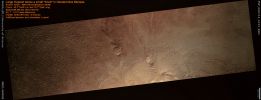
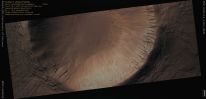
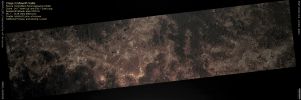
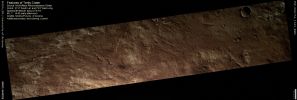
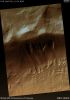
Clays in Mawrth Vallis (MULTISPECTRUM; credits: Lunexit)
Mawrth Vallis is one of the most colorful parts of Mars. However, it is not quite as colorful as seen in this observation, where this “extra” color comes from the fact that HiRISE can “see” into part of the infrared, enhancing its ability to detect color differences that are indicative of various minerals.

Properly identifying those minerals is where the CRISM instrument excels. 
They show that this area has a variety of different types of clay minerals: these are especially interesting because they had to form when water was interacting with rocks. 
The different types of clays point to different water chemistries and temperatures.

With HiRISE, we can better pinpoint how these different materials are distributed across the surface. Furthermore, by taking two images we can produce a stereo image and see the topography, allowing the different clay-bearing layers to be traced in 3D. 
Parole chiave: Mars from orbit - Mawrth Vallis

Clays in Mawrth Vallis (MULTISPECTRUM; credits: Lunexit)

Mawrth Vallis is one of the most colorful parts of Mars. However, it is not quite as colorful as seen in this observation, where this “extra” color comes from the fact that HiRISE can “see” into part of the infrared, enhancing its ability to detect color differences that are indicative of various minerals.

Properly identifying those minerals is where the CRISM instrument excels.
They show that this area has a variety of different types of clay minerals: these are especially interesting because they had to form when water was interacting with rocks.
The different types of clays point to different water chemistries and temperatures.

With HiRISE, we can better pinpoint how these different materials are distributed across the surface. Furthermore, by taking two images we can produce a stereo image and see the topography, allowing the different clay-bearing layers to be traced in 3D.

PSP_006714_2255_RED_abrowse.jpg PSP_006724_2165_RED_abrowse-PCF-LXTT.jpg PSP_006742_2050_RED_abrowse.jpg PSP_006752_1525_RED_abrowse-PCF-LXTT2.jpg PSP_006760_1370_RED_abrowse.jpg
Informazioni sul file
Nome del file:PSP_006742_2050_RED_abrowse.jpg
Nome album:MareKromium / Mars Reconnaissance Orbiter (MRO)
Valutazione (3 voti):55555(Mostra dettagli)
Parole chiave:Mars / from / orbit / - / Mawrth / Vallis
Copyright:NASA/JPL/Univ. of Arizona e Lunar Explorer Italia per il processing addizionale e la colorizzazione
Dimensione del file:1945 KiB
Data di inserimento:Lug 02, 2009
Dimensioni:6400 x 2122 pixels
Visualizzato:103 volte
URL:https://www.lunexit.it/gallery/displayimage.php?pid=24810
Preferiti:Aggiungi ai preferiti


Powered by Coppermine Photo Gallery