Inizio Registrati Login

Elenco album Ultimi arrivi Ultimi commenti Più viste Più votate Preferiti Cerca

Inizio > MARS > Mars Reconnaissance Orbiter (MRO)
Ritorna alla pagina delle miniature FILE 169/2237 Torna all'inizio Guarda foto precedente Guarda foto successiva Salta alla fine
"8"! (Natural Colors; credits: Lunar Explorer Italia)
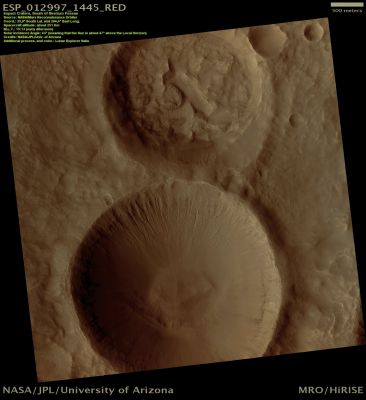
This image shows two craters in the Southern Hemisphere just South of Sirenum Fossae.
The Northern Crater (the one that is an upper position) is smaller, appears more degraded, and is partially filled with sediments that form a hummocky surface. Dunes have formed subsequently on this Surface. Some incipient gully-like features have formed midway along the Southern Crater Wall and expose Layers that are more resistant to erosion.
The larger crater to the South is eroded by Gullies on its Northern Slope while the Southern Slope Region lacks them. Most Gullies in this scene appear to emanate from more resistant Layers, although the larger Gullies have eroded back almost to the Crater Rim. 

The nature of the Layers and their connection to the water that formed the Gullies is unknown. 
Gullies typically form when flowing water erodes sediments and soft rocks in a channelized flow. Because Mars is very cold and dry, it is unknown where the water came from to form the Gullies.
Parole chiave: Mars from orbit - Craters - Unnamed Craters

"8"! (Natural Colors; credits: Lunar Explorer Italia)

This image shows two craters in the Southern Hemisphere just South of Sirenum Fossae.
The Northern Crater (the one that is an upper position) is smaller, appears more degraded, and is partially filled with sediments that form a hummocky surface. Dunes have formed subsequently on this Surface. Some incipient gully-like features have formed midway along the Southern Crater Wall and expose Layers that are more resistant to erosion.
The larger crater to the South is eroded by Gullies on its Northern Slope while the Southern Slope Region lacks them. Most Gullies in this scene appear to emanate from more resistant Layers, although the larger Gullies have eroded back almost to the Crater Rim.

The nature of the Layers and their connection to the water that formed the Gullies is unknown.
Gullies typically form when flowing water erodes sediments and soft rocks in a channelized flow. Because Mars is very cold and dry, it is unknown where the water came from to form the Gullies.

ESP_012940_1655_RED_abrowse-01.jpg ESP_012941_0930_RED_abrowse.jpg ESP_012997_1445_RED_abrowse.jpg ESP_013049_0950_RED_abrowse.jpg ESP_013066_1070_RED_abrowse.jpg
Informazioni sul file
Nome del file:ESP_012997_1445_RED_abrowse.jpg
Nome album:MareKromium / Mars Reconnaissance Orbiter (MRO)
Valutazione (3 voti):55555(Mostra dettagli)
Parole chiave:Mars / from / orbit / - / Craters / - / Unnamed / Craters
Copyright:NASA/JPL/Univ. of Arizona e Lunar Explorer Italia per il processing addizionale e la colorizzazione
Dimensione del file:425 KiB
Data di inserimento:Giu 05, 2009
Dimensioni:2048 x 2238 pixels
Visualizzato:63 volte
URL:https://www.lunexit.it/gallery/displayimage.php?pid=24607
Preferiti:Aggiungi ai preferiti


Powered by Coppermine Photo Gallery