Inizio Registrati Login

Elenco album Ultimi arrivi Ultimi commenti Più viste Più votate Preferiti Cerca

Inizio > MARS > Mars Reconnaissance Orbiter (MRO)
Ritorna alla pagina delle miniature FILE 1871/2237 Torna all'inizio Guarda foto precedente Guarda foto successiva Salta alla fine
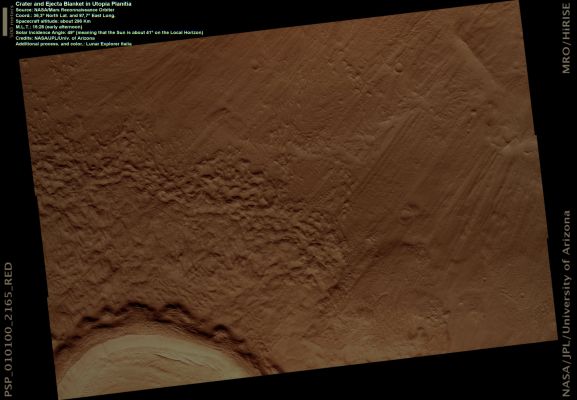
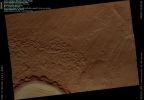
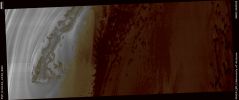
Ejecta Blanket (Natural Colors; credits: Lunar Explorer Italia)
This image of a crater in the Utopian Region can be described as what happens when heat produced from an impact comes into contact with Mars’ icy Surface.

Since the Surface Temperature of Mars is well below the freezing point of water, Mars’ soil is a mixture of soil and permafrost. When this impact occurred, a great deal of energy in the form of heat was released onto the Surface, creating a melted feature in the bright icy soil. This melting and then refreezing of the ice (as the impact cooled) caused what is known as a "Periglacial Formation". This is depicted towards the middle of the image where the Ejecta Blanket lays. 

This is likely a geologically newer surface since the only impacts disrupting the image are a few small craters that are mostly towards the bottom left-hand side of the full image. 
The fact the Ejecta Blanket is still intact and not fully collapsed supports the idea that is it a newer surface feature as it has not been affected by erosional processes.
Parole chiave: Mars from orbit - Craters - Unnamed Crater with Ejecta Blanket

Ejecta Blanket (Natural Colors; credits: Lunar Explorer Italia)

This image of a crater in the Utopian Region can be described as what happens when heat produced from an impact comes into contact with Mars’ icy Surface.

Since the Surface Temperature of Mars is well below the freezing point of water, Mars’ soil is a mixture of soil and permafrost. When this impact occurred, a great deal of energy in the form of heat was released onto the Surface, creating a melted feature in the bright icy soil. This melting and then refreezing of the ice (as the impact cooled) caused what is known as a "Periglacial Formation". This is depicted towards the middle of the image where the Ejecta Blanket lays.

This is likely a geologically newer surface since the only impacts disrupting the image are a few small craters that are mostly towards the bottom left-hand side of the full image.
The fact the Ejecta Blanket is still intact and not fully collapsed supports the idea that is it a newer surface feature as it has not been affected by erosional processes.

PSP_010086_2615_RED.jpg PSP_010090_1255_RED.jpg PSP_010100_2165_RED_abrowse.jpg PSP_010169_2650_RED_abrowse-00.jpg PSP_010169_2650_RED_abrowse-01.jpg
Informazioni sul file
Nome del file:PSP_010100_2165_RED_abrowse.jpg
Nome album:MareKromium / Mars Reconnaissance Orbiter (MRO)
Valutazione (3 voti):55555(Mostra dettagli)
Parole chiave:Mars / from / orbit / - / Craters / - / Unnamed / Crater / with / Ejecta / Blanket
Copyright:NASA/JPL/Univ. of Arizona e Lunar Explorer Italia per il processing addizionale e la colorizzazione
Dimensione del file:595 KiB
Data di inserimento:Mag 23, 2009
Dimensioni:2959 x 2048 pixels
Visualizzato:54 volte
URL:https://www.lunexit.it/gallery/displayimage.php?pid=24505
Preferiti:Aggiungi ai preferiti


Powered by Coppermine Photo Gallery