Inizio Registrati Login

Elenco album Ultimi arrivi Ultimi commenti Più viste Più votate Preferiti Cerca

Inizio > MARS > Mars Reconnaissance Orbiter (MRO)
Ritorna alla pagina delle miniature FILE 141/2237 Torna all'inizio Guarda foto precedente Guarda foto successiva Salta alla fine
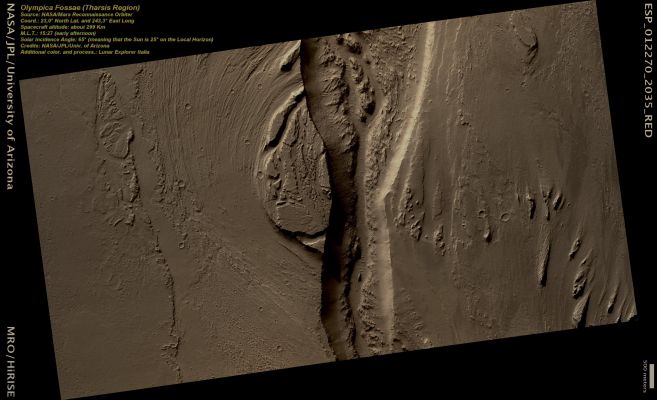
Flood-Carved Rock in Olympica Fossae (Natural Colors; credits: Lunar Explorer Italia)
This HiRISE image is part of the Olympica Fossae in the Tharsis Region of Mars.
Tharsis is most famous for being the home of the four largest Volcanoes in the Solar System. However, the Region also hosts a variety of other geologic features formed as the ground deformed under the tremendous weight of the Volcanoes.
Most of the Fissures (or “Fossae”) in the Region are primarily places where the ground was pulled apart. However, the Olympica Fossae are somewhat different. They are oriented at an angle to the other Fissures suggesting that some other process was important in their formation. 
A close-up image reveals that erosion by one or more catastrophic floods may have played a key role.

The teardrop shaped islands and the parallel ridges are rock left standing after the flood erosion. However, the deepest depression running basically East-West through the middle of the image was probably caused by tectonic extension, not flood erosion. This juxtaposition of tectonic and flood-carved valleys is visible elsewhere on Mars, suggesting that it may be common for the tectonic fracturing to release copious volumes of subterranean water.
Parole chiave: Mars from orbit - Olympica Fossae

Flood-Carved Rock in Olympica Fossae (Natural Colors; credits: Lunar Explorer Italia)

This HiRISE image is part of the Olympica Fossae in the Tharsis Region of Mars.
Tharsis is most famous for being the home of the four largest Volcanoes in the Solar System. However, the Region also hosts a variety of other geologic features formed as the ground deformed under the tremendous weight of the Volcanoes.
Most of the Fissures (or “Fossae”) in the Region are primarily places where the ground was pulled apart. However, the Olympica Fossae are somewhat different. They are oriented at an angle to the other Fissures suggesting that some other process was important in their formation.
A close-up image reveals that erosion by one or more catastrophic floods may have played a key role.

The teardrop shaped islands and the parallel ridges are rock left standing after the flood erosion. However, the deepest depression running basically East-West through the middle of the image was probably caused by tectonic extension, not flood erosion. This juxtaposition of tectonic and flood-carved valleys is visible elsewhere on Mars, suggesting that it may be common for the tectonic fracturing to release copious volumes of subterranean water.

ESP_012252_1245_RED_abrowse.jpg ESP_012265_0950_RED_abrowse.jpg ESP_012270_2035_RED_abrowse.jpg ESP_012271_0940_RED_abrowse.jpg ESP_012302_0985_RED_abrowse.jpg
Informazioni sul file
Nome del file:ESP_012270_2035_RED_abrowse.jpg
Nome album:MareKromium / Mars Reconnaissance Orbiter (MRO)
Valutazione (4 voti):55555(Mostra dettagli)
Parole chiave:Mars / from / orbit / - / Olympica / Fossae
Copyright:NASA/JPL/Univ. of Arizona e Lunar Explorer Italia per il processing addizionale e la colorizzazione
Dimensione del file:1265 KiB
Data di inserimento:Apr 16, 2009
Dimensioni:3364 x 2048 pixels
Visualizzato:55 volte
URL:https://www.lunexit.it/gallery/displayimage.php?pid=24226
Preferiti:Aggiungi ai preferiti


Powered by Coppermine Photo Gallery