Inizio Registrati Login

Elenco album Ultimi arrivi Ultimi commenti Più viste Più votate Preferiti Cerca

Inizio > MARS > Mars Reconnaissance Orbiter (MRO)
Ritorna alla pagina delle miniature FILE 83/2237 Torna all'inizio Guarda foto precedente Guarda foto successiva Salta alla fine
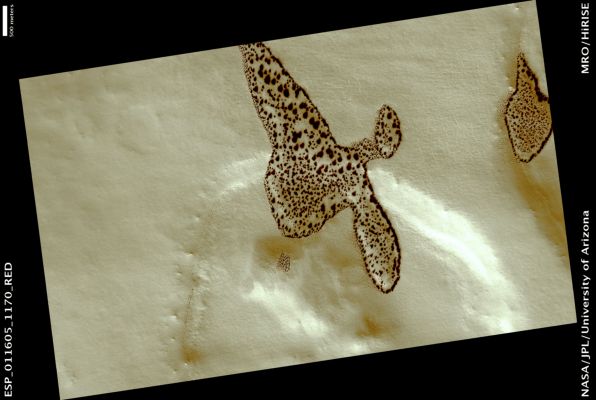
Defrosting Malea Patera (Natural Colors; credits: Lunar Explorer Italia)
Malea Patera is one of a group of ancient volcanoes that ring the Hellas Impact Basin. This HiRISE image was intended to investigate the nature of the volcanic materials at this location. However, the image was taken in early Spring for this location in the Southern Hemisphere and so the ground is covered with bright frost except for some dark splotches found in discrete patches. 
This is where the sunlight has penetrated the frost and initiated defrosting around discrete spots.
Clearly something is different about the patches where this defrosting has started before any other locations. One possibility is that these are (frost covered) dark sand dunes that heat up more easily than the surrounding terrain. However, we will need to take a new image in the Summer time to really know what is happening here. 

Mars Local Time: 16:11 (middle afternoon)
Coord. (centered): 62,5° South Lat. and 53,3° East Long.
Spacecraft altitude: 249,1 Km (such as about 155,7 miles) 
Original image scale range: 24,9 cm/pixel (with 1 x 1 binning) so objects ~75 cm across are resolved 
Map projected scale: 25 cm/pixel
Map projection: EQUIRECTANGULAR 
Emission Angle: 0,9° 
Phase Angle: 72,4°
Solar Incidence Angle: 73° (meaning that the Sun is about 17° above the Local Horizon)
Solar Longitude: 192,6° (Northern Autumn)
Credits: NASA/JPL/University of Arizona
Additional process. and coloring: Lunar Explorer Italia
Parole chiave: Mars from orbit - Malea Patera

Defrosting Malea Patera (Natural Colors; credits: Lunar Explorer Italia)

Malea Patera is one of a group of ancient volcanoes that ring the Hellas Impact Basin. This HiRISE image was intended to investigate the nature of the volcanic materials at this location. However, the image was taken in early Spring for this location in the Southern Hemisphere and so the ground is covered with bright frost except for some dark splotches found in discrete patches.
This is where the sunlight has penetrated the frost and initiated defrosting around discrete spots.
Clearly something is different about the patches where this defrosting has started before any other locations. One possibility is that these are (frost covered) dark sand dunes that heat up more easily than the surrounding terrain. However, we will need to take a new image in the Summer time to really know what is happening here.

Mars Local Time: 16:11 (middle afternoon)
Coord. (centered): 62,5° South Lat. and 53,3° East Long.
Spacecraft altitude: 249,1 Km (such as about 155,7 miles)
Original image scale range: 24,9 cm/pixel (with 1 x 1 binning) so objects ~75 cm across are resolved
Map projected scale: 25 cm/pixel
Map projection: EQUIRECTANGULAR
Emission Angle: 0,9°
Phase Angle: 72,4°
Solar Incidence Angle: 73° (meaning that the Sun is about 17° above the Local Horizon)
Solar Longitude: 192,6° (Northern Autumn)
Credits: NASA/JPL/University of Arizona
Additional process. and coloring: Lunar Explorer Italia

ESP_011575_1105_RED_abrowse.jpg ESP_011580_1255_RED_abrowse.jpg ESP_011605_1170_RED_abrowse.jpg ESP_011605_1170_RGB.jpg ESP_011610_0935_RED_abrowse.jpg
Informazioni sul file
Nome del file:ESP_011605_1170_RED_abrowse.jpg
Nome album:MareKromium / Mars Reconnaissance Orbiter (MRO)
Valutazione (2 voti):55555(Mostra dettagli)
Parole chiave:Mars / from / orbit / - / Malea / Patera
Copyright:NASA/JPL/Univ. of Arizona e Lunar Explorer Italia per l'additional process. e la colorizzazione
Dimensione del file:654 KiB
Data di inserimento:Mar 05, 2009
Dimensioni:3056 x 2048 pixels
Visualizzato:73 volte
URL:https://www.lunexit.it/gallery/displayimage.php?pid=23826
Preferiti:Aggiungi ai preferiti

Commento 1 a 6 di 6
Pagina: 1

george_p   [Mar 05, 2009 at 01:24 PM]
Ehm ehehe a prima vista pare una ripresa dall'alto del pane carasau tipico sardo, sarà la fame? eppure ho appena pranzato ;-)
Scherzi a parte è un environment estremamente particolare e Suggestivo. Si possono avere maggiori informazioni?
Grazie e un Abbraccio
Giorgio
MareKromium   [Mar 05, 2009 at 03:42 PM]
Nessuno sa il motivo esatto per cui il disgelo (thaw, in Inglese), su Marte, avviene a "macchia di leopardo". La risposta, però, potrebbe anche essere assai meno difficile di quanto la NASA vuol dare ad intendere... Ne parleremo in Futuro, comunque. Per quanto attiene il Color Processing, devo dire che mi sembra ben riuscito. Salutissimo! paolo
titanio44   [Mar 05, 2009 at 07:30 PM]
allora mettiamola così possiamo cambiare il clima? si è possibile,ci sono anche i brevetti depositati,bene come possiamo cambiare il nostro possiamo cambiarne anche quello di un altro pianeta ,come? nessuno può limitarci a pensare e quindi possiamo prendere in considerazione il fatto che magari ;dico, magari ,stiamo usando HAARP per surriscaldare il ghiaccio presente sul pianeta rosso,quello che vediamo sembrano degli spots ,troppo fantascientifico??
MareKromium   [Mar 06, 2009 at 01:44 PM]
...Io resto "razionale" e Vi dico questo: disgeli superficiali disomogenei sono indice di livelli di ghiaccio superficiali disomogenei OPPURE di "sacche" di temperatura superficiale disomogenee (mi piace!) OPPURE elementi superficiali differenti, i quali reagiscono differentemente all'aumento di temperatura.

Altro non si può dire. Abbracci! PCF
walthari   [Mar 13, 2009 at 08:56 AM]
...potrebbero altresì trattarsi di regioni più o meno estese in cui il gradiente geotermico sia più alto...potrebbe cioè esserci una geologia in qualche modo attiva negli strati superficiali della crosta...da qui il discgelo a macchie di leopardo..
MareKromium   [Mar 13, 2009 at 04:36 PM]
Bentrovato Walthari! Grazie per il tuo contributo (sempre prudente e significativo). Un abbraccio! - paolo

Commento 1 a 6 di 6
Pagina: 1


Powered by Coppermine Photo Gallery