Inizio Registrati Login

Elenco album Ultimi arrivi Ultimi commenti Più viste Più votate Preferiti Cerca

Inizio > MARS > Mars Reconnaissance Orbiter (MRO)
Ritorna alla pagina delle miniature FILE 1546/2237 Torna all'inizio Guarda foto precedente Guarda foto successiva Salta alla fine
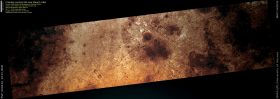
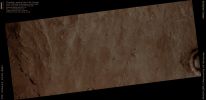
Potential MSL Landing Site near Mawrth Vallis (MULTISPECTRUM; credits: Lunexit)
Mawrth Vallis contains clay minerals that formed by chemical alteration of rocks by water. It is one of the short list of potential sites that the Mars Science Laboratory Rover will land at, and the HiRISE team is working to find a safe place to land in this area. 

This observation shows a wide variety of scientifically interesting terrains as well as some potential hazards for landing. The central part of the image is dominated by light-toned materials with curving fractures of many different sizes. These fractures do not have a preferred orientation, indicating that they did not form in response to some regional stress pattern.

Instead, they formed by some more uniform process, possibly the drying of a thick mud deposit or the gradual rebound of the area as the overlying material was eroded away. The scattered mounds and sand dunes may or may not prove to be a danger, but it is reassuring to see that many of the impact craters have been smoothed out with a filling of wind-blown sand.
Parole chiave: Mars from orbit - Mawrth Vallis

Potential MSL Landing Site near Mawrth Vallis (MULTISPECTRUM; credits: Lunexit)

Mawrth Vallis contains clay minerals that formed by chemical alteration of rocks by water. It is one of the short list of potential sites that the Mars Science Laboratory Rover will land at, and the HiRISE team is working to find a safe place to land in this area.

This observation shows a wide variety of scientifically interesting terrains as well as some potential hazards for landing. The central part of the image is dominated by light-toned materials with curving fractures of many different sizes. These fractures do not have a preferred orientation, indicating that they did not form in response to some regional stress pattern.

Instead, they formed by some more uniform process, possibly the drying of a thick mud deposit or the gradual rebound of the area as the overlying material was eroded away. The scattered mounds and sand dunes may or may not prove to be a danger, but it is reassuring to see that many of the impact craters have been smoothed out with a filling of wind-blown sand.

PSP_006573_1560_RED_abrowse-PCF-LXTT.jpg PSP_006588_1615_RED_abrowse-PCF-LXTT.jpg PSP_006610_2035_RED_abrowse~0.jpg PSP_006625_1405_RED_abrowse-00-PCF-LXTT.jpg PSP_006633_2010_RED_abrowse~0.jpg
Informazioni sul file
Nome del file:PSP_006610_2035_RED_abrowse~0.jpg
Nome album:MareKromium / Mars Reconnaissance Orbiter (MRO)
Valutazione (3 voti):55555(Mostra dettagli)
Parole chiave:Mars / from / orbit / - / Mawrth / Vallis
Copyright:NASA/JPL/Univ. of Arizona e Lunar Explorer Italia per il processing addizionale e la colorizzazione
Dimensione del file:1857 KiB
Data di inserimento:Feb 18, 2009
Dimensioni:6000 x 2142 pixels
Visualizzato:54 volte
URL:https://www.lunexit.it/gallery/displayimage.php?pid=23664
Preferiti:Aggiungi ai preferiti


Powered by Coppermine Photo Gallery