Inizio Registrati Login

Elenco album Ultimi arrivi Ultimi commenti Più viste Più votate Preferiti Cerca

Inizio > MARS > Mars Reconnaissance Orbiter (MRO)
Ritorna alla pagina delle miniature FILE 1620/2237 Torna all'inizio Guarda foto precedente Guarda foto successiva Salta alla fine
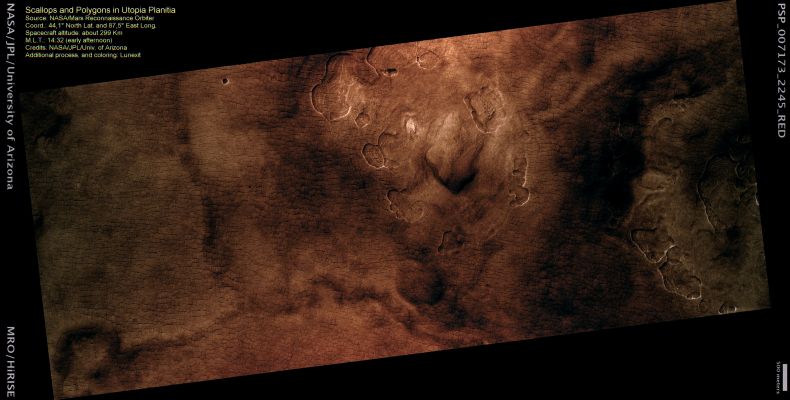
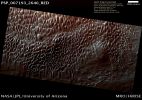
Scallops and Polygons in the Utopia Planitia Region (context frame - MULTISPECTRUM; credits: Lunexit)
This image shows a portion of the Utopia Planitia, marked by polygonal features bounded by cracks and depressions in the mantle that possess scalloped edges. 

Scalloped pits are typical features of the Martian mid-latitude mantle. Their presence has led to hypotheses of the removal of subsurface material, possibly interstitial ice, by sublimation (ice going directly from the solid state to the gas state). Their formation most likely involves development of oval- to scalloped-shaped depressions that may coalesce together, leading to the formation of large areas of pitted terrain. Scalloped pits typically have a steep pole-facing scarp and a gentler equator-facing slope. 

On the surface surrounding the scalloped depressions is a polygonal pattern of fractures. This is commonly associated with scalloped terrain, and indicates that the surface has undergone stress, potentially caused by subsidence (sinking), desiccation (drying out), or thermal contraction. These polygon features are similar to permafrost polygons that form in polar and high alpine regions on Earth by seasonal-to-annual contraction of the subsoil. On Earth, such polygon features are indicative of the presence of ground ice.
Parole chiave: Mars from orbit - Scallops and Polygons

Scallops and Polygons in the Utopia Planitia Region (context frame - MULTISPECTRUM; credits: Lunexit)

This image shows a portion of the Utopia Planitia, marked by polygonal features bounded by cracks and depressions in the mantle that possess scalloped edges.

Scalloped pits are typical features of the Martian mid-latitude mantle. Their presence has led to hypotheses of the removal of subsurface material, possibly interstitial ice, by sublimation (ice going directly from the solid state to the gas state). Their formation most likely involves development of oval- to scalloped-shaped depressions that may coalesce together, leading to the formation of large areas of pitted terrain. Scalloped pits typically have a steep pole-facing scarp and a gentler equator-facing slope.

On the surface surrounding the scalloped depressions is a polygonal pattern of fractures. This is commonly associated with scalloped terrain, and indicates that the surface has undergone stress, potentially caused by subsidence (sinking), desiccation (drying out), or thermal contraction. These polygon features are similar to permafrost polygons that form in polar and high alpine regions on Earth by seasonal-to-annual contraction of the subsoil. On Earth, such polygon features are indicative of the presence of ground ice.

PSP_007162_1915_RED_abrowse.jpg PSP_007166_1740_RED_abrowse-00~0.jpg PSP_007173_2245_RED_abrowse-00~0.jpg PSP_007173_2245_RED_abrowse-01.jpg PSP_007193_2640_RED_abrowse-00~0.jpg
Informazioni sul file
Nome del file:PSP_007173_2245_RED_abrowse-00~0.jpg
Nome album:MareKromium / Mars Reconnaissance Orbiter (MRO)
Valutazione (3 voti):55555(Mostra dettagli)
Parole chiave:Mars / from / orbit / - / Scallops / and / Polygons
Copyright:NASA/JPL/Univ. of Arizona e Lunar Explorer Italia per il processing addizionale e la colorizzazione
Dimensione del file:1590 KiB
Data di inserimento:Feb 17, 2009
Dimensioni:4500 x 2278 pixels
Visualizzato:57 volte
URL:https://www.lunexit.it/gallery/displayimage.php?pid=23653
Preferiti:Aggiungi ai preferiti


Powered by Coppermine Photo Gallery