Inizio Registrati Login

Elenco album Ultimi arrivi Ultimi commenti Più viste Più votate Preferiti Cerca

Inizio > MARS > Mars Reconnaissance Orbiter (MRO)
Ritorna alla pagina delle miniature FILE 1570/2237 Torna all'inizio Guarda foto precedente Guarda foto successiva Salta alla fine
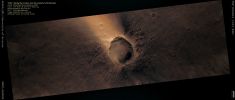
Peri-Equatorial "Sand-Patches" on a Crater Floor (MULTISPECTRUM; credits: Lunexit)
This image shows part of the floor of a large crater in Arabia Terra, near Mars’ Equator. A notable feature on this crater floor is a region of "Dark Patches" up to about 100 mt (330 feet) across. These Dark Patches sit in an area of connected small ridges and spurs and bury them, filling in the low areas and piling up. In several places light ridge crests protrude through the dark material. 
The dark patches appear to be collections of wind-blown sand. Sand on Mars is often dark, likely because it is fragments of a volcanic rock called basalt. (Sand on Earth is most often light-toned quartz). Sand may tend to collect in patches that can ultimately evolve into large dunes if more sand gathers. The patches of sand here are not big enough to form such large structures, but small-scale regular texture due to blowing wind is visible on the surface. 
The relatively dark tone which can be seen around the Sand Patches (compared with the surrounding material) is probably due to small amounts of additional sand. In some places this collects at the bottom of troughs.
Parole chiave: Mars from orbit - Sand-Patches

Peri-Equatorial "Sand-Patches" on a Crater Floor (MULTISPECTRUM; credits: Lunexit)

This image shows part of the floor of a large crater in Arabia Terra, near Mars’ Equator. A notable feature on this crater floor is a region of "Dark Patches" up to about 100 mt (330 feet) across. These Dark Patches sit in an area of connected small ridges and spurs and bury them, filling in the low areas and piling up. In several places light ridge crests protrude through the dark material.
The dark patches appear to be collections of wind-blown sand. Sand on Mars is often dark, likely because it is fragments of a volcanic rock called basalt. (Sand on Earth is most often light-toned quartz). Sand may tend to collect in patches that can ultimately evolve into large dunes if more sand gathers. The patches of sand here are not big enough to form such large structures, but small-scale regular texture due to blowing wind is visible on the surface.
The relatively dark tone which can be seen around the Sand Patches (compared with the surrounding material) is probably due to small amounts of additional sand. In some places this collects at the bottom of troughs.

PSP_006770_1760_RED_abrowse-01.jpg PSP_006806_2215_RED_abrowse~0.jpg PSP_006820_1760_RED_abrowse~0.jpg PSP_006841_1935_RED_abrowse~0.jpg PSP_006891_1970_RED_abrowse-01.jpg
Informazioni sul file
Nome del file:PSP_006820_1760_RED_abrowse~0.jpg
Nome album:MareKromium / Mars Reconnaissance Orbiter (MRO)
Valutazione (4 voti):55555(Mostra dettagli)
Parole chiave:Mars / from / orbit / - / Sand-Patches
Copyright:NASA/JPL/Univ. of Arizona e Lunar Explorer Italia per il processing addizionale e la colorizzazione
Dimensione del file:1011 KiB
Data di inserimento:Feb 17, 2009
Dimensioni:4401 x 2449 pixels
Visualizzato:56 volte
URL:https://www.lunexit.it/gallery/displayimage.php?pid=23648
Preferiti:Aggiungi ai preferiti


Powered by Coppermine Photo Gallery