Inizio Registrati Login

Elenco album Ultimi arrivi Ultimi commenti Più viste Più votate Preferiti Cerca

Inizio > MARS > Mars Reconnaissance Orbiter (MRO)
Ritorna alla pagina delle miniature FILE 1534/2237 Torna all'inizio Guarda foto precedente Guarda foto successiva Salta alla fine
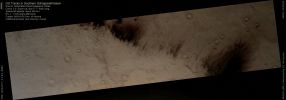
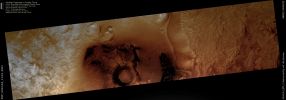
Aeolian Features in Arabia Terra (MULTISPECTRUM; credits: Lunexit)
This observation shows part of the floor of a large impact crater in Arabia Terra. This crater formed in the distant past when a large asteroid or comet struck Mars, and it has been heavily modified since formation. 
The crater was partially filled by sediments, forming the rock outcrops and layers visible in this image. 
After this material was laid down, part of the deposits were eroded away. The central part of the image has been carved especially deeply, forming a distinct depression. 
This depression has been a site of aeolian transport of sand in more recent times. A particularly interesting aspect of this site is that there appears to have been multiple styles of aeolian activity. Both large sand dunes (the dark hills) and smaller ripples (sharp, light-toned narrow ridges) are visible. 
While ripples are often found in association with dunes, the different colors suggest that the material is not the same.
(At full resolution, the surfaces of both the dunes and the large ripples are covered with much smaller ripples) 

Even where the ripples and dunes are in contact, there is a distinct contrast between the materials: dark sand appears to fill a trough between two large light ripples, suggesting that the dark sand has moved more recently. This could be due to different grain sizes, since certain sizes are most easily lifted by the wind.
Parole chiave: Mars from orbit - Dunes - Arabia Terra

Aeolian Features in Arabia Terra (MULTISPECTRUM; credits: Lunexit)

This observation shows part of the floor of a large impact crater in Arabia Terra. This crater formed in the distant past when a large asteroid or comet struck Mars, and it has been heavily modified since formation.
The crater was partially filled by sediments, forming the rock outcrops and layers visible in this image.
After this material was laid down, part of the deposits were eroded away. The central part of the image has been carved especially deeply, forming a distinct depression.
This depression has been a site of aeolian transport of sand in more recent times. A particularly interesting aspect of this site is that there appears to have been multiple styles of aeolian activity. Both large sand dunes (the dark hills) and smaller ripples (sharp, light-toned narrow ridges) are visible.
While ripples are often found in association with dunes, the different colors suggest that the material is not the same.
(At full resolution, the surfaces of both the dunes and the large ripples are covered with much smaller ripples)

Even where the ripples and dunes are in contact, there is a distinct contrast between the materials: dark sand appears to fill a trough between two large light ripples, suggesting that the dark sand has moved more recently. This could be due to different grain sizes, since certain sizes are most easily lifted by the wind.

PSP_006477_1745_RED_abrowse-PCF-LXTT.jpg PSP_006487_1580_RED.jpg PSP_006504_1910_RED_abrowse-00~0.jpg PSP_006528_1120_RED_abrowse-00~0.jpg PSP_006528_1120_RED_abrowse-01.jpg
Informazioni sul file
Nome del file:PSP_006504_1910_RED_abrowse-00~0.jpg
Nome album:MareKromium / Mars Reconnaissance Orbiter (MRO)
Valutazione (4 voti):55555(Mostra dettagli)
Parole chiave:Mars / from / orbit / - / Dunes / - / Arabia / Terra
Copyright:NASA/JPL/Univ. of Arizona e Lunar Explorer Italia per il processing addizionale e la colorizzazione
Dimensione del file:1459 KiB
Data di inserimento:Dic 20, 2008
Dimensioni:6301 x 2203 pixels
Visualizzato:62 volte
URL:https://www.lunexit.it/gallery/displayimage.php?pid=22937
Preferiti:Aggiungi ai preferiti


Powered by Coppermine Photo Gallery