Inizio Registrati Login

Elenco album Ultimi arrivi Ultimi commenti Più viste Più votate Preferiti Cerca

Inizio > MARS > Mars Reconnaissance Orbiter (MRO)
Ritorna alla pagina delle miniature FILE 1878/2237 Torna all'inizio Guarda foto precedente Guarda foto successiva Salta alla fine
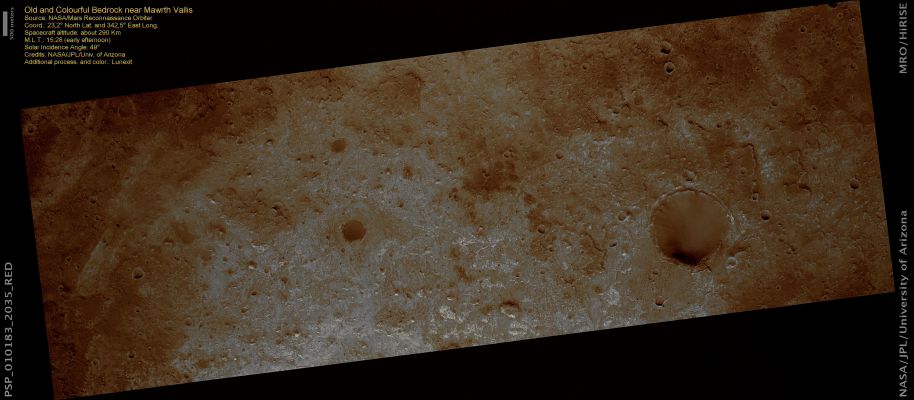
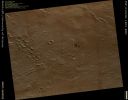
Colourful old Bedrock near Mawrth Vallis (possible True Colors; credits: Lunexit)
This image covers part of a proposed Rover Landing Site in the Mawrth Vallis Region of Mars. 

Polygonal fracture patterns (similar to a tiled floor) are visible on the surfaces of some of these rocks, and yellow/brown ridges protruding from the Surface may be composed of hard minerals or cemented sediments formed when water flowed through fractures in the ancient Bedrock. Dark gray-bluish dunes or ripples of wind-blown sand are also visible on the Surface here.

Elsewhere in the image, exposures of the light-toned rocks in the steep walls of impact craters reveal that these rocks are finely layered, similar to sedimentary rocks on Earth. The orbiting Infrared Spectrometers OMEGA and CRISM have demonstrated that these layered rocks contain Clay (---> argilla/minerali argillosi) minerals, which can only form in the presence of water. 
The different colors of the rocks typically reflect differences in composition, suggesting that multiple styles or episodes of water activity may be recorded in the rock record here.

These characteristics have made Mawrth Vallis a prime candidate Landing Site for future Mars Rover Missions, including NASA’s Mars Science Laboratory due to launch in 2009.
Parole chiave: Mars from orbit - Mawrth Vallis Region

Colourful old Bedrock near Mawrth Vallis (possible True Colors; credits: Lunexit)

This image covers part of a proposed Rover Landing Site in the Mawrth Vallis Region of Mars.

Polygonal fracture patterns (similar to a tiled floor) are visible on the surfaces of some of these rocks, and yellow/brown ridges protruding from the Surface may be composed of hard minerals or cemented sediments formed when water flowed through fractures in the ancient Bedrock. Dark gray-bluish dunes or ripples of wind-blown sand are also visible on the Surface here.

Elsewhere in the image, exposures of the light-toned rocks in the steep walls of impact craters reveal that these rocks are finely layered, similar to sedimentary rocks on Earth. The orbiting Infrared Spectrometers OMEGA and CRISM have demonstrated that these layered rocks contain Clay (---> argilla/minerali argillosi) minerals, which can only form in the presence of water.
The different colors of the rocks typically reflect differences in composition, suggesting that multiple styles or episodes of water activity may be recorded in the rock record here.

These characteristics have made Mawrth Vallis a prime candidate Landing Site for future Mars Rover Missions, including NASA’s Mars Science Laboratory due to launch in 2009.

PSP_010180_2645_RED_abrowse-00.jpg PSP_010180_2645_RED_abrowse-01.jpg PSP_010183_2035_RED_abrowse-00.jpg PSP_010198_2645_RED.jpg PSP_010200_1805_RED_abrowse-00.jpg
Informazioni sul file
Nome del file:PSP_010183_2035_RED_abrowse-00.jpg
Nome album:MareKromium / Mars Reconnaissance Orbiter (MRO)
Valutazione (3 voti):55555(Mostra dettagli)
Parole chiave:Mars / from / orbit / - / Mawrth / Vallis / Region
Copyright:NASA/JPL/Univ. of Arizona e Lunar Explorer Italia per il processing addizionale e la colorizzazione
Dimensione del file:1635 KiB
Data di inserimento:Nov 20, 2008
Dimensioni:5251 x 2297 pixels
Visualizzato:55 volte
URL:https://www.lunexit.it/gallery/displayimage.php?pid=22600
Preferiti:Aggiungi ai preferiti


Powered by Coppermine Photo Gallery