Inizio Registrati Login

Elenco album Ultimi arrivi Ultimi commenti Più viste Più votate Preferiti Cerca

Inizio > MARS > Mars Reconnaissance Orbiter (MRO)
Ritorna alla pagina delle miniature FILE 1888/2237 Torna all'inizio Guarda foto precedente Guarda foto successiva Salta alla fine
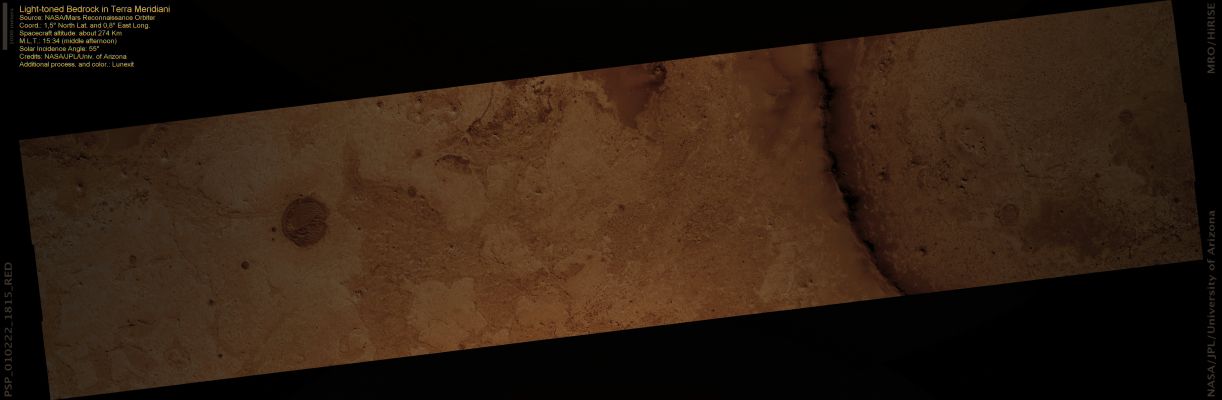
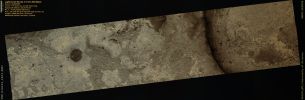
Light-toned Bedrock in Terra Meridiani (possible True Colors; credits: Lunexit)
This observation shows part of a broad expanse of bare rock in Terra Meridiani. This is a large area with abundant sedimentary rocks forming a stack hundreds of meters thick, and now being eroded into a landscape reminiscent of the South-Western United States. 

The timescale involved in depositing and eroding these layers is evident from the remnant impact craters preserved here. The large arc in the image is the rim of one crater; the smaller, circular dark spots are traces of other impacts. Light sediments are found both inside and outside the large crater, indicating that this crater formed during the period of sediment deposition. It is likely that this depression, which was probably more than a kilometer deep when it formed, was completely filled and buried and is now being exhumed. Crater densities are often used to estimate the age of surfaces on Mars, but here the rate of erosion is enough to erase small craters, reducing the apparent age of the surface. These rocks probably date from an early era of Martian History, but no fresh, pristine craters are visible. 
The smaller circular patches are also impact craters seen somewhere in a complex cycle of burial and erosion. They are filled with dark material which probably mantled the region at one point, most likely after all of the light material was deposited. In some places this appears to have been hardened into rock, as in the large dark circle in the north-central part of the image. Material eroded from this hardened mantle may now be forming the ripples seen in many places as it is blown by the wind; the color of the ripples is similar to the slabs of dark mantle. 

At the finest scale, the light sediments are intricately textured. A diverse assortment of fine cracks called joints are visible. The scale and density of these joints varies across the image; this suggests variations in the properties of the rocks. Although the image as a whole is a relatively flat plain, at small scale the surface is intricately rough. The balance between erosion and rock strength has left a surface with many small knobs, mesas, cliffs, and bumpy textures. 

Further evidence for the diversity of rocks here comes from the enhanced color. The dark mantling materials are generally blue in the RGB color image while the sediments are generally pale, but a diverse range of hues indicates variations in the composition (or in the amount of sand and dust trapped on the surface by textures of varying roughness). This helps to highlight layering and shows which rocks are most similar to each other.
Parole chiave: Mars from orbit - Meridiani Planum Region

Light-toned Bedrock in Terra Meridiani (possible True Colors; credits: Lunexit)

This observation shows part of a broad expanse of bare rock in Terra Meridiani. This is a large area with abundant sedimentary rocks forming a stack hundreds of meters thick, and now being eroded into a landscape reminiscent of the South-Western United States.

The timescale involved in depositing and eroding these layers is evident from the remnant impact craters preserved here. The large arc in the image is the rim of one crater; the smaller, circular dark spots are traces of other impacts. Light sediments are found both inside and outside the large crater, indicating that this crater formed during the period of sediment deposition. It is likely that this depression, which was probably more than a kilometer deep when it formed, was completely filled and buried and is now being exhumed. Crater densities are often used to estimate the age of surfaces on Mars, but here the rate of erosion is enough to erase small craters, reducing the apparent age of the surface. These rocks probably date from an early era of Martian History, but no fresh, pristine craters are visible.
The smaller circular patches are also impact craters seen somewhere in a complex cycle of burial and erosion. They are filled with dark material which probably mantled the region at one point, most likely after all of the light material was deposited. In some places this appears to have been hardened into rock, as in the large dark circle in the north-central part of the image. Material eroded from this hardened mantle may now be forming the ripples seen in many places as it is blown by the wind; the color of the ripples is similar to the slabs of dark mantle.

At the finest scale, the light sediments are intricately textured. A diverse assortment of fine cracks called joints are visible. The scale and density of these joints varies across the image; this suggests variations in the properties of the rocks. Although the image as a whole is a relatively flat plain, at small scale the surface is intricately rough. The balance between erosion and rock strength has left a surface with many small knobs, mesas, cliffs, and bumpy textures.

Further evidence for the diversity of rocks here comes from the enhanced color. The dark mantling materials are generally blue in the RGB color image while the sediments are generally pale, but a diverse range of hues indicates variations in the composition (or in the amount of sand and dust trapped on the surface by textures of varying roughness). This helps to highlight layering and shows which rocks are most similar to each other.

PSP_010221_1420_RED_abrowse-00.jpg PSP_010221_1420_RED_abrowse-01.jpg PSP_010222_1815_RED.jpg PSP_010222_1815_RED_abrowse.jpg PSP_010252_2550_RED-PCF-LXTT.jpg
Informazioni sul file
Nome del file:PSP_010222_1815_RED.jpg
Nome album:MareKromium / Mars Reconnaissance Orbiter (MRO)
Valutazione (5 voti):55555(Mostra dettagli)
Parole chiave:Mars / from / orbit / - / Meridiani / Planum / Region
Copyright:NASA/JPL/Univ. of Arizona e Lunar Explorer Italia per il processing addizionale e la colorizzazione
Dimensione del file:1115 KiB
Data di inserimento:Nov 20, 2008
Dimensioni:6600 x 2160 pixels
Visualizzato:54 volte
URL:https://www.lunexit.it/gallery/displayimage.php?pid=22591
Preferiti:Aggiungi ai preferiti


Powered by Coppermine Photo Gallery