Inizio Registrati Login

Elenco album Ultimi arrivi Ultimi commenti Più viste Più votate Preferiti Cerca

Inizio > MARS > Mars Reconnaissance Orbiter (MRO)
Ritorna alla pagina delle miniature FILE 1868/2237 Torna all'inizio Guarda foto precedente Guarda foto successiva Salta alla fine
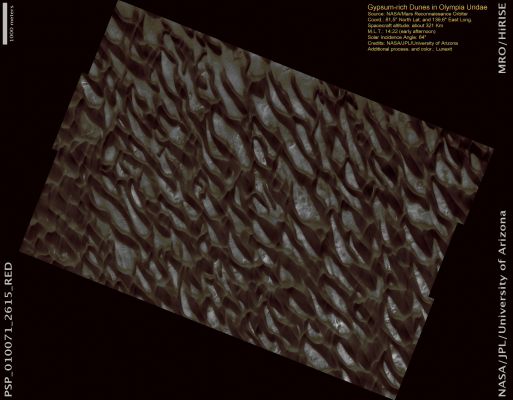
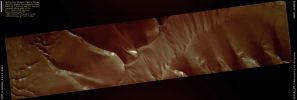
Gypsum-rich Dunes in Olympia Undae Region (natural colors; credits: Lunexit)
In this enhanced-natural color image are dunes within the largest collection of dunes on Mars, Olympia Undae, near the margin of the North Polar Layered Deposits, Planum Boreum. 
This section of Olympia Undae is particularly interesting because the dunes are rich in Gypsum (---> Gesso), a mineral that forms in the presence of water. The material comprising these dunes is thought to have eroded from geologic units near the base of the NPLD, but these units have poor to no gypsum content. 
Therefore, water likely affected these dunes after the sand had eroded out from the NPLD. Several ideas have been proposed to explain the formation of Gypsum, including hydrothermal (hot water) activity and melting of water-ice in the NPLD.
While gypsum dunes on Earth (for example, at White Sands, New Mexico) are white (the color of Gypsum), these Martian Dunes are dark due to the presence of basaltic grains that lower the brightness of the dunes. 
CRISM, another instrument on MRO, has found that the crests of the dunes are the most Gypsum-rich. So, what is the bright, polygonally-fractured material in the low spaces between the dunes? 
Perhaps it is Polar Ice lying beneath, desiccated (dried) gypsum material whose fine grain size makes it difficult for CRISM to detect, or something else altogether.
Parole chiave: Mars from orbit - North Polar Regions - Dunes

Gypsum-rich Dunes in Olympia Undae Region (natural colors; credits: Lunexit)

In this enhanced-natural color image are dunes within the largest collection of dunes on Mars, Olympia Undae, near the margin of the North Polar Layered Deposits, Planum Boreum.
This section of Olympia Undae is particularly interesting because the dunes are rich in Gypsum (---> Gesso), a mineral that forms in the presence of water. The material comprising these dunes is thought to have eroded from geologic units near the base of the NPLD, but these units have poor to no gypsum content.
Therefore, water likely affected these dunes after the sand had eroded out from the NPLD. Several ideas have been proposed to explain the formation of Gypsum, including hydrothermal (hot water) activity and melting of water-ice in the NPLD.
While gypsum dunes on Earth (for example, at White Sands, New Mexico) are white (the color of Gypsum), these Martian Dunes are dark due to the presence of basaltic grains that lower the brightness of the dunes.
CRISM, another instrument on MRO, has found that the crests of the dunes are the most Gypsum-rich. So, what is the bright, polygonally-fractured material in the low spaces between the dunes?
Perhaps it is Polar Ice lying beneath, desiccated (dried) gypsum material whose fine grain size makes it difficult for CRISM to detect, or something else altogether.

PSP_010059_2580_RED.jpg PSP_010063_2135_RED.jpg PSP_010071_2615_RED.jpg PSP_010086_2615_RED.jpg PSP_010090_1255_RED.jpg
Informazioni sul file
Nome del file:PSP_010071_2615_RED.jpg
Nome album:MareKromium / Mars Reconnaissance Orbiter (MRO)
Valutazione (3 voti):55555(Mostra dettagli)
Parole chiave:Mars / from / orbit / - / North / Polar / Regions / - / Dunes
Copyright:NASA/JPL/Univ. of Arizona e Lunar Explorer Italia per il processing addizionale e la colorizzazione
Dimensione del file:880 KiB
Data di inserimento:Nov 13, 2008
Dimensioni:3500 x 2728 pixels
Visualizzato:58 volte
URL:https://www.lunexit.it/gallery/displayimage.php?pid=22512
Preferiti:Aggiungi ai preferiti


Powered by Coppermine Photo Gallery