Inizio Registrati Login

Elenco album Ultimi arrivi Ultimi commenti Più viste Più votate Preferiti Cerca

Inizio > MARS > Mars Reconnaissance Orbiter (MRO)
Ritorna alla pagina delle miniature FILE 1858/2237 Torna all'inizio Guarda foto precedente Guarda foto successiva Salta alla fine
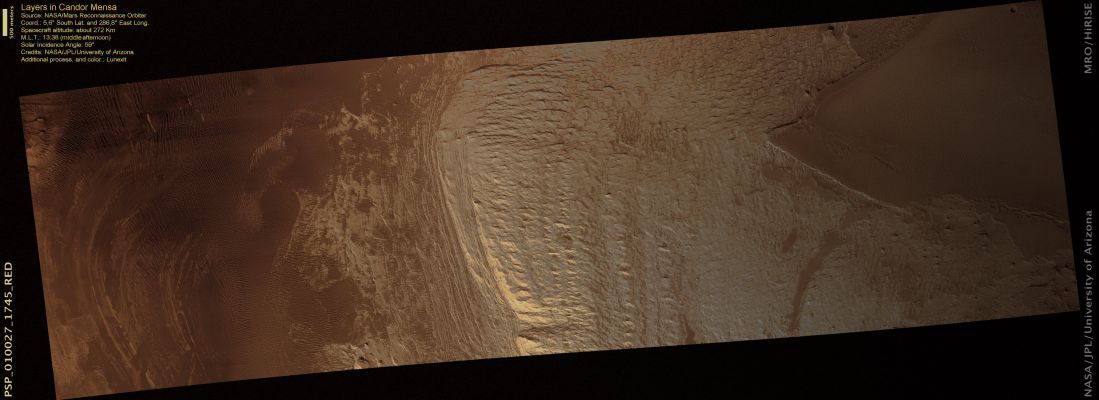
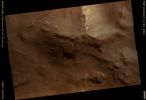
Layers in Candor Mensa (natural colors; credits: Lunexit)
This image shows Layered Sedimentary Deposits in Candor Mensa, a broad plateau of thickly stacked sedimentary rocks in Candor Chasma, part of the giant troughs of Valles Marineris.

Valles Marineris is a system of tectonic depressions formed by down-dropping faults; the floors are among the lowest points on the surface of Mars, and may have once held lakes. Some sites show evidence for streams or rivers. The troughs may have also been sites of volcanic activity. 
Currently, the deep floors contain massive deposits of bright sedimentary rocks. Some of the deposits are several kilometers thick, and have diverse composition and appearance. They were probably formed by many different processes in different environments. 
At this site, most of the bright rocks exhibit a scalloped, patterned texture. 
This is thought to be associated with low-density deposits undergoing wind erosion, although the process is still not well-understood. Despite this relatively uniform texture, some variations are evident. The Southern (left) part of the Deposit is relatively uniform, while the central portion appears to have thin layers. 
On close inspection, the layers near the center of the image are all composed of the same material; they are probably visible due to slight topographic steps caused by variations in the strength of the rock. The layers have been highlighted by a mantle of dark, wind-blown sand ripples, which cover the flat parts of the stepped structure. At low resolution, this gives the appearance of alternating light and dark layers. 
In the Northernmost part of the image (right), the sediments have an entirely different texture, ranging from massive to fractured. These sediments also show evidence of layering.

Interpretation of these sediments is complicated by younger mantling materials. In addition to the sand ripples (some of which may have hardened to rock), a relatively massive dark layer appears to cap or drape the deposit in many places, including the southern part of this image.
Parole chiave: Mars from orbit - Layers - Candor Mensa Region

Layers in Candor Mensa (natural colors; credits: Lunexit)

This image shows Layered Sedimentary Deposits in Candor Mensa, a broad plateau of thickly stacked sedimentary rocks in Candor Chasma, part of the giant troughs of Valles Marineris.

Valles Marineris is a system of tectonic depressions formed by down-dropping faults; the floors are among the lowest points on the surface of Mars, and may have once held lakes. Some sites show evidence for streams or rivers. The troughs may have also been sites of volcanic activity.
Currently, the deep floors contain massive deposits of bright sedimentary rocks. Some of the deposits are several kilometers thick, and have diverse composition and appearance. They were probably formed by many different processes in different environments.
At this site, most of the bright rocks exhibit a scalloped, patterned texture.
This is thought to be associated with low-density deposits undergoing wind erosion, although the process is still not well-understood. Despite this relatively uniform texture, some variations are evident. The Southern (left) part of the Deposit is relatively uniform, while the central portion appears to have thin layers.
On close inspection, the layers near the center of the image are all composed of the same material; they are probably visible due to slight topographic steps caused by variations in the strength of the rock. The layers have been highlighted by a mantle of dark, wind-blown sand ripples, which cover the flat parts of the stepped structure. At low resolution, this gives the appearance of alternating light and dark layers.
In the Northernmost part of the image (right), the sediments have an entirely different texture, ranging from massive to fractured. These sediments also show evidence of layering.

Interpretation of these sediments is complicated by younger mantling materials. In addition to the sand ripples (some of which may have hardened to rock), a relatively massive dark layer appears to cap or drape the deposit in many places, including the southern part of this image.

PSP_010017_1460_RED.jpg PSP_010025_1410_RED.jpg PSP_010027_1745_RED.jpg PSP_010040_2640_RED~0.jpg PSP_010047_1745_RED-00.jpg
Informazioni sul file
Nome del file:PSP_010027_1745_RED.jpg
Nome album:MareKromium / Mars Reconnaissance Orbiter (MRO)
Valutazione (2 voti):55555(Mostra dettagli)
Parole chiave:Mars / from / orbit / - / Layers / - / Candor / Mensa / Region
Copyright:NASA/JPL/Univ. of Arizona e Lunar Explorer Italia per il processing addizionale e la colorizzazione
Dimensione del file:1870 KiB
Data di inserimento:Nov 13, 2008
Dimensioni:6000 x 2182 pixels
Visualizzato:54 volte
URL:https://www.lunexit.it/gallery/displayimage.php?pid=22510
Preferiti:Aggiungi ai preferiti


Powered by Coppermine Photo Gallery