Inizio Registrati Login

Elenco album Ultimi arrivi Ultimi commenti Più viste Più votate Preferiti Cerca

Inizio > MARS > Mars Reconnaissance Orbiter (MRO)
Ritorna alla pagina delle miniature FILE 1809/2237 Torna all'inizio Guarda foto precedente Guarda foto successiva Salta alla fine
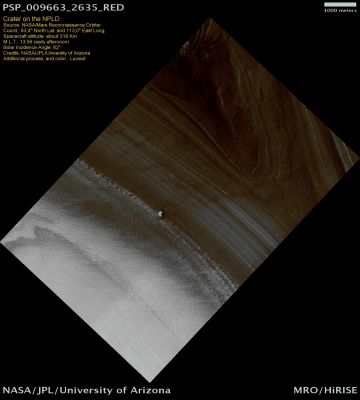
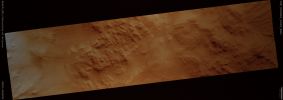
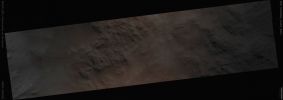
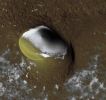
Small Crater on the North Polar Layered Deposits (CTX Frame - Saturated and Enhanced Natural Colors; credits for the additional process. and color.: Dr Paolo C. Fienga - Lunexit Team) 
The North Polar Layered Deposits, and the bright Ice Cap that covers them, are very young (by geologic standards) features. To try and figure out the age of an area, or how quickly it's being resurfaced, planetary scientists count up the number of craters at different sizes. An older surface has more time to accumulate more craters whereas a younger surface, or one that has a lot of geologic activity that destroys craters, doesn't have many impact craters. 

These Polar Deposits have a very low crater count so it is possible that the Ice Cap (bright white in this image) might only by about 10.000 years old and the surface of the layered deposits (orange-brown in this image) may be only a few million years old. 
This sounds like a long time but is very short compared to other surfaces on Mars.

HiRISE is enabling a more detailed study of these Polar Craters and the target of this observation is visible in the center of the image.
Parole chiave: Mars from orbit - North Polar Features - NPLD

Small Crater on the North Polar Layered Deposits (CTX Frame - Saturated and Enhanced Natural Colors; credits for the additional process. and color.: Dr Paolo C. Fienga - Lunexit Team)

The North Polar Layered Deposits, and the bright Ice Cap that covers them, are very young (by geologic standards) features. To try and figure out the age of an area, or how quickly it's being resurfaced, planetary scientists count up the number of craters at different sizes. An older surface has more time to accumulate more craters whereas a younger surface, or one that has a lot of geologic activity that destroys craters, doesn't have many impact craters.

These Polar Deposits have a very low crater count so it is possible that the Ice Cap (bright white in this image) might only by about 10.000 years old and the surface of the layered deposits (orange-brown in this image) may be only a few million years old.
This sounds like a long time but is very short compared to other surfaces on Mars.

HiRISE is enabling a more detailed study of these Polar Craters and the target of this observation is visible in the center of the image.

PSP_009660_2020_RED.jpg PSP_009660_2020_RED~0.jpg PSP_009663_2635_RED-00.jpg PSP_009663_2635_RED-01.jpg PSP_009696_2575_RED.JPG
Informazioni sul file
Nome del file:PSP_009663_2635_RED-00.jpg
Nome album:MareKromium / Mars Reconnaissance Orbiter (MRO)
Valutazione (6 voti):55555(Mostra dettagli)
Parole chiave:Mars / from / orbit / - / North / Polar / Features / - / NPLD
Copyright:NASA/JPL/Univ. of Arizona e Lunar Explorer Italia per il processing addizionale e la colorizzazione
Dimensione del file:740 KiB
Data di inserimento:Ott 17, 2008
Dimensioni:2707 x 3000 pixels
Visualizzato:54 volte
URL:https://www.lunexit.it/gallery/displayimage.php?pid=22201
Preferiti:Aggiungi ai preferiti


Powered by Coppermine Photo Gallery