Inizio Registrati Login

Elenco album Ultimi arrivi Ultimi commenti Più viste Più votate Preferiti Cerca

Inizio > MARS > Mars Reconnaissance Orbiter (MRO)
Ritorna alla pagina delle miniature FILE 1799/2237 Torna all'inizio Guarda foto precedente Guarda foto successiva Salta alla fine
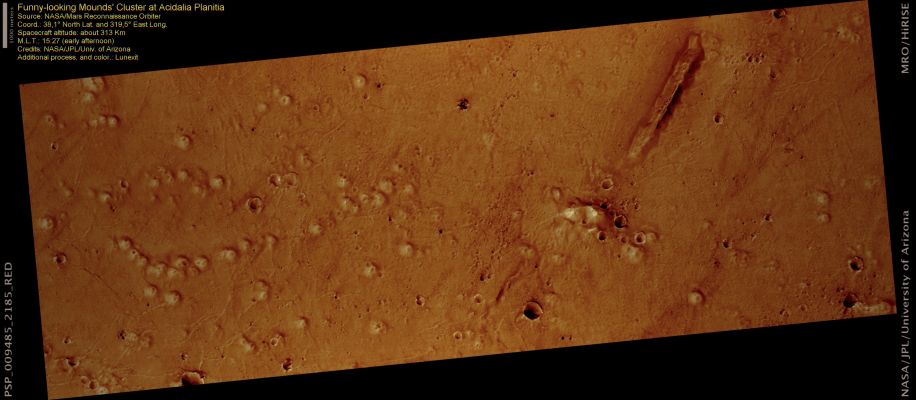
Clusters of Mounds at Acidalia Planitia (Extremely Enhanced and Saturated Natural Colors; credits for the additional process. and color.: Dr Paolo C. Fienga - Lunexit Team)
This HiRISE image shows clusters of light-colored Mounds poking through the Dark Plains of Acidalia. These Mounds are similar in shape and color to mounds identified elsewhere in the Northern Lowlands.

The mounds imaged here are approximately 250 meters (270 yards) across, and most of them have one or more central crater-like depressed areas, looking like terrestrial cinder cones. Terrestrial cinder cones are formed by loose volcanic fragments, mostly gravel- and boulder-size. In contrast, the surface of these Martian Mounds looks cemented rather than bouldery.
There are several hypothesis to explain the origin of these Martian Mounds; all of them require the presence of fluids near or at the surface. 
One hypothesis is that these mounds are Hydrothermal Spring edifices like those at Yellowstone. Terrestrial Hydrothermal Spring Mounds form when hot subsurface fluids, loaded with minerals, reach the surface and deposit their load.
Another possible explanation is that these Mounds are "Mud Volcanoes", similar to those found at Trinidad and Tobago. Mud Volcanism occurs when buried wet sediments are subject to high pressures and squeeze out though weak points at the surface.

Some terrestrial "Pseudocraters" are also similar to these Martian Mounds. Pseudocraters form when lava flows over wet terrains or over water bodies. The lava’s heat vaporizes the fluids, which then burst through the lava, producing small explosions and building conical landforms.
Parole chiave: Mars from orbit - Acidalia Planitia Region

Clusters of Mounds at Acidalia Planitia (Extremely Enhanced and Saturated Natural Colors; credits for the additional process. and color.: Dr Paolo C. Fienga - Lunexit Team)

This HiRISE image shows clusters of light-colored Mounds poking through the Dark Plains of Acidalia. These Mounds are similar in shape and color to mounds identified elsewhere in the Northern Lowlands.

The mounds imaged here are approximately 250 meters (270 yards) across, and most of them have one or more central crater-like depressed areas, looking like terrestrial cinder cones. Terrestrial cinder cones are formed by loose volcanic fragments, mostly gravel- and boulder-size. In contrast, the surface of these Martian Mounds looks cemented rather than bouldery.
There are several hypothesis to explain the origin of these Martian Mounds; all of them require the presence of fluids near or at the surface.
One hypothesis is that these mounds are Hydrothermal Spring edifices like those at Yellowstone. Terrestrial Hydrothermal Spring Mounds form when hot subsurface fluids, loaded with minerals, reach the surface and deposit their load.
Another possible explanation is that these Mounds are "Mud Volcanoes", similar to those found at Trinidad and Tobago. Mud Volcanism occurs when buried wet sediments are subject to high pressures and squeeze out though weak points at the surface.

Some terrestrial "Pseudocraters" are also similar to these Martian Mounds. Pseudocraters form when lava flows over wet terrains or over water bodies. The lava’s heat vaporizes the fluids, which then burst through the lava, producing small explosions and building conical landforms.

PSP_009460_1745_RED_abrowse-00.jpg PSP_009470_1965_RED_abrowse.jpg PSP_009485_2185_red.jpg PSP_009488_1745_RED_abrowse-00.jpg PSP_009488_1745_RED_abrowse-01.jpg
Informazioni sul file
Nome del file:PSP_009485_2185_red.jpg
Nome album:MareKromium / Mars Reconnaissance Orbiter (MRO)
Valutazione (6 voti):55555(Mostra dettagli)
Parole chiave:Mars / from / orbit / - / Acidalia / Planitia / Region
Copyright:NASA/JPL/Univ. of Arizona e Lunar Explorer Italia per il processing addizionale e la colorizzazione
Dimensione del file:998 KiB
Data di inserimento:Set 25, 2008
Dimensioni:4694 x 2048 pixels
Visualizzato:54 volte
URL:https://www.lunexit.it/gallery/displayimage.php?pid=21993
Preferiti:Aggiungi ai preferiti


Powered by Coppermine Photo Gallery