Inizio Registrati Login

Elenco album Ultimi arrivi Ultimi commenti Più viste Più votate Preferiti Cerca

Inizio > MARS > Mars Reconnaissance Orbiter (MRO)
Ritorna alla pagina delle miniature FILE 1751/2237 Torna all'inizio Guarda foto precedente Guarda foto successiva Salta alla fine
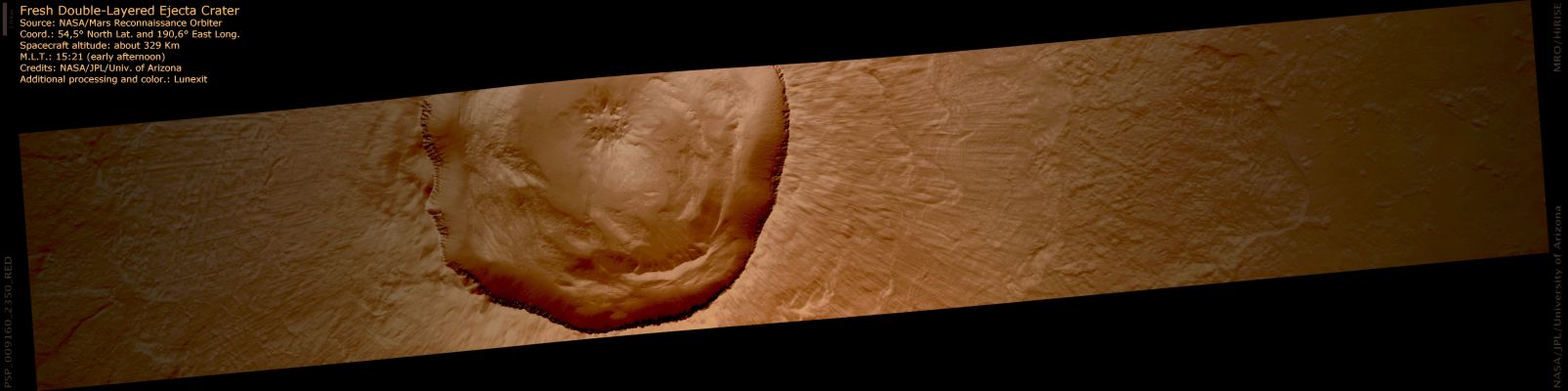
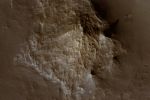
Fresh Double-Layered Ejecta Crater (natural colors; credits: Lunexit)
This scene features a High Latitude, Northern Hemisphere Crater with double-layered ejecta. The sharp rim and lack of small superposed craters indicates that this Crater is relatively young. 
The semi-circular feature that parallels the Crater Rim is a terrace that probably formed as part of the Crater wall collapsed into the center. The circular mound in the center likely formed at the same time as the Crater itself. 
Large craters on Mars can have central peaks; this Crater looks like it was on the cusp of having one. The linear features surrounding the Crater on its ejecta are striations that formed during the impact as material and wind exploded out from the center.

On the right side (Dx) of the scene, is a very distinct ejecta flow lobe (Lobate Ejecta). Lobate Ejecta is thought to form when an impact occurs on a surface with lots of volatiles — such as ices that quickly turn to gas when they are heated. The gases help make the ejecta flow like a fluid.
Parole chiave: Mars from orbit - Craters - Ejecta Crater

Fresh Double-Layered Ejecta Crater (natural colors; credits: Lunexit)

This scene features a High Latitude, Northern Hemisphere Crater with double-layered ejecta. The sharp rim and lack of small superposed craters indicates that this Crater is relatively young.
The semi-circular feature that parallels the Crater Rim is a terrace that probably formed as part of the Crater wall collapsed into the center. The circular mound in the center likely formed at the same time as the Crater itself.
Large craters on Mars can have central peaks; this Crater looks like it was on the cusp of having one. The linear features surrounding the Crater on its ejecta are striations that formed during the impact as material and wind exploded out from the center.

On the right side (Dx) of the scene, is a very distinct ejecta flow lobe (Lobate Ejecta). Lobate Ejecta is thought to form when an impact occurs on a surface with lots of volatiles — such as ices that quickly turn to gas when they are heated. The gases help make the ejecta flow like a fluid.

PSP_009155_1480_RED.jpg PSP_009156_1335_red_abrowse-PCF-LXTT.jpg PSP_009160_2350_RED.JPG PSP_009161_1450_RED-00.jpg PSP_009161_1450_RED-01.jpg
Informazioni sul file
Nome del file:PSP_009160_2350_RED.JPG
Nome album:MareKromium / Mars Reconnaissance Orbiter (MRO)
Valutazione (5 voti):55555(Mostra dettagli)
Parole chiave:Mars / from / orbit / - / Craters / - / Ejecta / Crater
Copyright:NASA/JPL/Univ. of Arizona e Lunar Explorer Italia per il processing addizionale e la colorizzazione
Dimensione del file:1276 KiB
Data di inserimento:Ago 21, 2008
Dimensioni:8221 x 2048 pixels
Visualizzato:54 volte
URL:https://www.lunexit.it/gallery/displayimage.php?pid=21519
Preferiti:Aggiungi ai preferiti


Powered by Coppermine Photo Gallery