Inizio Registrati Login

Elenco album Ultimi arrivi Ultimi commenti Più viste Più votate Preferiti Cerca

Inizio > MARS > Mars Reconnaissance Orbiter (MRO)
Ritorna alla pagina delle miniature FILE 1725/2237 Torna all'inizio Guarda foto precedente Guarda foto successiva Salta alla fine
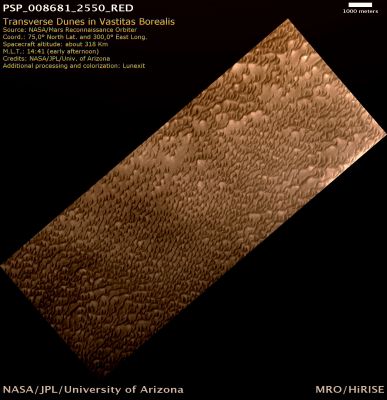
Transverse Dunes in Vastitas Borealis (natural colors; credits: Lunexit)
The Vastitas Borealis Region, or Northern Lowlands, is a large area of low-lying surface that surrounds Mars’ North Pole.

On average, the Region is 4-5 Km lower in elevation than the mean radius of the Planet. How this basin formed is not known, although researchers have postulated that it could have been the result of a very large-scale impact sometime in Mars’ distant past. As of this writing, it is Summer in the Martian Northern Hemisphere, allowing the HiRISE camera to image this Region in full sunlight.

The sinuous landforms are dunes composed of sand that is made of basalt (a volcanic rock) or gypsum (a hydrous sulfate). There is a transition of modified barchanoid (crescent shaped dunes, generally wider than they are long) and transverse chains into star dunes; the winds change a lot in this area. The orientation of the barchanoid and transverse dunes indicate that the winds that formed them blow from the East (right side of image). 
In some areas there are a few linear dunes. The light-toned, smaller bedforms are designated Transverse Aeolian Ridges (TARs). 


Parole chiave: Mars from orbit - Vastitas Borealis

Transverse Dunes in Vastitas Borealis (natural colors; credits: Lunexit)

The Vastitas Borealis Region, or Northern Lowlands, is a large area of low-lying surface that surrounds Mars’ North Pole.

On average, the Region is 4-5 Km lower in elevation than the mean radius of the Planet. How this basin formed is not known, although researchers have postulated that it could have been the result of a very large-scale impact sometime in Mars’ distant past. As of this writing, it is Summer in the Martian Northern Hemisphere, allowing the HiRISE camera to image this Region in full sunlight.

The sinuous landforms are dunes composed of sand that is made of basalt (a volcanic rock) or gypsum (a hydrous sulfate). There is a transition of modified barchanoid (crescent shaped dunes, generally wider than they are long) and transverse chains into star dunes; the winds change a lot in this area. The orientation of the barchanoid and transverse dunes indicate that the winds that formed them blow from the East (right side of image).
In some areas there are a few linear dunes. The light-toned, smaller bedforms are designated Transverse Aeolian Ridges (TARs).


PSP_008591_2485_cut_e.jpg PSP_008598_2155_RED_abrowse~0.jpg PSP_008681_2550_RED.jpg PSP_008708_1780_RED_abrowse.jpg PSP_008710_1710_red-PCF-LXTT.jpg
Informazioni sul file
Nome del file:PSP_008681_2550_RED.jpg
Nome album:MareKromium / Mars Reconnaissance Orbiter (MRO)
Valutazione (7 voti):55555(Mostra dettagli)
Parole chiave:Mars / from / orbit / - / Vastitas / Borealis
Copyright:NASA/JPL/Univ. of Arizona e Lunar Explorer Italia per il processing addizionale e la colorizzazione
Dimensione del file:491 KiB
Data di inserimento:Ago 17, 2008
Dimensioni:2048 x 2113 pixels
Visualizzato:54 volte
URL:https://www.lunexit.it/gallery/displayimage.php?pid=21458
Preferiti:Aggiungi ai preferiti


Powered by Coppermine Photo Gallery