Inizio Registrati Login

Elenco album Ultimi arrivi Ultimi commenti Più viste Più votate Preferiti Cerca

Inizio > MARS > Mars Reconnaissance Orbiter (MRO)
Ritorna alla pagina delle miniature FILE 1577/2237 Torna all'inizio Guarda foto precedente Guarda foto successiva Salta alla fine
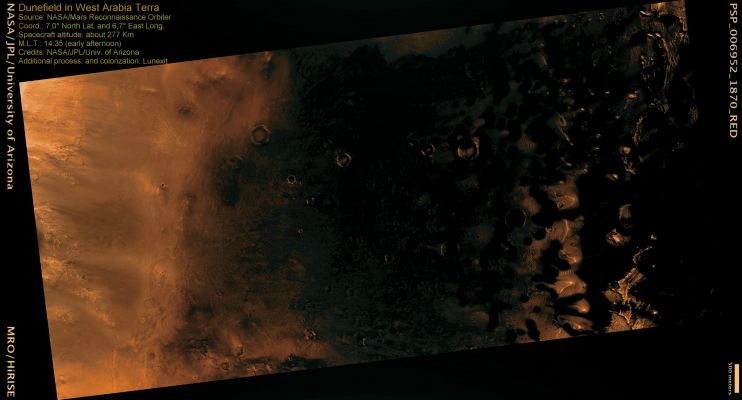
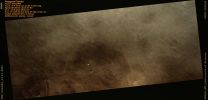
Dark Dunefield in West Arabia Terra (MULTISPECTRUM and Yellow/Orange Filters ON; credits: Lunexit)
This image shows dunes in an unnamed crater in the west Arabia Terra Region. 
The rim of the crater lies to the South of the image (Sx)and a dark, toned field of Barchan Sand Dunes rests on the crater floor in the Northern portion of the observation. 
Barchan Dunes are commonly found on Earth, and are generally crescent-shaped with a steep slip face bordered by horns oriented in the downwind direction. Barchan Dunes form by unidirectional winds and are good indicators of the dominant wind direction. In this case, the strongest winds blew approximately North to South. 
These dunes are most likely composed of basaltic sand that has collected on the bottom of the crater. 

Superimposed on their surface are smaller secondary dunes which are commonly seen on terrestrial dunes of this size. Many smaller and brighter bed forms — most likely small dunes or granule ripples — also cover the substrate between the larger dark dunes. The dark dunes overlie the small bright bed forms indicating that the darker dunes formed more recently.

Parole chiave: Mars from orbit - Dunes - Arabia Terra

Dark Dunefield in West Arabia Terra (MULTISPECTRUM and Yellow/Orange Filters ON; credits: Lunexit)

This image shows dunes in an unnamed crater in the west Arabia Terra Region.
The rim of the crater lies to the South of the image (Sx)and a dark, toned field of Barchan Sand Dunes rests on the crater floor in the Northern portion of the observation.
Barchan Dunes are commonly found on Earth, and are generally crescent-shaped with a steep slip face bordered by horns oriented in the downwind direction. Barchan Dunes form by unidirectional winds and are good indicators of the dominant wind direction. In this case, the strongest winds blew approximately North to South.
These dunes are most likely composed of basaltic sand that has collected on the bottom of the crater.

Superimposed on their surface are smaller secondary dunes which are commonly seen on terrestrial dunes of this size. Many smaller and brighter bed forms — most likely small dunes or granule ripples — also cover the substrate between the larger dark dunes. The dark dunes overlie the small bright bed forms indicating that the darker dunes formed more recently.

PSP_006952_1870_RED_abrowse-00~0.jpg PSP_006952_1870_RED_abrowse-01.jpg PSP_006952_1870_RED_abrowse~0.jpg PSP_006959_2610_RED_abrowse-PCF-LXTT.jpg PSP_006962_2215_RED_abrowse.jpg
Informazioni sul file
Nome del file:PSP_006952_1870_RED_abrowse~0.jpg
Nome album:MareKromium / Mars Reconnaissance Orbiter (MRO)
Valutazione (4 voti):55555(Mostra dettagli)
Parole chiave:Mars / from / orbit / - / Dunes / - / Arabia / Terra
Copyright:NASA/JPL/University of Arizona e Lunar Explorer Italia per l'elaborazione addizionale e la colorizzazione MULTISPECTRUM del frame
Dimensione del file:1006 KiB
Data di inserimento:Lug 16, 2008
Dimensioni:4651 x 2507 pixels
Visualizzato:54 volte
URL:https://www.lunexit.it/gallery/displayimage.php?pid=21110
Preferiti:Aggiungi ai preferiti


Powered by Coppermine Photo Gallery