|
|
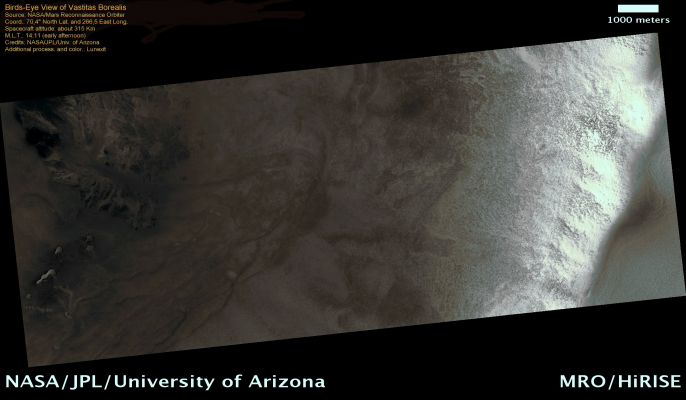
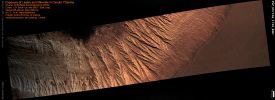
Dunes in Vastitas Borealis (MULTISPECTRUM; credits: Lunexit)
|
Windblown sand can be used to tell us the wind direction on Mars. Small-scale features, such as Ripples and Wind Tails, indicate the most recent wind directions.
Wind-Tails may be the remnants of a formerly widespread mantle of sediment that has been removed. Alternatively, they may have formed when aeolian sediment is deposited in the wind-shadow zone behind obstacles such as the 1,5 mt diameter boulders on the crater rim (Sx of the image). Their orientation points in the downwind direction and in this frane you can see two wind tails that extend from some boulders, thus indicating winds blowing from at least two different directions.
Ripples occur on the surface of all dunes imaged at HiRISE resolution on Mars and the alignment of Ripples often results from the influence of more than one wind direction.
In this frame, the Ripples are superimposed on a low dome dune.
On Earth, ripples on the surface of sand dunes may re-orientate in a matter of hours, but the time required to re-orientate Ripples on Mars is unknown.
|
|