Inizio Registrati Login

Elenco album Ultimi arrivi Ultimi commenti Più viste Più votate Preferiti Cerca

Inizio > MARS > Mars Reconnaissance Orbiter (MRO)
Ritorna alla pagina delle miniature FILE 1678/2237 Torna all'inizio Guarda foto precedente Guarda foto successiva Salta alla fine
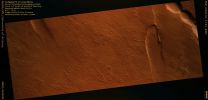
Layered Rocks in Iani Chaos (MULTISPECTRUM; credits: Lunexit)
This image shows rocks on the floor of Iani Chaos, a Region of collapsed and disorganized Terrain.

The Chaotic Terrains on Mars may have been the sources of floodwaters that carved the giant outflow channels. They typically contain irregular hills like the one in the center of this image. In some cases, they also have light-toned rocks exposed on the floors. The point of interest is to determine whether these rocks predate the chaos or formed after the collapse; however, the contacts may be obscured by later material mantling the ground. 

The rocks here are light-toned, and have dark low patches which are likely a thin cover of wind-blown sand. At a coarse scale, linear features are also visible in the rock, likely reflecting aeolian (wind) erosion in a preferred direction. A variety of processes could have contributed to forming these rocks, from volcanic eruptions to lake deposition or accumulation of wind-blown sand.

Stepped layers occur in places, suggesting a repetitive process. This argues for an origin as aeolian or lake-bed sediments, since volcanic eruptions may be of variable strength.
Parole chiave: Mars from orbit - Iani Chaos Region

Layered Rocks in Iani Chaos (MULTISPECTRUM; credits: Lunexit)

This image shows rocks on the floor of Iani Chaos, a Region of collapsed and disorganized Terrain.

The Chaotic Terrains on Mars may have been the sources of floodwaters that carved the giant outflow channels. They typically contain irregular hills like the one in the center of this image. In some cases, they also have light-toned rocks exposed on the floors. The point of interest is to determine whether these rocks predate the chaos or formed after the collapse; however, the contacts may be obscured by later material mantling the ground.

The rocks here are light-toned, and have dark low patches which are likely a thin cover of wind-blown sand. At a coarse scale, linear features are also visible in the rock, likely reflecting aeolian (wind) erosion in a preferred direction. A variety of processes could have contributed to forming these rocks, from volcanic eruptions to lake deposition or accumulation of wind-blown sand.

Stepped layers occur in places, suggesting a repetitive process. This argues for an origin as aeolian or lake-bed sediments, since volcanic eruptions may be of variable strength.

PSP_008075_1590_RED_abrowse.jpg PSP_008095_2500_RED_abrowse.jpg PSP_008100_1790_RED_abrowse.jpg PSP_008130_1745_RED_abrowse-00.jpg PSP_008130_1745_RED_abrowse-01.jpg
Informazioni sul file
Nome del file:PSP_008100_1790_RED_abrowse.jpg
Nome album:MareKromium / Mars Reconnaissance Orbiter (MRO)
Valutazione (1 voti):55555(Mostra dettagli)
Parole chiave:Mars / from / orbit / - / Iani / Chaos / Region
Copyright:NASA/JPL/University of Arizona e Lunar Explorer Italia per l'elaborazione addizionale e la colorizzazione MULTISPECTRUM del frame
Dimensione del file:1206 KiB
Data di inserimento:Giu 12, 2008
Dimensioni:5500 x 2104 pixels
Visualizzato:71 volte
URL:https://www.lunexit.it/gallery/displayimage.php?pid=20701
Preferiti:Aggiungi ai preferiti


Powered by Coppermine Photo Gallery