Inizio Registrati Login

Elenco album Ultimi arrivi Ultimi commenti Più viste Più votate Preferiti Cerca

Inizio > MARS > Mars Reconnaissance Orbiter (MRO)
Ritorna alla pagina delle miniature FILE 1696/2237 Torna all'inizio Guarda foto precedente Guarda foto successiva Salta alla fine
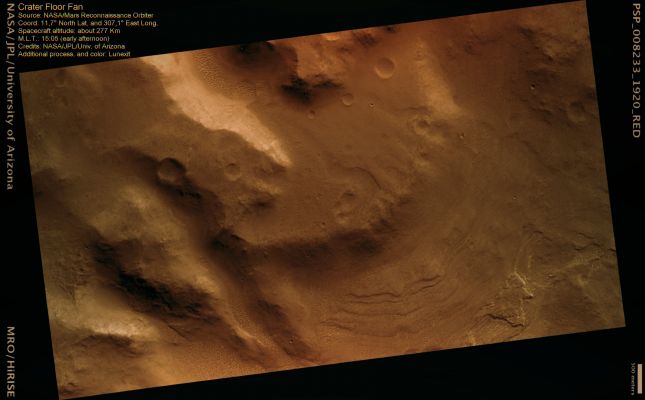
Crater Floor Fan (MULTISPECTRUM; credits: Lunexit)
This image shows a Fan of material deposited on the floor of a large Impact Crater.

The material was transported into the Crater through a valley, likely by running water. The end of the valley is visible in the West (lower) part of the image. Arcuate steps visible in the East are probably due to layers of different strength or cohesion; these suggest variations in the flow conditions.
A faint Trough is carved into the upper surface of the Fan. This could have been cut by the last water to flow across the surface. If the channel was flowing into a lake, this might indicate a drop in lake level, leading to erosion. 
The surface of the Fan has many small dark spots, particularly on the upper tier. 
The largest spots, most commonly around impact craters, are big enough to show that these are boulders. 

If these boulders are original and not due to the hardening of fan sediments into rock, it suggests that the flows which deposited the Fan were relatively energetic events able to carry rocks across several feet.
Parole chiave: Mars from orbit - Craters - Unnamed Crater with Fan

Crater Floor Fan (MULTISPECTRUM; credits: Lunexit)

This image shows a Fan of material deposited on the floor of a large Impact Crater.

The material was transported into the Crater through a valley, likely by running water. The end of the valley is visible in the West (lower) part of the image. Arcuate steps visible in the East are probably due to layers of different strength or cohesion; these suggest variations in the flow conditions.
A faint Trough is carved into the upper surface of the Fan. This could have been cut by the last water to flow across the surface. If the channel was flowing into a lake, this might indicate a drop in lake level, leading to erosion.
The surface of the Fan has many small dark spots, particularly on the upper tier.
The largest spots, most commonly around impact craters, are big enough to show that these are boulders.

If these boulders are original and not due to the hardening of fan sediments into rock, it suggests that the flows which deposited the Fan were relatively energetic events able to carry rocks across several feet.

PSP_008214_2285_red.jpg PSP_008218_1815_red.jpg PSP_008233_1920_RED_abrowse.jpg PSP_008234_2405_red-PCF-LXTT.jpg PSP_008244_2645_RED_abrowse.jpg
Informazioni sul file
Nome del file:PSP_008233_1920_RED_abrowse.jpg
Nome album:MareKromium / Mars Reconnaissance Orbiter (MRO)
Valutazione (2 voti):55555(Mostra dettagli)
Parole chiave:Mars / from / orbit / - / Craters / - / Unnamed / Crater / with / Fan
Copyright:NASA/JPL/University of Arizona e Lunar Explorer Italia per l'elaborazione addizionale e la colorizzazione MULTISPECTRUM del frame
Dimensione del file:672 KiB
Data di inserimento:Giu 12, 2008
Dimensioni:3501 x 2171 pixels
Visualizzato:59 volte
URL:https://www.lunexit.it/gallery/displayimage.php?pid=20700
Preferiti:Aggiungi ai preferiti


Powered by Coppermine Photo Gallery