Inizio Registrati Login

Elenco album Ultimi arrivi Ultimi commenti Più viste Più votate Preferiti Cerca

Inizio > MARS > Mars Reconnaissance Orbiter (MRO)
Ritorna alla pagina delle miniature FILE 1526/2237 Torna all'inizio Guarda foto precedente Guarda foto successiva Salta alla fine
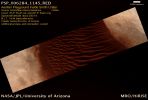
Large Dunefield inside Smith Crater (MULTISPECTRUM; credits: Lunexit)
This image shows a Dark Dunefield in Smith Crater. The dark color of the dunes indicates that they are probably made of basaltic sand, a dark volcanic rock that is common on Mars. This is in contrast to dunes on Earth, which are dominated by quartz, a rare mineral on Mars. 
The dunes here are “transverse dunes” that, based on analogy with similar features on Earth, form by winds that blow in a direction perpendicular to the crests. However, Secondary ripples on top of the dunes are oriented at right angles; that indicates a second wind regime that has redistributed the sand after the original dunes formed. The multiple orientations of the dunes may be partly caused by their location within the crater, whose own topography can act to redistribute regional wind patterns.
The dark streaks on the lighter terrain outside of the Dunefield are interpreted as DD tracks, where mini-tornadoes reveal darker ground beneath the bright dust of the surface. 
Some long DD Tracks are visible in the southern part of the dune field and climb onto the troughs of the transverse dunes. There are also a few faded tracks at the northern part of the dune field.
Parole chiave: Mars from orbit - Dunefield - Smith Crater

Large Dunefield inside Smith Crater (MULTISPECTRUM; credits: Lunexit)

This image shows a Dark Dunefield in Smith Crater. The dark color of the dunes indicates that they are probably made of basaltic sand, a dark volcanic rock that is common on Mars. This is in contrast to dunes on Earth, which are dominated by quartz, a rare mineral on Mars.
The dunes here are “transverse dunes” that, based on analogy with similar features on Earth, form by winds that blow in a direction perpendicular to the crests. However, Secondary ripples on top of the dunes are oriented at right angles; that indicates a second wind regime that has redistributed the sand after the original dunes formed. The multiple orientations of the dunes may be partly caused by their location within the crater, whose own topography can act to redistribute regional wind patterns.
The dark streaks on the lighter terrain outside of the Dunefield are interpreted as DD tracks, where mini-tornadoes reveal darker ground beneath the bright dust of the surface.
Some long DD Tracks are visible in the southern part of the dune field and climb onto the troughs of the transverse dunes. There are also a few faded tracks at the northern part of the dune field.

PSP_006271_2210_RED_abrowse.jpg PSP_006278_2225_RED_abrowse.jpg PSP_006284_1145_RED_abrowse-00.jpg PSP_006284_1145_RED_abrowse-01.jpg PSP_006284_1145_RED_abrowse-02.jpg
Informazioni sul file
Nome del file:PSP_006284_1145_RED_abrowse-00.jpg
Nome album:MareKromium / Mars Reconnaissance Orbiter (MRO)
Valutazione (4 voti):55555(Mostra dettagli)
Parole chiave:Mars / from / orbit / - / Dunefield / - / Smith / Crater
Copyright:NASA/JPL/University of Arizona e Lunar Explorer Italia per l'ingrandimento, l'elaborazione addizionale e la colorizzazione del frame
Dimensione del file:527 KiB
Data di inserimento:Apr 18, 2008
Dimensioni:2972 x 2000 pixels
Visualizzato:53 volte
URL:https://www.lunexit.it/gallery/displayimage.php?pid=20183
Preferiti:Aggiungi ai preferiti


Powered by Coppermine Photo Gallery