Inizio Registrati Login

Elenco album Ultimi arrivi Ultimi commenti Più viste Più votate Preferiti Cerca

Inizio > MARS > Mars Reconnaissance Orbiter (MRO)
Ritorna alla pagina delle miniature FILE 1582/2237 Torna all'inizio Guarda foto precedente Guarda foto successiva Salta alla fine
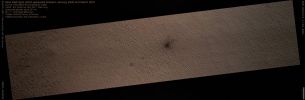
The Floor of Noctis Labyrinthus (extra-detail mgnf - MULTISPECTRUM; credits: Lunexit)
The most striking feature of many of these knobs is a thin, bright band which often wraps around the edges near the bottom, as in this extra-detail mgnf. This image was acquired in order to investigate whether this is an exposed layer of rock or the shoreline of a former body of water.
HiRISE resolves details of the bright band that indicate that this is an unusual layer of rock, rather than an old shoreline. In several places, the band is broken up along cracks, sometimes forming boulders. This indicates that the band is solid rock, while material left on a shoreline should be loose sediments. It is now exposed as rings and arcs where erosion has cut deeply enough to expose the layer.

This band must indicate some unusual event in the geologic history of the region when a different type of rock was deposited; it is strikingly different in color from the other rocks. Although it is not a shoreline, it could be material that was deposited on the floor of a much older lake or sea and then buried by other rock; it could also have been laid down by other sedimentary processes or as volcanic ash. 

Parole chiave: Mars from orbit - Noctis Labyrinthus Region

The Floor of Noctis Labyrinthus (extra-detail mgnf - MULTISPECTRUM; credits: Lunexit)

The most striking feature of many of these knobs is a thin, bright band which often wraps around the edges near the bottom, as in this extra-detail mgnf. This image was acquired in order to investigate whether this is an exposed layer of rock or the shoreline of a former body of water.
HiRISE resolves details of the bright band that indicate that this is an unusual layer of rock, rather than an old shoreline. In several places, the band is broken up along cracks, sometimes forming boulders. This indicates that the band is solid rock, while material left on a shoreline should be loose sediments. It is now exposed as rings and arcs where erosion has cut deeply enough to expose the layer.

This band must indicate some unusual event in the geologic history of the region when a different type of rock was deposited; it is strikingly different in color from the other rocks. Although it is not a shoreline, it could be material that was deposited on the floor of a much older lake or sea and then buried by other rock; it could also have been laid down by other sedimentary processes or as volcanic ash.

PSP_006968_1735_RED_abrowse~0.jpg PSP_006969_1725_RED_abrowse-00.jpg PSP_006969_1725_RED_abrowse-01.jpg PSP_006972_1710_RED_abrowse.jpg PSP_006978_1190_RED_abrowse.jpg
Informazioni sul file
Nome del file:PSP_006969_1725_RED_abrowse-01.jpg
Nome album:MareKromium / Mars Reconnaissance Orbiter (MRO)
Valutazione (5 voti):55555(Mostra dettagli)
Parole chiave:Mars / from / orbit / - / Noctis / Labyrinthus / Region
Copyright:NASA/JPL/University of Arizona e Lunar Explorer Italia per l'ingrandimento, l'elaborazione addizionale e la colorizzazione del frame
Dimensione del file:591 KiB
Data di inserimento:Mar 05, 2008
Dimensioni:2820 x 1880 pixels
Visualizzato:53 volte
URL:https://www.lunexit.it/gallery/displayimage.php?pid=19700
Preferiti:Aggiungi ai preferiti

Commento 1 a 2 di 2
Pagina: 1

MareKromium   [Apr 18, 2010 at 04:45 PM]
Se il "Lavoro" ed il "Ruolo" di Lunexit si fossero risolti nella sola esposizione (e colorizzazione) di frames, il plauso sarebbe gią stato (come minimo) dovuto. Invece abbiamo fatto di pił. MOLTO di pił. E continuiamo a farlo.
Per chi? Per che cosa? Cui prodest? ... domande, domande, domande ... - PCF
walthari   [Apr 19, 2010 at 05:34 PM]
la spiegazione ufficiale parla di un contatto litologico tra due ammassi rocciosi differenti, testimoniante una diversificazione nei processi geologici..anche sulla Terra situazioni analoghe sono molto comuni, genericamente si parla di "Discordanza litologica".

Commento 1 a 2 di 2
Pagina: 1


Powered by Coppermine Photo Gallery