Inizio Registrati Login

Elenco album Ultimi arrivi Ultimi commenti Più viste Più votate Preferiti Cerca

Inizio > MARS > Mars Reconnaissance Orbiter (MRO)
Ritorna alla pagina delle miniature FILE 1394/2237 Torna all'inizio Guarda foto precedente Guarda foto successiva Salta alla fine
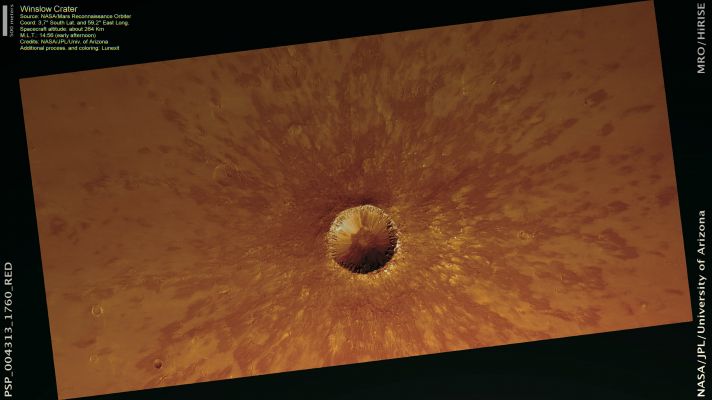
Winslow Crater - context frame n. 1 (MULTISPECTRUM; credits: Lunexit)
In this first HiRISE image of Winslow Crater (PSP_004313_1760), distinct dark rays surrounding the crater and are consistent with the THEMIS data’s suggestion of rockier materials. V-shaped patterns in the rays — referred to as a “herringbone” pattern — are identical to those around fresh Lunar Craters. 
These form when materials are ejected from the crater at a very low angle, which form clusters of secondary craters that preferentially eject materials down-range in a V-shaped pattern. (It‘s the same pattern that you would get when shooting a water pistol nearly parallel to a sidewalk.)

Also noteworthy are the large meter-to-decimeter-sized boulders on the steep rim that have not been buried or physically weathered to smaller sizes in this windy region, indicating that they have not been exposed long. 
This is also reminiscent of Meteor Crater and examples of fresh simple craters on the Moon.

The ring of rocky, cliff-forming materials in the inner wall of the Crater represents original bedrock that was uplifted and exposed by the impact. The characteristic morphology is called “spur and gully” consisting of both the protruding bedrock inter-fingered with debris shoots feeding fans of sandy materials that extend down to the crater floor. 
Throughout this Region, the present-day surface consists of a mix of global dust and volcanic sands from the Syrtis Major complex that typically cover the local bedrock. Winslow Crater is an excellent example of how craters can provide a window into the subsurface by exposing the local bedrock within the ejecta and crater wall.
Parole chiave: Mars from orbit - Craters - Winslow Crater

Winslow Crater - context frame n. 1 (MULTISPECTRUM; credits: Lunexit)

In this first HiRISE image of Winslow Crater (PSP_004313_1760), distinct dark rays surrounding the crater and are consistent with the THEMIS data’s suggestion of rockier materials. V-shaped patterns in the rays — referred to as a “herringbone” pattern — are identical to those around fresh Lunar Craters.
These form when materials are ejected from the crater at a very low angle, which form clusters of secondary craters that preferentially eject materials down-range in a V-shaped pattern. (It‘s the same pattern that you would get when shooting a water pistol nearly parallel to a sidewalk.)

Also noteworthy are the large meter-to-decimeter-sized boulders on the steep rim that have not been buried or physically weathered to smaller sizes in this windy region, indicating that they have not been exposed long.
This is also reminiscent of Meteor Crater and examples of fresh simple craters on the Moon.

The ring of rocky, cliff-forming materials in the inner wall of the Crater represents original bedrock that was uplifted and exposed by the impact. The characteristic morphology is called “spur and gully” consisting of both the protruding bedrock inter-fingered with debris shoots feeding fans of sandy materials that extend down to the crater floor.
Throughout this Region, the present-day surface consists of a mix of global dust and volcanic sands from the Syrtis Major complex that typically cover the local bedrock. Winslow Crater is an excellent example of how craters can provide a window into the subsurface by exposing the local bedrock within the ejecta and crater wall.

PSP_004277_1530_RED-PCF-LXTT-01.jpg PSP_004311_1050_RED_abrowse-PCF-LXTT.jpg PSP_004313_1760_RED_abrowse-00.jpg PSP_004313_1760_RED_abrowse-01.jpg PSP_004313_1760_RED_abrowse-02.gif
Informazioni sul file
Nome del file:PSP_004313_1760_RED_abrowse-00.jpg
Nome album:MareKromium / Mars Reconnaissance Orbiter (MRO)
Valutazione (4 voti):55555(Mostra dettagli)
Parole chiave:Mars / from / orbit / - / Craters / - / Winslow / Crater
Copyright:NASA/JPL/University of Arizona e Lunar Explorer Italia per l'ingrandimento, l'elaborazione addizionale e la colorizzazione del frame
Dimensione del file:846 KiB
Data di inserimento:Gen 12, 2008
Dimensioni:4050 x 2274 pixels
Visualizzato:61 volte
URL:https://www.lunexit.it/gallery/displayimage.php?pid=19236
Preferiti:Aggiungi ai preferiti


Powered by Coppermine Photo Gallery