Inizio Registrati Login

Elenco album Ultimi arrivi Ultimi commenti Più viste Più votate Preferiti Cerca

Inizio > MARS > Mars Reconnaissance Orbiter (MRO)
Ritorna alla pagina delle miniature FILE 1493/2237 Torna all'inizio Guarda foto precedente Guarda foto successiva Salta alla fine
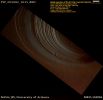
Possible ancient Salt Deposits in Terra Cimmeria (Extremely Saturated and ENhanced Natural Colors - credits for the additional process. and color.: Dr Paolo C. Fienga - Lunexit Team)
The ancient cratered highlands of the Southern Hemisphere of Mars has an intriguing and complex history as it has been riddled with impact craters and modified by volcanic processes and by the wind.
Additionally, it is one of the most heavily dissected terrains on Mars exhibiting the densest population of Valley Networks: old dried up channels and valleys that may have been formed by surface runoff, the seepage of ground water, or both.
Recently, the Thermal Emission Imaging System (THEMIS) aboard Mars Odyssey, in conjunction with spectral data from the Thermal Emission Spectrometer (TES) aboard the Mars Global Surveyor (MGS) have revealed the presence of a unique surface deposit that may be rich in chloride salts formed from the presence of liquid water. Three separate missions (MGS, MO and MRO) have come to reveal the composition and nature of these unique deposits, which, although they occur as relatively small deposits (less than 25 square Km) are widely distributed in Noachian (most ancient) terrains with fewer occurrences in the Hesperian (middle geologic time) terrains.
The deposit appears to be relatively thin and occurs in low-lying areas. It is also heavily pockmarked and discontinuous, possibly from removal of the material by erosion. Both of these aspects suggest that the deposit is indeed very old.
The presence of such salts is intriguing, and strongly suggests that conditions were favorable for water near or at the surface in the geologic past. 
Polygonal cracks can be observed in this image and other images of these deposits elsewhere on Mars (see PSP_003160_1410) and are similar to desiccation cracks (formed from the rapid evaporation and drying of a wet surface) and indicate that these may were more likely deposited at the surface. 
However, the volume and duration the water required for these deposits is still being investigated. 
Parole chiave: Mars from orbit - Craters - unnamed crater in Terra Cimmeria

Possible ancient Salt Deposits in Terra Cimmeria (Extremely Saturated and ENhanced Natural Colors - credits for the additional process. and color.: Dr Paolo C. Fienga - Lunexit Team)

The ancient cratered highlands of the Southern Hemisphere of Mars has an intriguing and complex history as it has been riddled with impact craters and modified by volcanic processes and by the wind.
Additionally, it is one of the most heavily dissected terrains on Mars exhibiting the densest population of Valley Networks: old dried up channels and valleys that may have been formed by surface runoff, the seepage of ground water, or both.
Recently, the Thermal Emission Imaging System (THEMIS) aboard Mars Odyssey, in conjunction with spectral data from the Thermal Emission Spectrometer (TES) aboard the Mars Global Surveyor (MGS) have revealed the presence of a unique surface deposit that may be rich in chloride salts formed from the presence of liquid water. Three separate missions (MGS, MO and MRO) have come to reveal the composition and nature of these unique deposits, which, although they occur as relatively small deposits (less than 25 square Km) are widely distributed in Noachian (most ancient) terrains with fewer occurrences in the Hesperian (middle geologic time) terrains.
The deposit appears to be relatively thin and occurs in low-lying areas. It is also heavily pockmarked and discontinuous, possibly from removal of the material by erosion. Both of these aspects suggest that the deposit is indeed very old.
The presence of such salts is intriguing, and strongly suggests that conditions were favorable for water near or at the surface in the geologic past.
Polygonal cracks can be observed in this image and other images of these deposits elsewhere on Mars (see PSP_003160_1410) and are similar to desiccation cracks (formed from the rapid evaporation and drying of a wet surface) and indicate that these may were more likely deposited at the surface.
However, the volume and duration the water required for these deposits is still being investigated.

PSP_005632_1225_RED_abrowse~0.jpg PSP_005658_1760_RED_abrowse-00-PCF-LXTT.jpg PSP_005680_1525_RED_abrowse-00.jpg PSP_005682_1035_RED_abrowse-00.jpg PSP_005682_1035_RED_abrowse-01.jpg
Informazioni sul file
Nome del file:PSP_005680_1525_RED_abrowse-00.jpg
Nome album:MareKromium / Mars Reconnaissance Orbiter (MRO)
Valutazione (5 voti):55555(Mostra dettagli)
Parole chiave:Mars / from / orbit / - / Craters / - / unnamed / crater / in / Terra / Cimmeria
Copyright:NASA/JPL/University of Arizona e Lunar Explorer Italia per l'ingrandimento, l'elaborazione addizionale e la colorizzazione del frame
Dimensione del file:1603 KiB
Data di inserimento:Ott 26, 2007
Dimensioni:4254 x 2048 pixels
Visualizzato:53 volte
URL:https://www.lunexit.it/gallery/displayimage.php?pid=18480
Preferiti:Aggiungi ai preferiti


Powered by Coppermine Photo Gallery