Inizio Registrati Login

Elenco album Ultimi arrivi Ultimi commenti Più viste Più votate Preferiti Cerca

Inizio > MARS > Mars Reconnaissance Orbiter (MRO)
Ritorna alla pagina delle miniature FILE 1988/2237 Torna all'inizio Guarda foto precedente Guarda foto successiva Salta alla fine
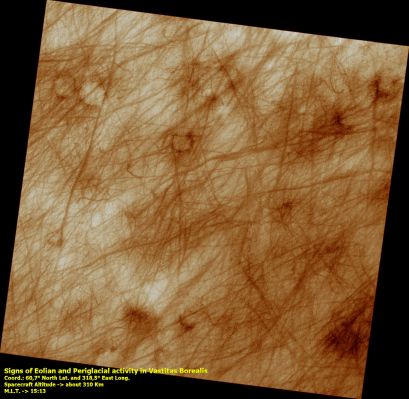
Eolian and Periglacial Activities in Vastitas Borealis (DD Tracks and Polygons)
This image shows a region of approximately 7 x 7 km (4.4-by-4.4 miles) located in Vastitas Borealis, part of the Northern Plains. 

The surface imaged is relatively young, as indicated by the lack of recent impact craters. 
Eolian and Periglacial activity seem to be the dominant geological processes at work, as shown by numerous crisscrossing DD Tracks and ubiquitous polygonal features, respectively.

Dust Devils form when the sun warms up the air near a flat, dry surface. Warm air then rises quickly through the cooler air above and starts spinning, causing a forward motion. The spinning, forward-moving cell may pick up dust and sand as it advances, thus leaving behind a "clean" track. We infer from this image that a thin veneer of light-colored particles of dust and/or fine-grained sand cover relatively darker materials, apparent in the dust devil tracks.

The tracks pictured in this image are in many cases more than 30 mt (27 yards) wide and over 4 Km (2,5 miles) long, surpassing the dimensions of average terrestrial DD tracks.
Parole chiave: Mars from orbit - Vastitas Borealis

Eolian and Periglacial Activities in Vastitas Borealis (DD Tracks and Polygons)

This image shows a region of approximately 7 x 7 km (4.4-by-4.4 miles) located in Vastitas Borealis, part of the Northern Plains.

The surface imaged is relatively young, as indicated by the lack of recent impact craters.
Eolian and Periglacial activity seem to be the dominant geological processes at work, as shown by numerous crisscrossing DD Tracks and ubiquitous polygonal features, respectively.

Dust Devils form when the sun warms up the air near a flat, dry surface. Warm air then rises quickly through the cooler air above and starts spinning, causing a forward motion. The spinning, forward-moving cell may pick up dust and sand as it advances, thus leaving behind a "clean" track. We infer from this image that a thin veneer of light-colored particles of dust and/or fine-grained sand cover relatively darker materials, apparent in the dust devil tracks.

The tracks pictured in this image are in many cases more than 30 mt (27 yards) wide and over 4 Km (2,5 miles) long, surpassing the dimensions of average terrestrial DD tracks.

Psp_001470_2665_red~0.jpg Psp_001477_2470_red.jpg Psp_001481_2410_red-00.jpg Psp_001481_2410_red-01.jpg Psp_001483_2465_red.jpg
Informazioni sul file
Nome del file:Psp_001481_2410_red-00.jpg
Nome album:MareKromium / Mars Reconnaissance Orbiter (MRO)
Valutazione (2 voti):55555(Mostra dettagli)
Parole chiave:Mars / from / orbit / - / Vastitas / Borealis
Copyright:NASA - Mars Reconnaissance Orbiter e Lunar Explorer Italia per la pulizia digitale del frame e la colorizzazione
Dimensione del file:589 KiB
Data di inserimento:Feb 23, 2007
Dimensioni:2048 x 2001 pixels
Visualizzato:54 volte
URL:https://www.lunexit.it/gallery/displayimage.php?pid=16002
Preferiti:Aggiungi ai preferiti


Powered by Coppermine Photo Gallery