Inizio Registrati Login

Elenco album Ultimi arrivi Ultimi commenti Più viste Più votate Preferiti Cerca

Inizio > MARS > Mars Reconnaissance Orbiter (MRO)
Ritorna alla pagina delle miniature FILE 2010/2237 Torna all'inizio Guarda foto precedente Guarda foto successiva Salta alla fine
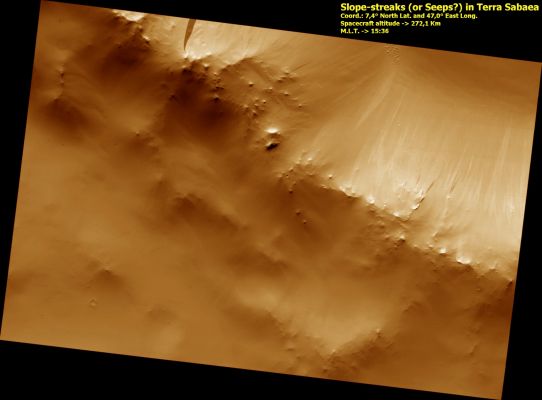
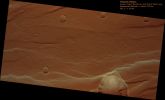
Slope Streaks (or "Seeps"?) in Terra Sabaea
Slope streak formation is among the few known processes currently active on Mars. While their mechanism of formation and triggering is debated, they are most commonly believed to form by downslope movement of extremely dry sand or very fine-grained dust in an almost fluidlike manner (analogous to a terrestrial snow avalanche) exposing darker underlying material. Other ideas include the triggering of slope streak formation by possible concentrations of near-surface ice or scouring of the surface by running water from aquifers intercepting slope faces, spring discharge (perhaps brines) and/or hydrothermal activity.
Several of the slope streaks visible here, particularly the 3 longest darker streaks, show evidence that downslope movement is being diverted around obstacles such as large boulders. Several streaks also appear to originate at boulders or clumps of rocky material.
In general, the slope streaks do not have large deposits of displaced material at their downslope ends and do not run out onto the crater floor suggesting that they have little reserve kinetic energy. The darkest slope streaks are youngest and can be seen to cross cut and superpose older and lighter-toned streaks. The lighter-toned streaks are believed to be dark streaks that have lightened with time as new dust is deposited on their surface.


Parole chiave: Mars from orbit - Terra Sabaea

Slope Streaks (or "Seeps"?) in Terra Sabaea

Slope streak formation is among the few known processes currently active on Mars. While their mechanism of formation and triggering is debated, they are most commonly believed to form by downslope movement of extremely dry sand or very fine-grained dust in an almost fluidlike manner (analogous to a terrestrial snow avalanche) exposing darker underlying material. Other ideas include the triggering of slope streak formation by possible concentrations of near-surface ice or scouring of the surface by running water from aquifers intercepting slope faces, spring discharge (perhaps brines) and/or hydrothermal activity.
Several of the slope streaks visible here, particularly the 3 longest darker streaks, show evidence that downslope movement is being diverted around obstacles such as large boulders. Several streaks also appear to originate at boulders or clumps of rocky material.
In general, the slope streaks do not have large deposits of displaced material at their downslope ends and do not run out onto the crater floor suggesting that they have little reserve kinetic energy. The darkest slope streaks are youngest and can be seen to cross cut and superpose older and lighter-toned streaks. The lighter-toned streaks are believed to be dark streaks that have lightened with time as new dust is deposited on their surface.

Psp_001700_2505_red-01.jpg Psp_001736_2605_red.jpg Psp_001808_1875_red.jpg Psp_001840_1660_red.jpg Psp_001840_2000_red.jpg
Informazioni sul file
Nome del file:Psp_001808_1875_red.jpg
Nome album:MareKromium / Mars Reconnaissance Orbiter (MRO)
Valutazione (6 voti):55555(Mostra dettagli)
Parole chiave:Mars / from / orbit / - / Terra / Sabaea
Copyright:NASA - Mars Reconnaissance Orbiter e Lunar Explorer Italia per la pulizia digitale del frame e la colorizzazione
Dimensione del file:327 KiB
Data di inserimento:Gen 27, 2007
Dimensioni:2776 x 2048 pixels
Visualizzato:71 volte
URL:https://www.lunexit.it/gallery/displayimage.php?pid=15687
Preferiti:Aggiungi ai preferiti


Powered by Coppermine Photo Gallery