|
|
Yardangs in Medusa Fosse
|
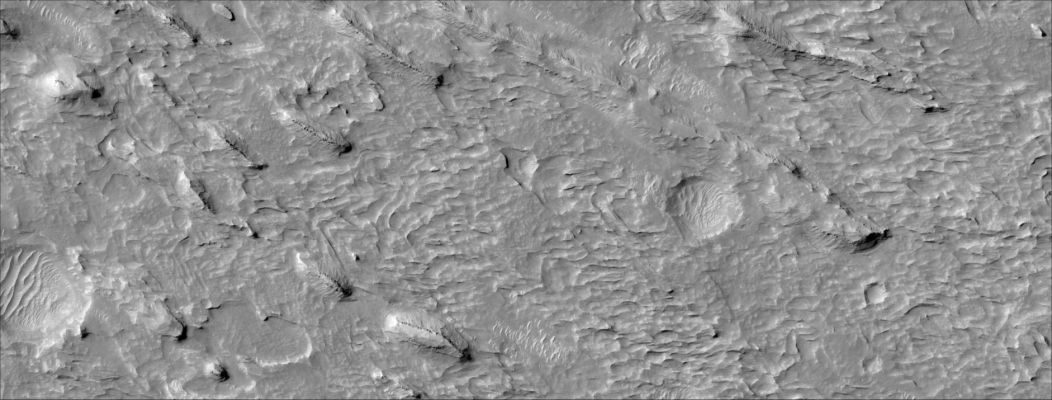
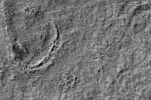
This image covers a portion of an outcrop of the Medusae Fossae Formation, a series of light-toned terrains in the Martian mid-latitudes. The Medusae Fossae has been and remains one of the most enigmatic features on Mars. The unit is characterized by wind-sculpted landforms, most notably eroded ridges known as yardangs. The composition of the Medusae Fossae is not known, but candidates include indurated (hardened) volcanic ash or remnants of dust-ice mixtures that formed in a different Martian climate. This HiRISE image reveals new details of the Medusae Fossae.
Three prominent yardangs are seen, at upper right, lower center right, and partially at lower right. They are aligned with their long axes pointing NW-SE, with tapered ends on the NW, consistent with erosion from a southeasterly wind. One or more hard rocky layers within the yardangs are visible, with the layers commonly segregated into discreet boulders. Isolated rocks are seen on the slopes and at the base of the yardangs, indicating that some formed from breakup of the layers. The rocks may be similar in composition to the softer, non-rocky parts of the yardangs, but simply more indurated. Alternatively, they may be compositionally distinct, challenging current hypotheses for the origin of the Medusae Fossae.
Light-toned ridges at center left have a gross morphology similar to that of barchanoid dunes, formed from wind-blown sand. If these are dunes or ripples, their orientation is consistent with the presumed wind direction that carved the yardangs. However, zooming in to full resolution reveals flat tops, grooves, and smaller, darker ripple forms to the northwest of the ridges. Therefore if these are dunes, they seem indurated.
|
|