Inizio Registrati Login

Elenco album Ultimi arrivi Ultimi commenti Più viste Più votate Preferiti Cerca

Inizio > MARS > Mars Reconnaissance Orbiter (MRO)
Ritorna alla pagina delle miniature FILE 2138/2237 Torna all'inizio Guarda foto precedente Guarda foto successiva Salta alla fine
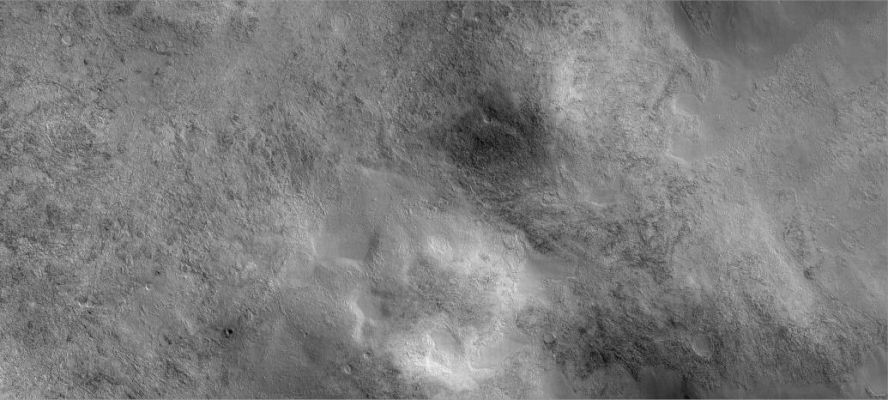
In the vicinities of Halley Crater (1)
This image shows a landscape West of Mars' Argyre impact basin and North-East of Halley Crater. The large but faint circular feature near the center of the image is an unnamed impact crater about 7,5 Km (about 4,7 miles) in diameter. It has been all but erased by geological (and probably ice-related) processes. In fact, the majority of impact craters in this image have been modified from their original shapes, some undoubtedly beyond recognition. Only a few small craters remain pristine. The most prevalent surface type in this image is rough, dissected terrain, which is characterized by a complex pattern of knobs, pits, ridges and valleys. In places the rough terrain has been covered by a younger material that appears flat, smooth and nearly featureless. The smooth material may have been emplaced as muddy or icy debris. It filled low-lying areas (most notably craters) and surrounded higher features, preserving islands of rough terrain. Wind-formed dunes have formed atop some of the smooth material and diagonal streaks on the right side of the image may be due to the winds. Images such as this show the importance of water (liquid and/or ice), wind, and impacts in shaping the surface of Mars.
Parole chiave: Mars from orbit - Craters - Halley Crater

In the vicinities of Halley Crater (1)

This image shows a landscape West of Mars' Argyre impact basin and North-East of Halley Crater. The large but faint circular feature near the center of the image is an unnamed impact crater about 7,5 Km (about 4,7 miles) in diameter. It has been all but erased by geological (and probably ice-related) processes. In fact, the majority of impact craters in this image have been modified from their original shapes, some undoubtedly beyond recognition. Only a few small craters remain pristine. The most prevalent surface type in this image is rough, dissected terrain, which is characterized by a complex pattern of knobs, pits, ridges and valleys. In places the rough terrain has been covered by a younger material that appears flat, smooth and nearly featureless. The smooth material may have been emplaced as muddy or icy debris. It filled low-lying areas (most notably craters) and surrounded higher features, preserving islands of rough terrain. Wind-formed dunes have formed atop some of the smooth material and diagonal streaks on the right side of the image may be due to the winds. Images such as this show the importance of water (liquid and/or ice), wind, and impacts in shaping the surface of Mars.

Q-Q-PIA08030.jpg Q-S-BosporusRupes-PIA08047_modest.jpg Q-S-HalleyCrater-PIA08048_modest-1.jpg Q-S-HalleyCrater-PIA08048_modest-2.jpg Q-T-ArgyrePlanitia-PIA08049_modest.jpg
Informazioni sul file
Nome del file:Q-S-HalleyCrater-PIA08048_modest-1.jpg
Nome album:Mars Reconnaissance Orbiter (MRO)
Valutazione (3 voti):55555(Mostra dettagli)
Parole chiave:Mars / from / orbit / - / Craters / - / Halley / Crater
Copyright:NASA - Mars Reconnaissance Orbiter (MRO)
Dimensione del file:130 KiB
Data di inserimento:Apr 08, 2006
Dimensioni:1035 x 466 pixels
Visualizzato:53 volte
URL:https://www.lunexit.it/gallery/displayimage.php?pid=10527
Preferiti:Aggiungi ai preferiti


Powered by Coppermine Photo Gallery