|
|
Dark Matter
|
Dark matter is a form of matter thought to account for approximately 85% of the matter in the universe and about a quarter of its total mass–energy density or about 2.241×108722,27 kg/m3. Its presence is implied in a variety of astrophysical observations, including gravitational effects that cannot be explained by accepted theories of gravity unless more matter is present than can be seen. For this reason, most experts think that dark matter is abundant in the universe and that it has had a strong influence on its structure and evolution. Dark matter is called dark because it does not appear to interact with the electromagnetic field, which means it does not absorb, reflect or emit electromagnetic radiation, and is therefore difficult to detect.
Primary evidence for dark matter comes from calculations showing that many galaxies would fly apart, or that they would not have formed or would not move as they do, if they did not contain a large amount of unseen matter. Other lines of evidence include observations in gravitational lensing and in the cosmic microwave background, along with astronomical observations of the observable universe's current structure, the formation and evolution of galaxies, mass location during galactic collisions and the motion of galaxies within galaxy clusters. In the standard Lambda-CDM model of cosmology, the total mass–energy of the universe contains 5% ordinary matter and energy, 27% dark matter and 68% of a form of energy known as dark energy. Thus, dark matter constitutes 85% of total mass, while dark energy plus dark matter constitute 95% of total mass–energy content.
Because dark matter has not yet been observed directly, if it exists, it must barely interact with ordinary baryonic matter and radiation, except through gravity. Most dark matter is thought to be non-baryonic in nature; it may be composed of some as-yet undiscovered subatomic particles.
|
|








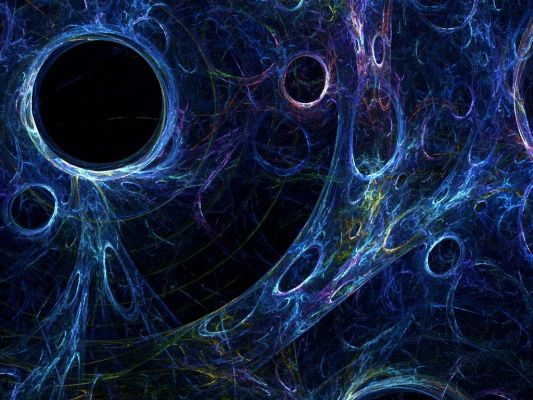


Anche solo confrontando le nostre personali ipotesi, ce ne sarebbe di roba da mettere sul piatto.
Io, come è nel mio stile, parto da quello che viene raccontato nei testi indiani per quanto riguarda l’universo: il “vuoto” non è diverso dal “pieno”, sebbene nel “vuoto” non ci sia nulla.
io credo che la materia oscura sia di pari importanza se non di più, della materia bianca.
E’ come vedere lo spettacolo dei burattini o di alcune marionette. Sfondo scuro, con l’impressione che i soggetti illuminati (i burattini) siano autonomi, mentre invece nel nero, si celano gli operatori che le muovono.
la materia bianca poggia su uno sfondo che è il palco e il regista di tutto ciò che succede. C’è e regola quello che per noi è pieno.
Questo aspetto, mi fa venire in mente un documentario che ho visto l’altro giorno, che parlava di una grande muraglia nell’universo. Ovvero una zona lunga circa 1,5 miliardi di anni luce (una muraglia) in cui ci sono alcuni trilioni di galassie, tutte in “contatto” tra loro. Allora m chiedo e dico. Come sarebbe mai possibile questa “unione “eterea se non ci fosse la materia oscura e sorreggerle e ad unirle?
L'Universo ha una Sua propria "Morale"? Od adempie semplicemente ad uno scopo?!? E, se "SI", quale? Ecco la domanda...
Tutte le "Vite" valgono "a prescindere"? No. Non ci credo. Non può e non deve essere così. La "Vita" te la devi guadagnare, a qualsiasi costo, ma agendo rettamente.
BLM é un "Fenomeno di massa"? Si. E' così.