Inizio Registrati Login

Elenco album Ultimi arrivi Ultimi commenti Più viste Più votate Preferiti Cerca

Inizio > DEEP SKY > The Universe Inside
Ritorna alla pagina delle miniature FILE 421/466 Torna all'inizio Guarda foto precedente Guarda foto successiva Salta alla fine
Warm Planet, Cold Star
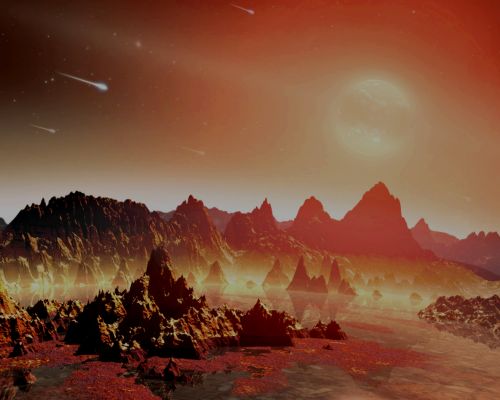
This artist's conception shows a young, hypothetical planet around a cool star. A soupy mix of potentially life-forming chemicals can be seen pooling around the base of the jagged rocks. Observations from NASA's Spitzer Space Telescope hint that planets around cool stars — the so-called M-dwarfs and Brown dwarfs that are widespread throughout our Galaxy — might possess a different mix of life-forming, or prebiotic, chemicals than our young Earth. 

Life on our Planet is thought to have arisen out of a pond-scum-like mix of chemicals. Some of these chemicals are thought to have come from a planet-forming disk of gas and dust that swirled around our young Sun. Meteorites carrying the chemicals might have crash-landed on Earth. 

Astronomers don't know if these same life-generating processes are taking place around stars that are cooler than our Sun, but the Spitzer observations show their disk chemistry is different. Spitzer detected a prebiotic molecule, called Hydrogen Cyanide (Cianuro di Idrogeno), in the disks around yellow stars like our Sun, but found none around cooler, less massive, reddish stars. Hydrogen Cyanide is a carbon-containing, or organic compound. Five Hydrogen Cyanide molecules can join up to make Adenine — a chemical element of the DNA molecule found in all living organisms on Earth.
Parole chiave: Artistic Interpretations of the Universe

Warm Planet, Cold Star

This artist's conception shows a young, hypothetical planet around a cool star. A soupy mix of potentially life-forming chemicals can be seen pooling around the base of the jagged rocks. Observations from NASA's Spitzer Space Telescope hint that planets around cool stars — the so-called M-dwarfs and Brown dwarfs that are widespread throughout our Galaxy — might possess a different mix of life-forming, or prebiotic, chemicals than our young Earth.

Life on our Planet is thought to have arisen out of a pond-scum-like mix of chemicals. Some of these chemicals are thought to have come from a planet-forming disk of gas and dust that swirled around our young Sun. Meteorites carrying the chemicals might have crash-landed on Earth.

Astronomers don't know if these same life-generating processes are taking place around stars that are cooler than our Sun, but the Spitzer observations show their disk chemistry is different. Spitzer detected a prebiotic molecule, called Hydrogen Cyanide (Cianuro di Idrogeno), in the disks around yellow stars like our Sun, but found none around cooler, less massive, reddish stars. Hydrogen Cyanide is a carbon-containing, or organic compound. Five Hydrogen Cyanide molecules can join up to make Adenine — a chemical element of the DNA molecule found in all living organisms on Earth.

WOW.jpg Walhalla-070912_8930-39.jpg WarmPlanetColdStar-PIA11980.jpg Waterworld.jpg White_Eagle.jpg
Informazioni sul file
Nome del file:WarmPlanetColdStar-PIA11980.jpg
Nome album:MareKromium / The Universe Inside
Valutazione (8 voti):55555(Mostra dettagli)
Parole chiave:Artistic / Interpretations / of / the / Universe
Copyright:NASA/JPL-Caltech
Dimensione del file:490 KiB
Data di inserimento:Apr 08, 2009
Dimensioni:3000 x 2400 pixels
Visualizzato:61 volte
URL:https://www.lunexit.it/gallery/displayimage.php?pid=24174
Preferiti:Aggiungi ai preferiti


Powered by Coppermine Photo Gallery