Inizio Registrati Login

Elenco album Ultimi arrivi Ultimi commenti Più viste Più votate Preferiti Cerca

Inizio > MARS > Walking on Mars with Spirit and Opportunity
Ritorna alla pagina delle miniature FILE 1714/5456 Torna all'inizio Guarda foto precedente Guarda foto successiva Salta alla fine
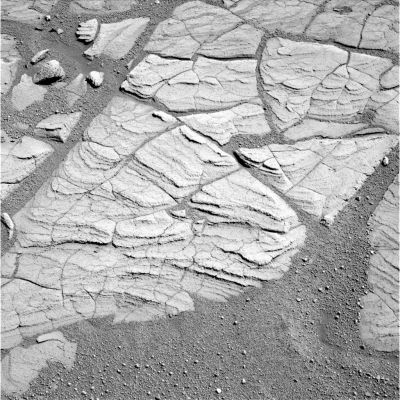
Razor-blades & recent water... (2) - Sol 791
In June, the sand was dry and cracks were filled in or worn away.
Cracks do form in drying mud, but this is not mud, Sumner said. There was no explanation for the formation of these types of cracks in sulfate sands before Opportunity landed, she said. Chavdarian also looked at two types of thin, brittle fins poking a few inches out of the desert sand, usually facing into the wind. The most common type was found only in January, when the sand was moist. Chavdarian and Sumner think that the fins are formed when water seeps into cracks in the sand, carrying minerals with it. The water evaporates away, leaving behind those minerals, which are exposed as the wind blows sand away. Windblown material sticks to the exposed fin, making it larger and stronger.
If the cracks and fins seen by Opportunity on Mars are formed in the same way as the features at White Sands, it would provide evidence for water at the surface of Mars away from the Polar Ice Caps, which are mostly formed by CO2 and water ice.
Parole chiave: Martian Surface - Layered features and Razorblades

Razor-blades & recent water... (2) - Sol 791

In June, the sand was dry and cracks were filled in or worn away.
Cracks do form in drying mud, but this is not mud, Sumner said. There was no explanation for the formation of these types of cracks in sulfate sands before Opportunity landed, she said. Chavdarian also looked at two types of thin, brittle fins poking a few inches out of the desert sand, usually facing into the wind. The most common type was found only in January, when the sand was moist. Chavdarian and Sumner think that the fins are formed when water seeps into cracks in the sand, carrying minerals with it. The water evaporates away, leaving behind those minerals, which are exposed as the wind blows sand away. Windblown material sticks to the exposed fin, making it larger and stronger.
If the cracks and fins seen by Opportunity on Mars are formed in the same way as the features at White Sands, it would provide evidence for water at the surface of Mars away from the Polar Ice Caps, which are mostly formed by CO2 and water ice.

OPP-SOL789-1R198228128EFF68OLP1375L0M1.jpg OPP-SOL791-1P198407290EFF68Q9P2572R1M1.jpg OPP-SOL791-1P198408172EFF68Q9P2574L7M1~0.jpg OPP-SOL792-1N198499844EFF68VNP0695R0M1.jpg OPP-SOL792-1N198499895EFF68VNP0695R0M1.jpg
Informazioni sul file
Nome del file:OPP-SOL791-1P198408172EFF68Q9P2574L7M1~0.jpg
Nome album:Walking on Mars with Spirit and Opportunity
Valutazione (2 voti):55555(Mostra dettagli)
Parole chiave:Martian / Surface / - / Layered / features / and / Razorblades
Copyright:NASA - Opportunity Rover Mission
Dimensione del file:325 KiB
Data di inserimento:Apr 16, 2006
Dimensioni:1024 x 1024 pixels
Visualizzato:54 volte
URL:https://www.lunexit.it/gallery/displayimage.php?pid=10624
Preferiti:Aggiungi ai preferiti


Powered by Coppermine Photo Gallery