Inizio Registrati Login

Elenco album Ultimi arrivi Ultimi commenti Più viste Più votate Preferiti Cerca

Inizio > SOLAR SYSTEM > Mercury
Ritorna alla pagina delle miniature FILE 129/248 Torna all'inizio Guarda foto precedente Guarda foto successiva Salta alla fine
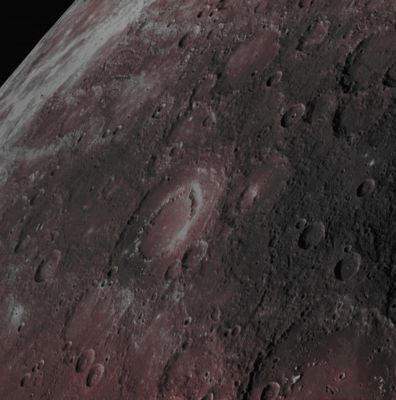
Scarlatti Crater (Absolute Natural Colors; credits for the additional process. and color.: Dr Paolo C. Fienga/Lunar Explorer Italia/Italian Planetary Foundation)
In this image-mosaic, obtained by putting together three frames taken by the NASA - MESSENGER Spacecraft on March, 30, 2014, we can see, located almost at the center of the frame, the large (such as approx. 132 Km - such as about 81,97 miles - in diameter) Peak-Ring Basin known as Scarlatti. 

While Scarlatti has a typical Peak-Ring in many respects, if you take a good look towards its North/Eastern Section (upper right side - Dx - of the Feature), you will be able to notice its "transition" to a relatively wide (in this case, approx. 30 Km - such as about 18,63 miles - across) sort of Collapse Pit, surrounded by High-Reflectance (white and reddish in color) Surface Material. This Pit (perhaps a Volcanic Vent or a Caldera, eons ago), according to several NASA Planetary Scientists, could have been - and we say, as IPF, reasonably, considering all the visible Features characterizing it - the site of some (most likely extremely ancient as well as really powerful) Explosive Volcanic Activity.

Date acquired: March, 30th, 2014
Images Mission Elapsed Time (MET): 38528557, 38528553, 38528551
Images ID: 6032934, 6032932, 6032931
Instrument: Wide Angle Camera (WAC) of the Mercury Dual Imaging System (MDIS)
Center Latitude: 40,70° North
Center Longitude: 258,90° East
Solar Incidence Angle: 86,2° (meaning that the Sun, at the time that the picture was taken, was about 3,8° above the imaged Local Mercurian Horizon)
Emission Angle: 51,1°
Sun-Mercury-Messenger (or "Phase") Angle: 137,3°

This picture (which is an Original NASA - MESSENGER Spacecraft's false colors and NON-Map-Projected image-mosaic published on the NASA - Planetary Photojournal with the ID n. PIA 18215) has been additionally processed, contrast enhanced, Gamma corrected, magnified to aid the visibility of the details and then re-colorized in Absolute Natural Colors (such as the colors that a human eye would actually perceive if someone were onboard the NASA - MESSENGER Spacecraft and then looked outside, towards the Surface of Mercury), by using an original technique created - and, in time, dramatically improved - by the Lunar Explorer Italia Team. Different colors, as well as different shades of the same color, mean, among other things, the existence of different Elements (Minerals) present on the Surface of Mercury, each having a different Albedo (---> Reflectivity) and Chemical Composition.
Parole chiave: Mercury from orbit - Craters - Scarlatti Crater

Scarlatti Crater (Absolute Natural Colors; credits for the additional process. and color.: Dr Paolo C. Fienga/Lunar Explorer Italia/Italian Planetary Foundation)

In this image-mosaic, obtained by putting together three frames taken by the NASA - MESSENGER Spacecraft on March, 30, 2014, we can see, located almost at the center of the frame, the large (such as approx. 132 Km - such as about 81,97 miles - in diameter) Peak-Ring Basin known as Scarlatti.

While Scarlatti has a typical Peak-Ring in many respects, if you take a good look towards its North/Eastern Section (upper right side - Dx - of the Feature), you will be able to notice its "transition" to a relatively wide (in this case, approx. 30 Km - such as about 18,63 miles - across) sort of Collapse Pit, surrounded by High-Reflectance (white and reddish in color) Surface Material. This Pit (perhaps a Volcanic Vent or a Caldera, eons ago), according to several NASA Planetary Scientists, could have been - and we say, as IPF, reasonably, considering all the visible Features characterizing it - the site of some (most likely extremely ancient as well as really powerful) Explosive Volcanic Activity.

Date acquired: March, 30th, 2014
Images Mission Elapsed Time (MET): 38528557, 38528553, 38528551
Images ID: 6032934, 6032932, 6032931
Instrument: Wide Angle Camera (WAC) of the Mercury Dual Imaging System (MDIS)
Center Latitude: 40,70° North
Center Longitude: 258,90° East
Solar Incidence Angle: 86,2° (meaning that the Sun, at the time that the picture was taken, was about 3,8° above the imaged Local Mercurian Horizon)
Emission Angle: 51,1°
Sun-Mercury-Messenger (or "Phase") Angle: 137,3°

This picture (which is an Original NASA - MESSENGER Spacecraft's false colors and NON-Map-Projected image-mosaic published on the NASA - Planetary Photojournal with the ID n. PIA 18215) has been additionally processed, contrast enhanced, Gamma corrected, magnified to aid the visibility of the details and then re-colorized in Absolute Natural Colors (such as the colors that a human eye would actually perceive if someone were onboard the NASA - MESSENGER Spacecraft and then looked outside, towards the Surface of Mercury), by using an original technique created - and, in time, dramatically improved - by the Lunar Explorer Italia Team. Different colors, as well as different shades of the same color, mean, among other things, the existence of different Elements (Minerals) present on the Surface of Mercury, each having a different Albedo (---> Reflectivity) and Chemical Composition.

ZZ-Mercury-Craters-Rembrandt_Crater-PIA14549-PCF-LXTT.jpg ZZ-Mercury-Craters-Rustaveli_Crater-PIA16359-PCF-LXTT-IPF.jpg ZZ-Mercury-Craters-Scarlatti_Crater-PIA18215-PCF-LXTT-IPF.jpg ZZ-Mercury-Craters-Snorri_Crater-PIA16993-PCF-LXTT-IPF.jpg ZZ-Mercury-Craters-Soseki-PIA16356-PCF-LXTT-IPF.jpg
Informazioni sul file
Nome del file:ZZ-Mercury-Craters-Scarlatti_Crater-PIA18215-PCF-LXTT-IPF.jpg
Nome album:MareKromium / Mercury
Valutazione (3 voti):55555(Mostra dettagli)
Parole chiave:Mercury / from / orbit / - / Craters / - / Scarlatti / Crater
Copyright:NASA/Johns Hopkins University Applied Physics Laboratory/Carnegie Institution of Washington and Dr Paolo C. Fienga/LXTT/IPF for the additional process. and color.
Dimensione del file:700 KiB
Data di inserimento:Mag 07, 2014
Dimensioni:2975 x 2998 pixels
Visualizzato:108 volte
URL:https://www.lunexit.it/gallery/displayimage.php?pid=31211
Preferiti:Aggiungi ai preferiti

Commento 1 a 10 di 10
Pagina: 1

Anakin   [Mag 23, 2014 at 07:36 AM]
I colori così rossastri e bruni, potrebbero essere stati causati dalla vicinanaza del sole?
Ufologo   [Mag 23, 2014 at 05:17 PM]
Mmmm ... penso proprio di no. Cotto? Non può essere; sembra quasi un terreno umido (fangoso) ...
MareKromium   [Mag 23, 2014 at 09:30 PM]
Salve Amici!

I colori di Mercurio dipendono, nella "mia" interpretazione cromatica, dall'effetto - esteso su quasi 5 miliardi di anni - che le Particelle Erranti Cariche (e cioè Vento Solare e Raggi Cosmici) hanno sulle rocce.

Esse, prima le rendono rossastre, poi granata/scuro, ed infine nere. Le immagini NASA in "Colori Autentici" (dicono loro) mostrano Mercurio color grigio-chiaro. Questo è impossibile (in accordo alla "loro" stessa Scienza).

Ed infatti, anche le immagini a colori ottenute in via telescopica (a partire dalla metà degli Anni '60), ci dicono che Mercurio è rossiccio (in alcune zone) e nero (in altre).
Ovviamente le zone che, nelle ere, sono state lasciate "tranquille", sono ora nere; quelle che invece hanno subito movimenti cospicui e rilevanti (per impatti, attività sismica, vulcanica e tettonica etc.), sono rossastre. Tutto qui.

Dove vado a parare? Le foto a colori "veri" rilasciate dalla NASA sono solo foto sovraesposte e con una correzione Gamma (scolorimento verso il bianco) esagerata. Devo essere più chiaro? Sono "cromaticamente taroccate". E non chiedetemi il motivo, perché non ne ho la minima idea....

Un Abbraccio a Voi! paolo
Ufologo   [Mag 24, 2014 at 01:17 PM]
Ma ... possibile a quella distanza ...?
cicas65   [Mag 25, 2014 at 08:27 PM]
L'atmosfera su mercurio è completamente assente?
Anakin   [Mag 26, 2014 at 02:17 PM]
Ecco. Quindi è cotto :-)
Ufologo   [Mag 26, 2014 at 06:17 PM]
Mercurio sì; Marte, dubito ...
KKK   [Mag 27, 2014 at 03:07 PM]
Mercurio è, effettivamente (e non potrebbe essere altrimenti) "cotto". Marte è letteralmente ricoperto di particolato a base di Ossido di Ferro (ruggine, se si preferisce), dunque - e direi ancora una volta "ovviamente" - le storie sono diverse. Ma qui il "Punto" non è nelle Storie Geologiche dei Pianeti, ma nei "taroccamenti cromatici" (inspiegabili!!!) che fa la NASA!!! Ma non preoccupateVi: io sono un misero "complottista", e dunque vedo taroccamenti ovunque.... Un Abbraccio Circolare! paolo

p.s.: e poi quello che ci dice e ci fa vedere la NASA (e, credetemi, parlo per esperienza), qui in Italia (e SOLO in Italia!) è considerato Vangelo....
Anakin   [Mag 30, 2014 at 11:01 AM]
Il famoso potere di autorità
KKK   [Mag 30, 2014 at 12:09 PM]
C'è un detto, in Diritto, che recita quanto segue: "Mai Potere all'Autorità, o all'Autoritarietà, ma Potere all'Autorevolezza". Sembra la stessa cosa, ma non lo è...

Commento 1 a 10 di 10
Pagina: 1


Powered by Coppermine Photo Gallery